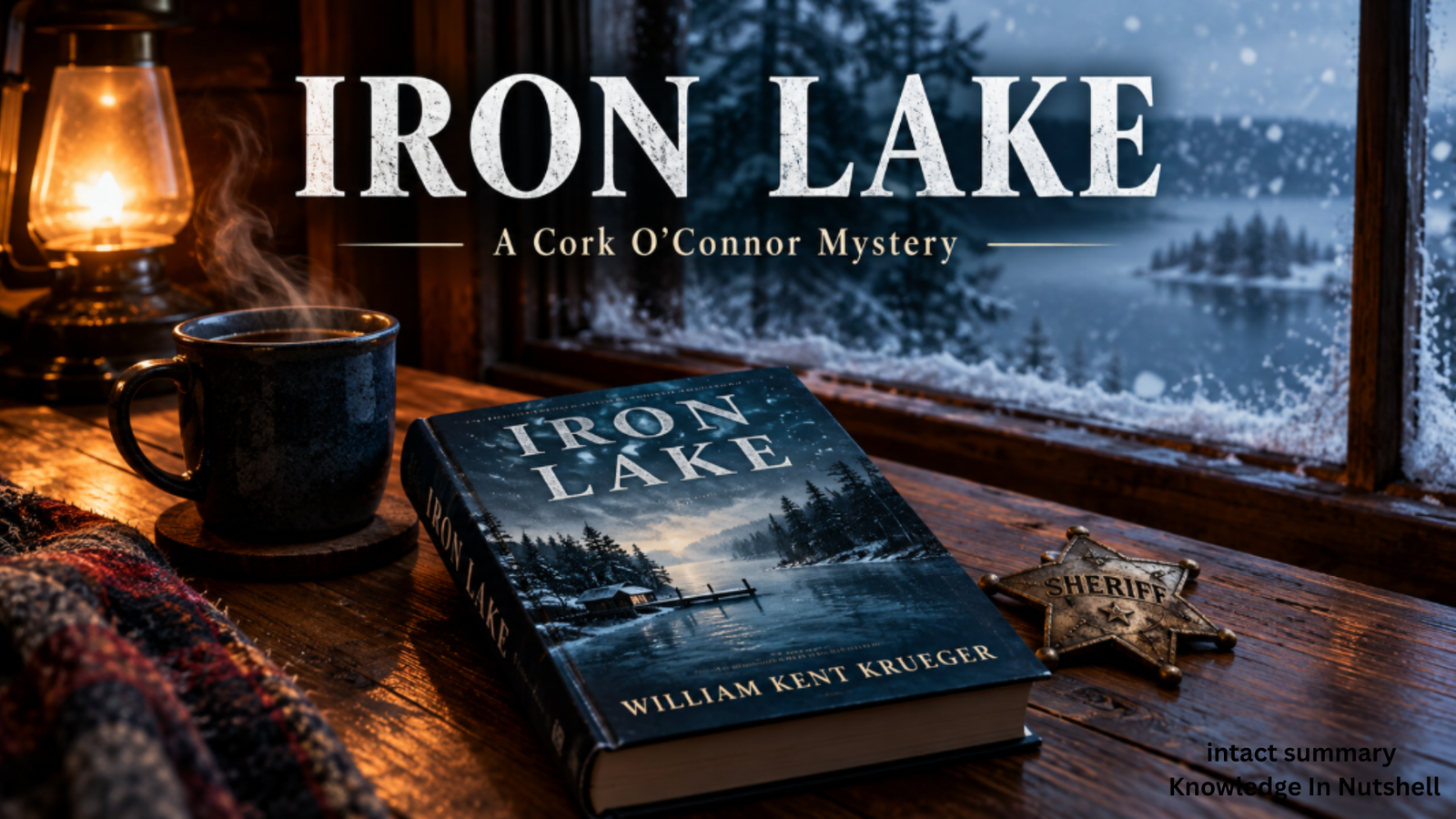
Maybe you just finished the last page of Iron Lake and you’re still turning the ending over in your head. Maybe you’re deciding whether to start the Cork O’Connor series at all, or you’re prepping for a book club meeting tomorrow and you need the details straight. Whatever brought you here, you want one thing: a clear, accurate, and complete picture of this book — without wading through a dozen half-finished blog posts to get it.
Iron Lake is the first novel in William Kent Krueger’s Cork O’Connor mystery series, and it’s the book that introduced readers to one of modern crime fiction’s most distinctive detectives: a former sheriff of mixed Irish and Anishinaabe heritage, working a case that starts with a dead judge and a missing boy and ends up exposing the rot underneath an entire small town. Below, you’ll find a spoiler-free summary for readers who haven’t finished the book yet, a full summary with spoilers for those who have (or don’t mind knowing what happens), a breakdown of every major character, an explanation of the Windigo legend that runs through the story, the book’s key themes, and answers to the most common questions readers search for.
Everything here has been cross-checked against the actual text and reliable publisher and literary sources, so you’re getting an accurate account — not a generic mystery-novel summary that could apply to any book on the shelf.
Quick Answer
Iron Lake by William Kent Krueger (1998) is a mystery novel and the first book in the Cork O’Connor Mystery Series. It follows Corcoran “Cork” O’Connor, the former sheriff of Aurora, Minnesota, who is of Irish and Anishinaabe descent, as he investigates the apparent suicide of Judge Robert Parrant and the disappearance of a young Eagle Scout, Paul LeBeau, during a brutal winter storm. The case unravels into a web of political corruption, blackmail, and small-town secrets, all set against the backdrop of the Anishinaabe reservation and an old legend about a monster called the Windigo.
Book Overview and Background
Iron Lake was published in 1998 and immediately put William Kent Krueger on the map as a serious voice in American crime fiction. It went on to win the Minnesota Book Award, the Loft-McKnight Fiction Award, and both the Anthony Award and the Barry Award for Best First Novel — an unusually strong showing for a debut mystery, and a big reason the book is still recommended nearly three decades later.
Also Read:/save-me-a-seat-summary/
The novel is set in the fictional town of Aurora, Minnesota (population 3,752), in the state’s rugged north woods near the shore of Lake Superior. Krueger, who lives in Minnesota himself, is known for getting the region’s landscape and culture right, and Iron Lake reflects real research into Anishinaabe (Ojibwe) history and folklore — Krueger has said he worked with Anishinaabe readers and historical sources to portray the culture respectfully rather than as decoration.
At its core, Iron Lake is a murder mystery and small-town conspiracy story, but it’s also something more layered than a typical detective novel. It’s as much about Cork O’Connor’s fractured identity, his failing marriage, and his complicated relationship with his own heritage as it is about who killed the judge. That combination — a tightly plotted crime story wrapped around real emotional and cultural depth — is why the book still holds up, and why it launched a series that has since grown to nearly twenty installments.
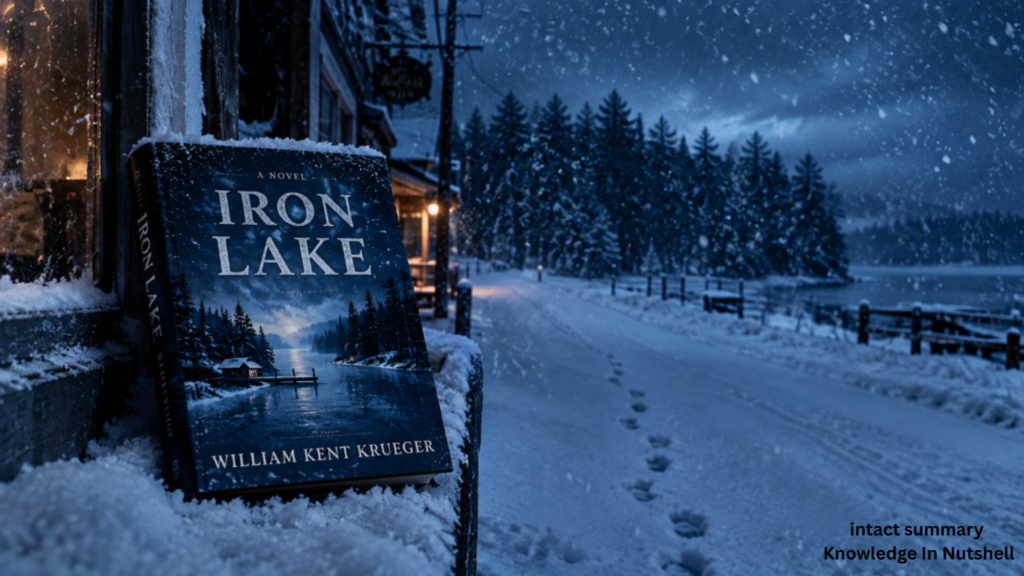
Going in, it helps to know that this is not a lighthearted cozy mystery. It deals with suicide, murder, alcohol misuse, racism, and generational trauma within the Anishinaabe community, alongside a genuinely suspenseful plot full of twists. It rewards patient readers who enjoy character development as much as plot mechanics.
Who Is Cork O’Connor?
Corcoran “Cork” O’Connor is the former sheriff of Aurora, Minnesota, and the central figure of every book in the series. Before returning to his hometown, he worked as a cop on Chicago’s South Side, so very little rattles him. When Iron Lake opens, though, Cork is in rough shape.
A year before the events of the novel, a violent confrontation over fishing rights on Iron Lake — a dispute between the Anishinaabe community and local resort owners — ended in Cork shooting a man, and it cost him his badge in the recall election that followed. That same conflict is tied to the death of his childhood mentor, Sam Winter Moon, whose old hamburger shack and small back apartment Cork has since inherited and now lives in.
His marriage to Jo O’Connor, a successful attorney, has also collapsed; the two are separated, and Cork has since started seeing a warm, grounding local waitress named Molly Nurmi — though he still hopes, mostly for the sake of his three children, Jenny, Annie, and Stevie, to somehow repair things with Jo.
What makes Cork such a compelling flawed protagonist is his mixed heritage: he is part Irish and part Anishinaabe, and much of the novel is about a man who has never fully felt at home in either world. He drinks too much coffee, smokes too much, and carries a heavy dose of guilt — but he also has sharp investigative instincts and a real, unshakable sense of responsibility to the people of Aurora, even after the town turned on him.
Where Iron Lake Takes Place
The novel is set in and around Aurora, a small, close-knit town in northern Minnesota, near the edge of an Anishinaabe reservation and the cold expanse of Lake Superior. The setting isn’t just scenery — it actively shapes the plot. Much of the book unfolds during a punishing Minnesota winter snowstorm right around Christmas, and the brutal cold and near-whiteout conditions repeatedly put characters, including a missing child, in real physical danger.
The town itself is small enough that everyone knows everyone, which is exactly what makes the central conspiracy so effective — and so dangerous for Cork to expose. Secrets in Aurora don’t stay buried; they just get quietly protected by people with power. The rural Minnesota setting, combined with the reservation land at its edge, also lets Krueger explore the real, uneasy history and racial tension between the town’s white residents and its Anishinaabe neighbors, including a new casino development that has become a serious source of local money and local resentment.
Cork’s Irish and Anishinaabe Heritage
One of the most distinctive things about Iron Lake, compared to a typical crime thriller, is how central cultural identity is to the story. Cork’s father was Irish; his mother’s side of the family is Anishinaabe. Krueger uses this mixed heritage to explore something a lot of readers find relatable even outside the mystery genre: the feeling of belonging fully to neither side of your own background.
Cork’s connection to his Anishinaabe roots comes largely through Sam Winter Moon, the mentor who raised him after his father’s death and first told him the story of the Windigo. Even though Cork isn’t especially religious or superstitious, that early relationship shapes how seriously he takes the warnings he starts hearing once the investigation begins. This tension — a modern, skeptical ex-cop confronted with an old, frightening piece of Indigenous folklore — is one of the book’s most memorable threads, and we’ll dig into it fully in the Windigo section below.
Plot Summary (Spoiler-Free)
For a week, young Paul LeBeau, a reliable Eagle Scout who delivers papers around Aurora, has had an uneasy feeling he can’t shake. Then, during a brutal winter storm, he vanishes after finishing his route — and the last house on that route belonged to Judge Robert Parrant, one of the most powerful and most feared men in town.
When Parrant turns up dead, it’s first written off as suicide. But Cork O’Connor, the town’s former sheriff, isn’t convinced. When Paul’s frightened mother, Darla LeBeau, calls asking for his help finding her son, Cork can’t say no — even though he no longer wears a badge, even though the new sheriff doesn’t want him involved, and even though almost everyone in Aurora seems to want him to quietly back off.
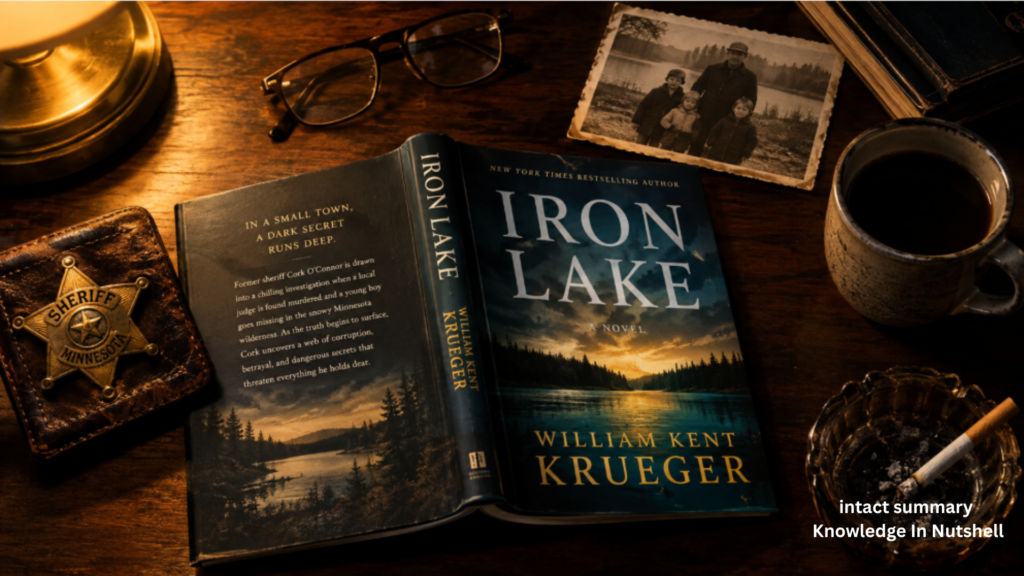
What starts as a missing person investigation quickly grows into something far bigger: a case tangled up in old land disputes, a lucrative new casino deal on the Anishinaabe reservation, long-buried family secrets, and people willing to do almost anything to keep them buried. As more bodies turn up and the blizzard tightens its grip on the town, Cork also has to reckon with an old Anishinaabe warning — that a monstrous, ice-hearted creature called the Windigo has come to Aurora, and it’s calling out the names of the people it intends to kill.
Along the way, Cork’s fractured personal life — his separation from Jo, his relationship with Molly, his strained bond with his own children — collides directly with the investigation, forcing him to confront just how much of Aurora’s “respectable” surface has been built on things nobody wants him to find.
Iron Lake blends a genuinely suspenseful murder mystery with real emotional weight, and it earns its reputation as one of the strongest debut crime novels of its era.
Full Summary (With Spoilers)
The investigation begins the night Paul LeBeau finishes his paper route and never comes home. Cork retraces his steps and discovers Judge Parrant dead in his home — apparently by his own hand. But something about the scene bothers Cork: the position of the blood tells a different story than “suicide.” He quietly concludes the judge was murdered.
As Cork digs, despite resistance from the new sheriff, Wally Schanno, and warnings from nearly everyone to leave it alone, he learns that Judge Parrant and his son, Sandy Parrant — a newly elected U.S. Senator with his sights on higher office — ran a development company together, one deeply involved in bringing a highly profitable casino to the reservation. It becomes clear the judge’s death, Paul’s disappearance, and the town’s uneasy racial politics are all connected.
The case pulls in a local hate group called the Minnesota Civilian Brigade, tied to the earlier death of Paul’s own father, Joe LeBeau, a custodian who had apparently stumbled onto evidence of the Parrants’ corrupt dealings before he died. A member of that group, Harlan Lytton, calls Cork claiming to have information — and Cork finds him dead too. In Lytton’s darkroom, Cork uncovers a file of photographs proving something painful and unrelated to the murder: his wife Jo has been carrying on a long-term affair with Sandy Parrant, dating back well before she and Cork separated.
Eventually, Cork learns Paul is alive — he’s been hidden and protected by his mother, a local priest, and Wanda Manydeeds, a member of the reservation community, because they don’t trust the white-run sheriff’s department to keep him safe from whoever is trying to silence him as a witness.
As the storm and the danger both close in, more deaths follow, seemingly foretold by the Windigo warnings from Anishinaabe medicine man Henry Meloux. The trail of blackmail photographs, corrupt land deals, and violence eventually forces Cork to confront the true architects of the conspiracy protecting Aurora’s most powerful family — putting himself, Molly, and his own children directly in harm’s way before the truth, and the killer, are finally exposed.
Main Characters Explained
Character: Cork O’Connor
Role & Arc: The former sheriff and protagonist. He begins the book embittered, guilt-ridden, and unmoored from both his marriage and his own Anishinaabe roots. By the end, the investigation forces him to reconnect with the instincts, the community, and the heritage he’d been avoiding.
Character: Jo O’Connor
Role & Arc: Cork’s estranged wife, a sharp, successful attorney whose clients include the reservation’s casino interests. Her affair with Sandy Parrant, revealed partway through the story, recontextualizes everything about the marriage’s collapse.
Character: Sandy Parrant
Role & Arc: The murdered judge’s son, a charismatic local politician freshly elected to the U.S. Senate. He represents the story’s central danger: a man whose public polish hides his role in the town’s political corruption.
Character: Molly Nurmi
Role & Arc: A warm, steady local waitress who becomes Cork’s partner after his separation from Jo. She offers Cork an emotional anchor even as his investigation grows more dangerous.
Character: Sam Winter Moon
Role & Arc: Cork’s late childhood mentor, an Anishinaabe man who raised Cork after his father’s death and first told him the legend of the Windigo. Though he’s already gone when the novel opens, his memory and teachings guide Cork throughout.
Character: Henry Meloux
Role & Arc: An elderly Anishinaabe medicine man who senses the Windigo’s presence and warns Cork directly. He represents the novel’s link between modern crime and older, mystical tradition.
Character: Darla LeBeau
Role & Arc: Paul’s desperate mother, whose plea for help is what draws Cork back into investigative work. Her fierce protectiveness over her son drives several of the book’s tensest moments.
Character: Paul LeBeau
Role & Arc: The missing Eagle Scout paperboy whose disappearance kicks off the entire plot. His father’s earlier death, tied to the same conspiracy, gives his storyline extra emotional stakes.
Character: Wally Schanno
Role & Arc: The new Minnesota sheriff who replaced Cork and initially clashes with him over the investigation, wary of an outsider — even a former lawman — interfering in his case.
The Windigo Legend and Indigenous Mythology Explained
One of the things that sets Iron Lake apart from a standard crime thriller is its use of Anishinaabe folklore, specifically the legend of the Windigo — a mythical creature described as a giant with a heart of ice, a hunger that can never be satisfied, and the unsettling ability to call out the names of the people it intends to kill.
Cork first hears the story as a boy, out hunting with Sam Winter Moon. He doesn’t consider himself superstitious, but as the investigation unfolds and Henry Meloux warns that the Windigo has returned to Aurora, the legend takes on real weight — especially once people start hearing their own names called, and then turning up dead.
Krueger uses the Windigo less as a literal monster and more as a symbol: a way of talking about what happens when greed, corruption, and cruelty hollow a person out completely. As Meloux puts it, a Windigo isn’t born a monster — it’s made one, one cold, selfish choice at a time. That idea sits at the emotional core of the book’s human villains as much as its folklore, and it’s part of why readers so often describe Iron Lake as having a genuinely mystical atmosphere layered over its murder mystery plot.
Key Themes Explained
Identity and Belonging
Cork’s Irish and Anishinaabe heritage sits at the heart of the novel. He’s spent his whole life feeling like he doesn’t fully belong to either community, and the investigation keeps forcing him back into contact with the Anishinaabe reservation and culture he’d drifted away from. By the end, reconnecting with that identity isn’t optional — it’s part of how he survives the case at all.
Corruption Hiding Behind Respectability
The novel’s central conspiracy works precisely because the people running it — a judge, a senator, a well-connected development company — look respectable on the surface. Iron Lake argues that political corruption rarely announces itself; it hides behind good reputations, charity dinners, and small-town trust.
Guilt and Redemption
Cork carries guilt from multiple directions — the shooting that cost him his badge, the collapse of his marriage, his distance from his kids. His pursuit of the truth about Paul and the judge becomes, in part, a way of trying to prove to himself (and to Aurora) that he’s still capable of doing right by people.
Family and Fatherhood
Between Cork’s strained relationship with his own children and Darla LeBeau’s desperate fight to protect Paul, family loyalty runs through nearly every major relationship in the book. The novel repeatedly asks what people are willing to risk to protect the ones they love.
Racial Tension and Cultural Conflict
The uneasy history between Aurora’s white residents and its Anishinaabe neighbors — including the earlier fishing-rights conflict that cost Cork his job, and the new casino development stirring fresh resentment — gives the mystery real social texture rather than treating the reservation as a backdrop.
Symbolism and Literary Devices
The Windigo is the novel’s clearest symbol, representing what greed and cruelty can turn a person into. But Krueger uses several other devices worth noticing:
- The blizzard mirrors the plot itself — visibility drops, danger closes in, and Cork is repeatedly forced to act on instinct rather than certainty, just like the townspeople trying to navigate the storm.
- Iron Lake itself, the body of water the town is named for, represents both the region’s natural beauty and the source of real conflict — the fishing-rights dispute that cost Cork his badge happened there, tying the setting directly to his personal history.
- Photographs and hidden files recur as a motif for buried secrets — literal, physical evidence of the affairs and corruption everyone in town is working hard to keep out of sight.
- Christmas, placed right in the middle of the investigation, sharpens the contrast between the warmth of family togetherness Cork is fighting to hold onto and the cold violence unfolding around him.
Cork O’Connor Series Reading Order
Iron Lake is unambiguously Book 1 in the Cork O’Connor Mystery Series, and it’s the recommended starting point for new readers. Krueger has written the series to be read in publication order, since Cork’s family situation, his relationship history, and the town of Aurora’s history all build across books. After Iron Lake, the series continues with Boundary Waters, Purgatory Ridge, Blood Hollow, and onward through nearly twenty total installments, making it one of the more substantial ongoing mystery series in American crime fiction
Frequently Asked Questions
What is Iron Lake about?
Iron Lake follows former sheriff Cork O’Connor as he investigates the apparent suicide of a local judge and the disappearance of a young Eagle Scout, uncovering a conspiracy of political corruption in his Minnesota hometown.
Is Iron Lake the first book in the Cork O’Connor series?
Yes. Iron Lake is Book 1 of William Kent Krueger’s Cork O’Connor Mystery Series.
Who is the author of Iron Lake?
William Kent Krueger, a Minnesota-based author also known for Ordinary Grace and This Tender Land.
What genre is Iron Lake?
It’s a mystery/crime fiction novel with elements of thriller and light supernatural atmosphere drawn from Anishinaabe folklore.
Does Iron Lake have supernatural elements?
It references the Windigo, a figure from Anishinaabe legend, but the story stays grounded in a realistic murder mystery rather than becoming a horror novel.
Who killed Judge Parrant in Iron Lake?
The judge’s death is revealed to be murder tied directly to the corrupt land and casino dealings at the center of the book’s conspiracy, rather than the suicide it first appears to be.
Is Paul LeBeau found alive in Iron Lake?
Yes. Paul is found alive, hidden by his mother and allies who feared he wasn’t safe from the people trying to silence him.
Is Iron Lake based on a true story?
No. It’s a work of fiction, though Krueger researched real Anishinaabe history and culture to portray the setting and community accurately.
How long is the Iron Lake audiobook?
The audiobook, narrated by David Chandler, runs approximately 11 hours and 57 minutes.
Is Iron Lake appropriate for young readers?
It’s written for adult readers and deals with mature themes including murder, suicide, and racism, so it’s best suited to older teens and adults.
Do I need to read Iron Lake before other Cork O’Connor books?
It’s strongly recommended. As Book 1, it establishes the character relationships and town history that later books build on.
What awards has Iron Lake won?
It won the Minnesota Book Award, the Loft-McKnight Fiction Award, the Anthony Award, and the Barry Award for Best First Novel.
Is Iron Lake a slow burn or a fast-paced thriller?
It’s a character-driven mystery — the pacing is deliberate rather than breakneck, balancing investigation with Cork’s personal life.
What is the significance of the title Iron Lake?
Iron Lake is both the literal body of water near Aurora and the site of the fishing-rights conflict that cost Cork his job, tying the title directly to his personal history and the town’s racial tensions.
How many books are in the Cork O’Connor series?
The series has grown to nearly twenty novels since Iron Lake was published in 1998.
About This Article
This summary was researched directly against Iron Lake’s published text, official publisher descriptions, and reputable literary sources to ensure every plot detail, character name, and thematic claim is accurate to the actual book — not generated from genre assumptions. Direct excerpts from the novel were avoided in favor of original explanation, in keeping with respectful and accurate literary coverage. Where plot specifics were uncertain, they were cross-checked against multiple independent sources before inclusion.
Conclusion
Iron Lake is a great mystery book about a man named Cork O’Connor. He used to be the sheriff of a small town called Aurora, Minnesota. One snowy night, a judge dies and a boy named Paul goes missing. Cork decides to find out what really happened, even though it is dangerous.
As Cork looks for answers, he learns that some people in town are hiding big secrets. He also hears an old story about a scary creature called the Windigo. The story mixes a real mystery with Anishinaabe legends, cold winter snow, and Cork’s own family problems.
This book is exciting because you never know who to trust. It also teaches us about doing the right thing, even when it is hard. If you like mysteries with twists, strong characters, and a snowy setting, Iron Lake is a wonderful first book to start with. It is the very first book in the Cork O’Connor series, so there are many more adventures waiting after this one!