Now picture that animal living in the ocean, with three hearts, eight arms, blue blood and skin that can change color in a blink. That is the strange and wonderful world of the octopus. It is also the world that Sy Montgomery explores in The Soul of an Octopus, a book that makes many readers rethink how they see animals.
You may be here because you are trying to decide if the book is worth your time. Maybe you read it long ago and want a quick refresher. Maybe you are a book club member looking for discussion ideas, or you simply love ocean animals. Whatever the reason, you are in the right place.
So, what is the book about? The Soul of an Octopus is a nonfiction nature book about the author’s friendships with several octopuses at the New England Aquarium in Boston. Through these friendships, she asks big questions. Can an octopus think? Can it feel? Does it have a personality? And what does it mean to be conscious? The book blends popular science, personal memoir and gentle philosophy. It is more of a heartfelt journey than a dry science lesson.
In this article, you will find a short answer first, then a full guide. You will read about the author and why the book became so loved. You will get a spoiler-free summary and a full summary with spoilers. We will meet the octopuses and the people in the story. We will look at the main themes, the science of octopus intelligence, and the book’s strengths. We will also look at its weaknesses, including fair criticism about animal captivity and aquarium ethics. At the end, you will find book club questions, similar books, and answers to common questions.
Quick Answer of The Soul of an Octopus
The Soul of an Octopus (2015) is a nonfiction book by Sy Montgomery. It follows her friendships with giant Pacific octopuses at the New England Aquarium and shows how smart, curious and individual these animals can be. The book uses octopus behavior, science and personal stories to ask whether octopuses have emotions and consciousness. It is warm and easy to read, though some readers feel it does not question keeping wild animals in aquariums enough.
What Is The Soul of an Octopus About?
At its heart, this book is about connection. Montgomery is a naturalist and writer who has spent her life getting close to animals. In this book, she turns her attention to one of the most mysterious animals in the sea. She visits the aquarium again and again. She meets the keepers and volunteers who care for the octopuses every day. Slowly, she gets to know the octopuses themselves.
Also Read:/the-lost-library-summary/
The book is full of small, sweet moments. An octopus reaches out and gently holds the author’s arm with its suckers. Another octopus plays with a toy, almost like a puppy. Another solves a puzzle to get food. These stories show octopus personalities. One octopus may be shy and another bold. One may be playful and another grumpy. The book argues that each octopus is an individual, not just a copy of its species in The Soul of an Octopus.
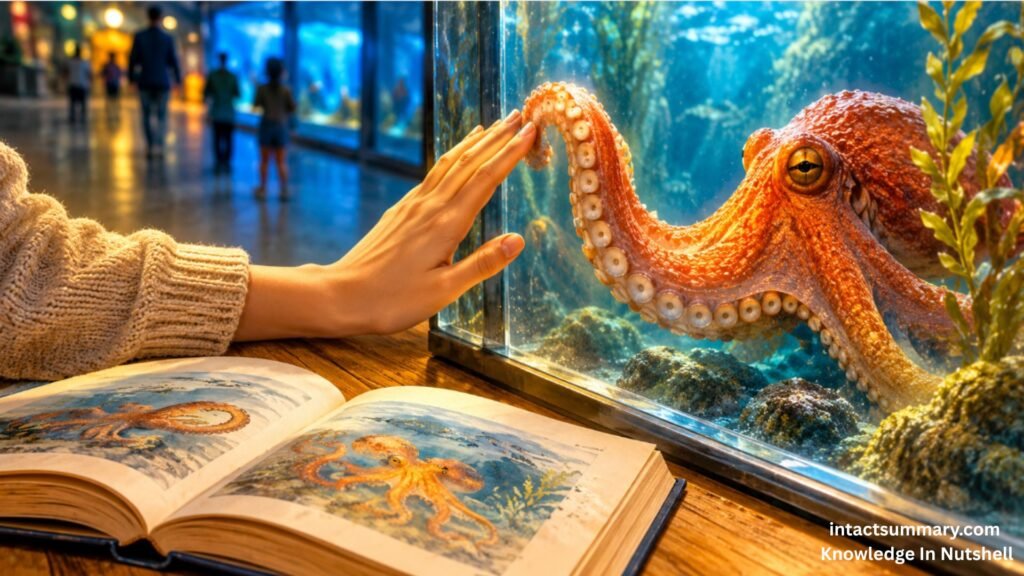
The book is also about science. Along the way, you learn how the octopus nervous system works. You learn about the octopus brain, the independent arm movements, and how octopuses use camouflage to hide. You also learn how scientists have tested their problem-solving abilities, including escape behavior in The Soul of an Octopus.
Finally, the book is about big questions. What is a mind? What is a soul? Do humans have a special place in nature, or are we one kind of thinker among many? Montgomery does not claim to have all the answers. Instead, she invites you to wonder along with her, and that wonder is what makes the book special.
Who Is Sy Montgomery?
Sy Montgomery is an American author, naturalist and science writer. She has written many books for both adults and children. She is known for traveling to wild places and spending time with animals up close. Her travels have taken her to rainforests, jungles and oceans around the world in The Soul of an Octopus.
Many readers know her from an earlier book called The Good Good Pig. It tells the story of a pig she raised and loved, and it shows her gift for finding deep meaning in the lives of animals. In The Soul of an Octopus, she uses the same warm and personal style. She writes as a friend and a careful watcher, not as a distant scientist in The Soul of an Octopus.
One thing makes her writing stand out. She treats animals as individuals with feelings and personalities. Some scientists have warned against this, because it can lead to anthropomorphism, which means giving human thoughts to animals. Montgomery knows about this debate. She tries to balance careful science with real emotion, and you will see that balance throughout the book. In her view, being kind and curious about other minds is a strength, not a weakness in The Soul of an Octopus.
The Soul of an Octopus Summary
This section gives two versions of the story. The first is safe for anyone who has not read the book. The second tells the whole story, including how it ends.
Spoiler-Free Summary of The Soul of an Octopus
The Soul of an Octopus starts with a simple wish. Sy Montgomery wants to know an octopus, truly know one, the way you might know a dog or a good friend. She begins visiting the New England Aquarium in Boston, where several giant Pacific octopuses live in large tanks. She meets the keepers and volunteers who feed them, play with them and watch over them every day in The Soul of an Octopus.
At first, the octopuses seem like mysterious, alien-like creatures. Over time, Montgomery sees that each one acts in its own way. Some are bold, some are shy, and some love to play. She learns that an octopus can look at a person and seem to decide whether that person is a friend. She sees one solve puzzles, one slip out of its tank, and one gently taste her skin with its suckers in The Soul of an Octopus.
As the friendships grow, so do the questions. How can an animal with no bones and a very different body have such a lively mind? What does it feel? Does it know who it is? Montgomery follows these questions into the world of science. She talks with researchers, reads studies and even learns to scuba dive so she can meet wild octopuses in the open sea. Through it all, she carries a sad truth. Octopuses live very short lives, so every new friendship comes with a goodbye.
Full Summary (With Spoilers) of The Soul of an Octopus
The story begins with Montgomery’s first visits to the aquarium. She meets Athena, a large female giant Pacific octopus who becomes her first octopus friend. Athena is gentle and curious. She lets the author touch her and feel the pull of her suckers. Montgomery also meets the aquarium staff, who treat each octopus like a unique person with its own habits. These early scenes set the tone of the book. They show a woman learning to pay close attention to a creature most people barely notice.
Soon the book shows that these friendships are not simple. Octopuses are clever escape artists and often outsmart the people trying to keep them safe. Athena and the others show how well they can solve problems, open containers and figure out new puzzles. Montgomery also learns how strange the octopus body is. It has three hearts, blue blood and a brain that is spread through its arms, so each arm seems able to think a little on its own in The Soul of an Octopus.
Next comes Octavia, another octopus who becomes dear to Montgomery. Octavia’s story is the most moving in the book. After laying her eggs, she spends her final months guarding them. She stops eating and slowly grows weak, as female giant Pacific octopuses do when they are near the end of their lives. Montgomery watches this slow goodbye with deep sadness. The scene shows that an octopus can be devoted to its young, which makes the loss feel all the heavier in The Soul of an Octopus.
Later, a younger octopus named Kali arrives. Kali is full of energy and loves to explore. She is a very different personality from the calmer octopuses Montgomery knew before. Then comes Karma, whose arrival closes the circle of the book. Each octopus adds to a picture of how different individuals can be, even when they belong to the same species. Montgomery’s friendships with them show how deeply a person can bond with an animal that is so unlike us.

In the middle of the story, Montgomery leaves the aquarium to meet octopuses in the wild. She earns her scuba certification and travels to the warm waters of Tahiti. There she sees octopuses living freely in the ocean. This part of the book gives a bright, adventurous contrast to the quiet tanks of Boston. She sees how octopuses move, hide and hunt when no glass surrounds them.
Throughout the story, Montgomery returns to a sad fact. A giant Pacific octopus lives only about three to five years. One by one, the octopuses she loves grow old and die. She grieves each one, and the book ends not with a big twist but with a quiet, thoughtful mood. She is left with sorrow, but also with gratitude for what these animals showed her about minds, feelings and friendship across species. The ending reminds us that a short life can still be rich, and that loving someone for a short time is still worth it.
Meet the Octopuses in the Book
The main characters are not people. They are the octopuses, and this is part of what makes the book unique. Each one is shown as an individual with a personality. Here are the main ones, in simple words.
Athena
Athena is the first octopus Montgomery befriends, and she sets the whole book in motion. She is a large and gentle giant Pacific octopus who seems curious about visitors. Through her, readers see how an octopus can seem to recognize a person and reach out in a friendly way. Her arc is one of trust. At first Montgomery is a stranger, and later she is a friend. Athena’s story also introduces the book’s sadder lesson that octopus lives are short in The Soul of an Octopus.
Octavia
Octavia is the octopus whose story touches readers most. Her arc is about motherhood and loss. She lays eggs and guards them with great devotion until her body gives out. For many readers, her story answers one of the book’s big questions. If an animal can care, guard and sacrifice, then it seems wrong to call it a simple machine.
Kali
Kali is a younger and more energetic octopus. She is bold, playful and curious, and she shows how very different one octopus can be from another. Through Kali, the book shows that an octopus has a personality, not just instincts. She adds lightness and humor to a story that can also be quite sad in The Soul of an Octopus.
Karma
Karma is the octopus who comes into the story later. She helps show that the cycle of meeting, loving and losing an octopus keeps going, and that each new octopus brings a new personality to learn. Her presence also shows how the book looks at both the beauty and the hard truths of a short octopus life.
Meet the Humans in The Soul of an Octopus
Although the octopuses are the stars, people play an important part. They are the ones who care for the animals and who help Montgomery understand them.
Sy Montgomery herself is the narrator and main human character. She begins as a curious visitor and becomes a loving friend to the octopuses. Her arc is about learning to pay closer attention and stay humble when facing a mind that is different from her own. She also faces her own sadness as she says goodbye again and again in The Soul of an Octopus.
Read More:/i-survived-the-american-revolution-1776-summary/
The aquarium keepers and divers are the quiet heroes of the book. They feed the octopuses, clean the tanks, make toys and try to keep the animals interested and healthy. They know each octopus well and talk about them as unique personalities. Their stories give the book its warm, community feeling. They also help Montgomery learn small details, like how an octopus shows moods through color and texture changes in The Soul of an Octopus.
The volunteers also matter. Many are ordinary people who simply love animals and give their time to help. Their devotion shows that you do not need to be a scientist to care about animal minds. Montgomery also talks with scientists and researchers who study octopus intelligence. They bring facts and careful testing to the story and balance out the emotional side.
Together, these people show that understanding animals takes patience, care and curiosity. They also show that science and kindness can work side by side.
The Soul of an Octopus Key Themes Explained
This book has several big ideas. Here are the main themes in plain words, and why each one matters.
Theme 1: Octopus Consciousness and the Idea of a “Soul”
The main question of the book is whether an octopus has a mind. Montgomery shows stories of curiosity, play, memory and choice. She suggests that an octopus is aware of the world and of the people near it. She does not claim to prove it with science alone, but she gives many hints. The title uses the word soul in a loose and poetic way. It points to the inner life that makes an animal feel like someone, not something. This matters because it asks readers to think about what makes a being matter in The Soul of an Octopus.
Theme 2: Friendship Across Species in The Soul of an Octopus
Another big theme is friendship between very different beings. An octopus has no bones, no face like ours and no shared language with us. Yet Montgomery shows that touch, trust and attention can build a real bond. The book suggests that connection does not need the same body or the same words. This matters because it invites us to be kinder to creatures we do not usually notice.
Theme 3: Every Animal Is an Individual in The Soul of an Octopus
The book shows again and again that animals are not all the same. One octopus may be bold and another shy. This idea fights against the habit of thinking about animals only as groups. It matters because it encourages respect for each life, and it ties into debates about animal rights and welfare.
Theme 4: Humility and the Limits of Human Thinking in The Soul of an Octopus
Montgomery often reminds us that humans are not the only clever animals. The octopus has a body and brain very different from ours, yet it can learn, plan and play. The book invites readers to be humble and to question anthropocentric thinking, which means believing humans are the center of everything. This matters because it can change how we see the whole living world.
Theme 5: Love, Loss and Short Lives in The Soul of an Octopus
Because octopuses live such a short time, grief runs through the whole book. Montgomery shows that love and loss go together. She suggests that a short life can still be full and meaningful. This theme gives the book its deep emotional power. It reminds readers to value the time we have with the beings we love.
Theme 6: Wonder and Curiosity in The Soul of an Octopus
Finally, the book is a celebration of wonder. Montgomery shows how paying close attention to nature can fill a life with joy. The octopus becomes a doorway to a bigger and stranger world. This matters because curiosity is the first step to caring, and caring is the first step to protecting the natural world.
The Science of Octopus Intelligence and Behavior in The Soul of an Octopus
The book is built on stories, but it is backed by real science. Here are the main facts about octopus intelligence that Montgomery explores, explained simply.
An octopus has a body unlike almost any other animal’s. It has three hearts: two pump blood through the gills, and one sends blood to the rest of the body. Its blood is blue because it uses copper to carry oxygen, while our blood uses iron. It has no bones, so it can squeeze through any hole about as big as its hard beak. That is why octopus escape behavior is so famous. If the beak fits, the whole octopus can follow.
The octopus nervous system is even stranger. An octopus has about 500 million nerve cells, a number closer to a dog’s than to a snail’s. Most of those cells are not in its head. They are in its eight arms. Because of this, people often say an octopus has “nine brains,” one big brain and a smaller one in each arm. That is a popular way to explain it, not an exact scientific count. The real point is that the arms can taste, touch and make small decisions on their own. An arm can keep working even while the main brain is busy with something else. Scientists call this a decentralized nervous system.

Octopuses are also known for their problem-solving abilities. In tests, they have learned to open jars with lids, find their way through mazes and tell shapes apart. Some octopuses in the wild carry coconut shell halves and use them as portable shelters, which is a form of tool use. In aquariums, keepers hand them puzzle feeders and toys, and the octopuses often seem to enjoy the challenge. Researchers have even watched some octopuses play with floating objects, which is rare among invertebrates.
Octopuses can also recognize individual people. Montgomery shares stories of octopuses treating certain keepers and volunteers in different ways. Some seem to welcome one person and spray water at another. This matters, because it suggests that an octopus remembers faces and may form likes and dislikes.
Finally, there is camouflage. An octopus’s skin has tiny sacs of color called chromatophores. By squeezing and relaxing the muscles around them, the octopus can change skin color, pattern and even texture in a flash. It can look like a rock, a patch of seaweed or a patch of sand. This is one of the best survival strategies in the ocean. It also lets the octopus show its mood, since colors can change when it is calm, startled or excited.
Do Octopuses Have Emotions and Consciousness?
Short answer: many scientists think octopuses are sentient, meaning they can feel things like pain and pleasure. Whether they have full consciousness like humans is still debated. The book does not claim to settle this. It shows what a careful and caring observer sees.
The word sentience and the word consciousness are related, but not the same. Sentience is the ability to have feelings. Consciousness is a bigger idea that includes being aware of yourself and your world. Many researchers now agree that octopuses show strong signs of sentience. In 2012, a group of scientists signed a public statement called the Cambridge Declaration on Consciousness. It said that many animals, including octopuses, have the brain machinery needed for conscious experience. The United Kingdom has also recognized octopuses and other cephalopods as sentient beings in its animal welfare law.
In the book, Montgomery points to behavior that hints at emotions. An octopus can turn dark red when upset or pale when afraid. It can seem excited when a favorite person arrives. It can show curiosity by exploring new objects. These signs fit with the idea of octopus emotions and awareness, though no one can see inside an octopus’s mind. This is the famous puzzle of nonhuman consciousness. We can only guess from what the animal does.
The book also touches on the question of free will and theory of mind, which means understanding that others have thoughts of their own. Scientists have not proven that octopuses have a theory of mind. Still, their clever tricks and how they react to different people make readers wonder. The book’s strength is in asking these questions honestly without pretending the science is finished.
Is It Ethical to Keep Octopuses in Aquariums?
This is probably the most important question that critics raise about the book. The book shows a deep love for octopuses, and yet it takes place largely in an aquarium. Some readers feel that is a contradiction.
Here is the heart of the criticism. Many octopuses in aquariums are wild-caught, meaning they were taken from the ocean. Octopuses are curious, active and clever, and some critics say a tank can never give them enough to do. If an octopus is as smart and sentient as the book says, then keeping it in a small space may cause suffering. Critics also point out that octopuses are famous escape artists, which may be a sign they want to leave. Some reviewers felt the book did not question captivity enough, and that it treated these concerns lightly.
Here is the other side. The aquarium keepers in the book work hard to give the octopuses enrichment, such as puzzles, toys and new things to explore. Supporters argue that aquariums help the public fall in love with marine life, and that people protect what they love. Some aquariums also release octopuses back into the wild after a period of time. Montgomery herself shows the keepers worrying about the animals’ well-being and boredom.
The honest answer is that thoughtful people disagree. The book can make you more caring toward octopuses, and it can also leave you asking whether we should keep them in tanks at all. That tension is part of why the book is still discussed today. The same debate is behind newer octopus farming questions. In recent years, some U.S. states, such as Washington and California, have passed laws against farming octopuses, and many scientists argue that such farming would be hard to do kindly.
If you read the book, a good approach is to enjoy the friendships and also ask your own questions about animal welfare, captivity versus natural habitats and human responsibility toward wildlife.
Symbolism and Literary Devices of The Soul of an Octopus
Although this is a nonfiction book, it uses some of the same tools as a story. Understanding them can make the reading richer.
The octopus as a mirror. The octopus is so different from us that it works like a mirror. By trying to understand it, Montgomery learns about human thinking, including its limits. The animal becomes a way to ask what a mind really is.
The word “soul.” The title is not a scientific claim. It is a poetic symbol for the inner life of a creature. It asks readers to consider that an animal may be a someone instead of a something.
Touch and water. The book returns again and again to the moment when an octopus’s arms reach out and touch a person. Touch stands for trust and connection. Water, glass and the tank wall stand for the barrier between species, one that friendship can sometimes cross but never completely remove.
Eyes and attention. Many scenes describe the octopus looking back at the author. These moments symbolize being seen. They suggest that the animal is paying attention too, which makes the friendship feel two-sided.

Short lives and the cycle of seasons. The octopus’s short lifespan works as a quiet symbol of how precious time is. Each arrival and goodbye repeats like a cycle, reminding us that life and loss are linked.
As for style, Montgomery writes in the first person, like a diary shared with a friend. She mixes science-based memoir with sensory detail, humor and gentle reflection. This is part of what makes it literary nonfiction instead of a plain textbook.
Frequently Asked Questions About The Soul of an Octopus
What is The Soul of an Octopus about?
It is a nonfiction book by Sy Montgomery about her friendships with giant Pacific octopuses at the New England Aquarium. It explores octopus intelligence, emotions and consciousness, and it includes a trip to meet wild octopuses in Tahiti.
Who wrote The Soul of an Octopus, and when was it published?
Sy Montgomery, an American naturalist and author, wrote it. It was published in 2015.
Is The Soul of an Octopus a true story?
Yes. It is nonfiction. It describes the author’s real visits, real people and real octopuses, though it is told in a personal, story-like style.
What is the main theme of The Soul of an Octopus?
The main theme is that octopuses are thinking, feeling individuals, and that humans can form real bonds with them. Other themes include humility, wonder, love and loss, and the limits of human understanding.
How does The Soul of an Octopus end?
The book ends quietly. The octopuses Montgomery loves grow old and die, as their short lives require. She is left with grief and gratitude for what they taught her about friendship and the minds of other species.
Do octopuses really have souls?
No one can prove that, and the book does not claim to. The word soul is used in a poetic way to point to an octopus’s inner life. Science can speak about sentience and awareness, but not about souls.
Are octopuses conscious in The Soul of an Octopus?
Scientists are still debating this. Many agree that octopuses show strong signs of sentience, meaning they can feel things like pain and pleasure. Full consciousness is harder to measure, and research is ongoing.
How many brains does an octopus have in The Soul of an Octopus?
It has one central brain. It also has large groups of nerve cells in each arm. People often say it has “nine brains” as a simple way to explain this, but that is not an exact count.
Why do octopuses have three hearts in The Soul of an Octopus?
Two hearts send blood through the gills to pick up oxygen, and the third sends blood to the rest of the body. Their blood is blue because it carries oxygen using copper.
Can octopuses recognize people in The Soul of an Octopus?
Evidence suggests they can. The book shares stories of octopuses treating some people warmly and others coldly, and scientists have found that some octopuses respond differently to individual humans.
Is The Soul of an Octopus worth reading?
For most readers, yes. It is warm, easy to read and full of wonder. It may feel light on science to expert readers, and some people dislike how it handles aquarium ethics. If you like personal nature writing, it is a strong pick.
Is The Soul of an Octopus suitable for kids?
Older children and teens can read it, since the language is clear. Younger kids may find the deaths of the octopuses sad, so a parent may want to read along. Montgomery has also written books for young readers about octopuses.
Who is Athena in The Soul of an Octopus?
Athena is the giant Pacific octopus at the New England Aquarium who becomes Montgomery’s first octopus friend. She starts the whole story.
What is the difference between this book and My Octopus Teacher?
My Octopus Teacher is a documentary about one man and one wild octopus in a kelp forest. The Soul of an Octopus is a book about several octopuses, mainly in an aquarium, mixed with science and philosophy.
Conclusion of The Soul of an Octopus
The Soul of an Octopus is a book about a very special friendship. A writer named Sy Montgomery visited the New England Aquarium in Boston. There she met giant Pacific octopuses and got to know each one, just like you get to know a new friend at school.
She learned that octopuses are very smart. They can open jars, solve puzzles, and even sneak out of their tanks! They have three hearts, blue blood, and eight arms that can touch and taste things. Their skin can change color to hide, like magic.
Best of all, she learned that every octopus is different. Some are shy. Some are bold. Some love to play. Athena, Octavia, Kali, and Karma each had their own personality. Octopuses can even remember people they like.
The book is also a little sad. Octopuses only live a few years, so Sy had to say goodbye to the friends she loved. But the book teaches us that even a short friendship can be full of joy. Loving someone, even for a little while, is always worth it.