Picture this. You walk home from school one day and nothing is on the village green. The next morning, a little wooden box full of books is standing there, as if it grew overnight. Would you look inside? Evan McClelland does, and that one small choice sets off the whole story in The Lost Library.
The Lost Library is a middle grade mystery written by Rebecca Stead and Wendy Mass. It came out in 2023. It mixes a ghost story, an animal adventure story and a detective story for kids in one book. The tale is told by three narrators: a boy, an orange cat, and a ghost librarian. It also asks a big question. What happened to the old library in the town of Martinville, and why does nobody want to talk about it?
Maybe you are a parent trying to pick a book for a 9-year-old. Maybe you are a teacher who wants a read-aloud for fifth graders. Maybe you read the book already and need a quick refresher. Or maybe you are a young reader who just wants to know if the book is scary. Many pages online give only a few lines, or they give away the best secrets too early. That is not much help.
This article does it differently. You get a quick answer first. Then you get a spoiler-free summary so you can decide about the book without losing the fun. In the next sections, you will find a full summary with spoilers, a guide to the main characters, the big themes, the writing style, and what Evan teaches about writing a mystery. At the end, you will find book club questions, similar books to try, and answers to common questions.
Everything here is written in simple words, so even a young reader can follow along. Let’s open the door to Martinville.
Quick Answer of The Lost Library
The Lost Library is a children’s fantasy mystery by Rebecca Stead and Wendy Mass. An eleven-year-old boy named Evan McClelland finds a little free library that appears out of nowhere. Its books come from a library that burned down in his town many years ago. With his best friend Rafe, a talking-in-his-head cat named Mortimer, and a friendly ghost librarian named AL, Evan works to uncover the truth about the library fire. It is a gentle, not-scary story about friendship, family, kindness and the power of reading, and it fits readers ages 8 to 12.
Who Wrote The Lost Library? Rebecca Stead and Wendy Mass
This book has two authors, and both are well known in the world of middle grade fiction. Rebecca Stead wrote When You Reach Me, which won the Newbery Medal. She also wrote Liar & Spy, Goodbye Stranger, First Light and The List of Things That Will Not Change. Her books are known for clever plots, where small clues come together at the end in a surprising way.
Wendy Mass is a bestselling author too. Many young readers know her from The Candymakers, the Willow Falls series and A Mango-Shaped Space. Her stories are warm and full of heart, and they often show how people from different places and backgrounds connect.
Also Read:/two-kinds-by-amy-tan-reveiw/
The two writers met at a writing retreat more than ten years before this book came out, and they became friends. Their first book together was Bob. At the end of Bob, there is a little free library, and that small idea stayed with them. It grew into The Lost Library. So the Rebecca Stead and Wendy Mass collaboration was not a sudden idea. It was a friendship that turned into a story.
What makes this pair special is how well their voices blend. The book feels like it was written by one person, and yet it has the mystery skill of Stead and the gentle warmth of Mass.
What Is The Lost Library About?
Spoiler-Free Summary of The Lost Library
Evan McClelland is eleven years old, and the school year is almost over. He loves his fifth-grade teacher, Mr. O’Neal, and he feels a little nervous about moving on to middle school. He also likes to think up stories, and he enjoys looking closely at the world around him in The Lost Library.
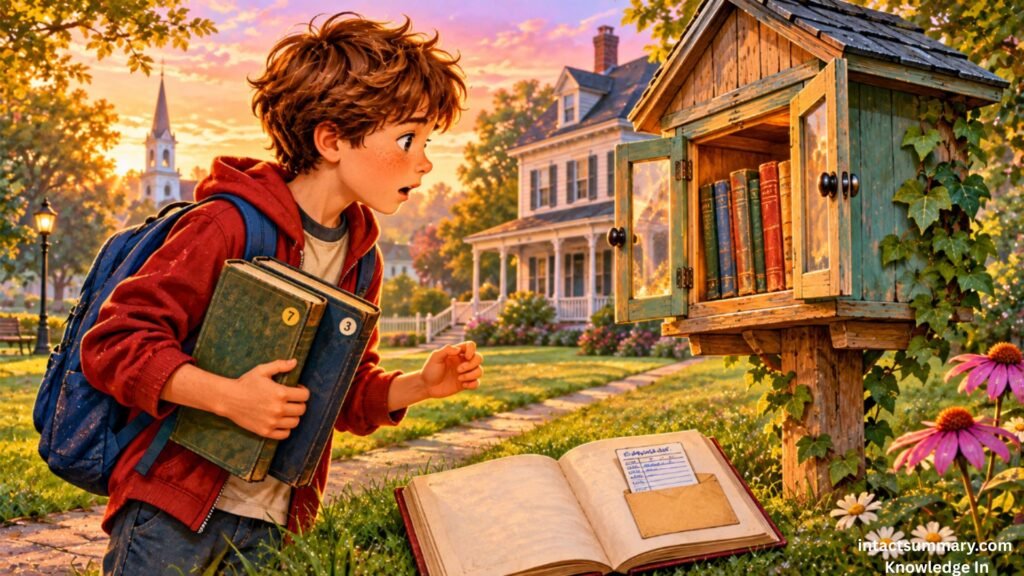
One morning, Evan finds a little free library standing on the green in the middle of town. Yesterday it was not there. A small sign tells people to take a book, leave a book, or do both. So Evan takes two. Both books look old, and both have stickers and little pockets inside, the kind that real libraries used to use. One of the books is a guide called How to Write a Mystery Novel.
Here is the odd part. Martinville does not have a public library anymore. It had one long ago, but it was lost to a tragic fire before Evan was born. The checkout card inside one of Evan’s books has the name of the old library on it. It also has only one name written on it, and that name belongs to Evan’s own dad in The Lost Library.
When Evan shows his father the books, his dad acts very strangely. He turns red, drops the book and hurries off to work. Evan knows right then that something is hiding behind the story of the old library. With the help of his best friend Rafe, he decides to treat it like a real case, using the mystery book as his guide in The Lost Library.
Meanwhile, two other storytellers are watching from nearby. Mortimer, a large orange cat, believes he is the guardian of the little free library. AL, a ghost assistant librarian, lives in the town’s History House, and she is the one who has been quietly building the little library. Each of them has a secret, and each of them is missing a piece of the puzzle. Only by working together, even without knowing it, can they find the truth in The Lost Library.
Where Does the Story Happen? Setting and the Three Narrators
The story is set in Martinville, a small town where everybody knows everybody. Most of the action takes place around the town green, where the little free library stands, and in the History House next door. The History House is an old home that people can tour on certain days. Inside, it looks the way a home would have looked when the town was first started. It is also the home of some ghostly characters, though visitors never see them in The Lost Library.
The time is today. Evan lives in a modern house, where his mom helps people fix computer problems over a headset. So the book feels like a contemporary middle grade novel, with a bit of magic hiding in the corners.
What makes the book stand out is its three narrators. Evan tells his part like a young detective. Mortimer the cat tells his part with a lot of pride and a little confusion about humans. AL the ghost tells hers with care and some worry about her friends. Because of this alternating viewpoint style, readers know more than any one character does. You will find yourself leaning forward and wanting to shout, “Look over there!” That is a big part of the fun in The Lost Library.
One of the authors explained that each narrator brings a different kind of tale: a ghost story, an animal story and a detective story. Each has its own mystery, set up early on. Near the end, they all come together. That clever design is why this book is more than a simple kids’ mystery, and it is why it is easy to follow even though the plot has many moving parts in The Lost Library.
The Lost Library Full Summary (With Spoilers)
Evan finds the little free library on the town green and takes two books. One has an old checkout card from the Martinville Library, and the only name on it is Edward McClelland, Evan’s dad. When Evan shows his father the book, his dad panics and runs to his basement office. Evan decides to solve the mystery. He reads How to Write a Mystery Novel, makes a plan, and asks his best friend Rafe to help in The Lost Library.
At the same time, we learn who built the little library. It was AL, who lives in the History House with Ms. Scroggin and Mr. Brock. She believes all three of them are ghosts from the library fire that happened about twenty years ago. AL has saved a cart of books that survived and set up the tiny library to bring books back to town. Mortimer the cat guards it. He also carries a secret worry. He and his sister Petunia lived in the old library as kittens, and after the fire he never saw her again in The Lost Library.

Evan and Rafe ask the grown-ups about the fire, but almost no one wants to talk about it. They learn the fire began in the basement, and they learn that Evan’s dad was the only person down there. This worries Evan a lot, because his own father is now a suspect. The boys also look into H.G. Higgins, the writer whose name is on the second book. They begin to wonder if this writer is hiding something in The Lost Library.
The truth comes out in pieces. First, Evan learns that H.G. Higgins is really his father. His dad writes mystery books under that pen name. Next, a clue in an old photo leads Evan to learn that Mr. O’Neal was part of the library’s past too. Then AL makes a big confession. She is not a ghost. She lived through the fire because Edward, who worked at the library as a teenager, helped her out of the building. She was so shaken that she came to believe she had died in The Lost Library.
The last piece belongs to Mortimer. The fire was an accident. He and Petunia chased a mouse through the basement, and a lit match was knocked over. Nobody was to blame on purpose. Mortimer, with help from some mice, finds a way to show Evan and his father what happened. Edward and AL meet again for the first time since that day. In the end, Edward uses the money from his books to help build a new library, and Mortimer is reunited with Petunia in The Lost Library.
The Lost Library Characters: Meet the Main Cast
The cast is not huge, so it is easy to keep track of everyone. Here are the main characters and the people around them.
Evan McClelland
Role & Arc: Evan is the eleven-year-old protagonist and a young mystery writer in the making. He is curious, kind and a little shy about big changes. At the start, he is sad about leaving fifth grade and his favorite teacher. By the end, he has learned that facing the truth, even a hard one, can bring a family closer. He also grows more ready for middle school in The Lost Library.
Mortimer the Cat
Role & Arc: Mortimer is a large orange cat with extra toes, and he is the story’s first narrator. He proudly calls himself the guardian of the little free library, even though townspeople give him lots of different names. His best qualities are loyalty and a big heart. His weak spot is that he cannot talk to people. He also carries guilt about the fire and about losing his sister Petunia. His arc is about finally finding a way to share the truth in The Lost Library.
AL the Ghost Librarian
Role & Arc: AL is short for Assistant Librarian. She bakes muffins, makes tea for the others, and cares deeply about books. At first, she seems like a ghost who is bad at being invisible. Later, we learn the reason: she is not a ghost at all. Her arc is about letting go of fear and learning she can live again. She shows why librarians matter so much.
Rafe
Role & Arc: Rafe is Evan’s best friend. His worried parents set many rules for him, but he is much braver than he looks. He helps Evan stay on track, and he shows what a supportive friendship looks like. He never asks Evan to give up the search in The Lost Library.
Edward McClelland (Evan’s Dad)
Role & Arc: Edward is a quiet writer and a gentle man. He also moves mice out of homes instead of harming them. For years, he kept a secret about the library fire. His arc is about healing and learning that sharing a hard memory can make it lighter. His father and son bond with Evan is one of the warmest parts of The Lost Library.
Ms. Scroggin and Mr. Brock
Role & Arc: Ms. Scroggin was the head librarian, and Mr. Brock was a library patron. Both truly died in the fire and now live in the History House as friendly ghosts. She is firm but loving. He loves adventure stories. They are not scary. They give the book its gentle, ghost story for kids feeling.
Mr. O’Neal and Evan’s Mom
Role & Arc: Mr. O’Neal is Evan’s favorite teacher, and he helps Evan love learning. Evan’s mom helps people fix computers from home and gives steady support. These two adults show how community and caring teachers help a child feel safe.
How Do Evan and Rafe Solve the Mystery? The Clues Explained
The answer is that they follow small clues, one at a time, just like the book Evan is reading tells them to. Here is how the trail goes, in simple order.
The first clue is the checkout card. It shows the library’s name and the name of Evan’s dad. This tells Evan the books are real and that his father has a link to them. The second clue is Evan’s dad acting strange. When someone you trust gets upset about a book, you know it matters.
Read More:/the-gentleman-guide-to-vice-and-virtue-summary/
The third clue is the second book by H.G. Higgins. Evan and Rafe think the name might be fake, and they are right. The fourth clue is the silence of the town. When adults will not answer questions, it often means there is pain behind them. The fifth clue is the basement. Learning where the fire started points the boys toward the right place to look.
Another clue is the old photo, which helps Evan see who was close to the library long ago. The final clue is Mortimer himself. He was there on the night of the fire, and he is the only one who remembers exactly what happened. Evan listens to the cat in a way that most people would not. That is how the truth is shown at last.
What makes this a good mystery for young readers is that the boys do not find the answer by magic. They ask questions, write down what they learn, and keep going even when the answer scares them.
The Lost Library Ending Explained
The ending is calm and kind. Nobody is punished, because nobody did anything evil. The fire was an accident caused by a chase, a mouse and a match. This is important, because it takes away the heavy guilt that Edward, AL and Mortimer have all carried.
AL learns she is alive and can step back into the world. Edward and AL are reunited, and their meeting shows that old pain can turn into emotional healing. Mortimer gets to see his sister again, and that finally eases his worry. Most of all, Martinville gets what it was missing: a library again. Edward helps pay for it, and the little free library that started everything stays as a reminder of how one small box of books can bring a town together.
For Evan, the ending is also a beginning. He walks away from the case with a stronger bond with his dad, a loyal friend in Rafe, and more courage to step into sixth grade.
Key Themes Explained in The Lost Library
The book has a few big ideas, and each one shows up in the story in a clear way. Here are the main themes of The Lost Library, explained simply.
Friendship and loyalty in The Lost Library. Evan and Rafe do not leave each other’s side, even when the search gets scary. Rafe has strict rules at home, but he still finds ways to help. Evan never makes him feel small for it. This kind of supportive friendship matters because the mystery is too big for one boy to solve alone. Mortimer is loyal too. He guards the little free library day after day, because he cares about it so much.

Healing from the past in The Lost Library. For years, Evan’s dad, AL and Mortimer each carried a heavy secret about the library fire. Each of them thought they were alone with it. When the truth comes out, the weight gets lighter for everyone. The book shows that hard memories feel smaller when we share them with people who care. That is a good lesson for young readers, because kids also hold in worries that they think they cannot say out loud.
Family and honesty in The Lost Library. Evan loves his dad, but he feels that something is being hidden from him. The story shows that a father and son can love each other and still have hard talks. It also shows that being honest, even when it is scary, builds trust.
Kindness and community in The Lost Library. Once the little free library appears, people in town begin to drop off books and treats. A small act turns into something bigger. The theme teaches that helping others and sharing can bring a whole town back together.
Growing up and accepting change in The Lost Library. Evan does not want to leave fifth grade behind. He worries that nothing will be as good again. By the end, he sees that change can bring new friends, new stories and new chances. This makes the book a good pick for children who are about to move up to middle school.
The Role of Libraries and Great Readers
At its heart, this is a love letter to libraries and librarians. The story shows what a town loses when its library disappears. Martinville had no place where people could gather, borrow books or meet each other. When the little free library appears, we see how much a few shelves can change a place. One of the authors said that the book shows how the absence of a library leaves a hole in a town’s heart, and how its return can bring people together.
The book also looks at what it means to be a Great Reader. In the story, the old library had a club for readers. The big idea is that being a Great Reader is not about reading hard books, long books or lots of books. It is about feeling something when you read. If a story makes you laugh, worry, cry or think, then you are a Great Reader. This is a kind message for kids who think they are not good at reading because they are slow or because they like simple books.
Another sweet idea is sharing books with others. People leave short notes with the books they donate, to tell the next reader why they loved the story. A personal book recommendation can be more powerful than any advertisement. The book also describes how the stories we read can build a kind of house inside our minds, filled with all the places and people we have met in books. That idea helps children see reading as a way to grow, not just a school chore.
Finally, the book honors librarians. AL and Ms. Scroggin are not just helpers. They are people who connect readers with the right book at the right time. The book’s message is that a good book can change a life, and the librarian who hands it to you matters too.
Writing Style: Multiple Narrators and Mystery Storytelling
The writing style is simple and warm, so it is easy for kids to follow. Sentences are short, the humor is gentle, and the mood is never too heavy. Yet the plot has many layers, which gives older readers something to enjoy too.
The biggest feature is the use of multiple narrators. The story moves between Evan, Mortimer and AL. This is called alternating points of view. Each narrator knows only part of the truth, and each one has a different voice. Evan is thoughtful and a bit nervous. Mortimer is proud and funny. AL is caring and worried. Because readers see all three sides, they can spot clues the characters miss. This builds suspense, but a gentle kind that does not frighten anyone.
The authors also blend three kinds of stories into one: a ghost story, an animal story and a detective story. Each one starts with its own small mystery early on. Then the strands come together near the end in a way that feels earned. This careful narrative structure is a hallmark of Rebecca Stead’s books, and the warm feeling is a hallmark of Wendy Mass’s.
One more thing to notice is the tone. Evan does not like scary stories, and the book respects that. The ghosts are friendly, the fire happened long ago, and the sad parts are treated with care. It is a suspense story without frightening scenes.
Symbolism and Motifs in The Lost Library
Even in a simple children’s book, some objects carry a deeper meaning. Here are the most important ones.
The little free library itself is the biggest symbol. It stands for hope and second chances. A small box on a pole brings back something the town thought it had lost for good. It also shows that a community can rebuild when people share what they have.
The checkout card is another strong symbol. It is a tiny record of who borrowed a book and when. In this story, it links the past to the present and shows that every reader leaves a trace. It also makes Evan see that his father has a hidden history.

Mortimer the cat works as a symbol of guardianship and loyalty. He cannot speak to humans, but he never stops trying to protect what he loves. His silence also stands for the many things that go unspoken in the town.
The fire stands for loss and for the fear of blame. It is the moment that broke the town’s heart. Because it turns out to be an accident, it also teaches that not every painful event has a villain.
Finally, the History House shows how the past can stay alive. The ghosts living there remind us that memories and stories do not simply disappear.
Frequently Asked Questions About The Lost Library
What is The Lost Library by Rebecca Stead and Wendy Mass about?
It is a middle grade mystery about an eleven-year-old boy named Evan who finds a little free library that appears overnight. The books inside come from an old town library that burned down many years ago. Evan, his friend Rafe, a cat named Mortimer and a librarian named AL work to learn what really happened.
Who wrote The Lost Library, and when was it published?
Rebecca Stead and Wendy Mass wrote it, and it was published on August 29, 2023. It is their second book together, after Bob.
Who are the main characters in The Lost Library?
The main characters are Evan McClelland, his best friend Rafe, Mortimer the cat, and AL the assistant librarian. Important supporting characters include Evan’s father Edward, the ghosts Ms. Scroggin and Mr. Brock, and Evan’s teacher Mr. O’Neal.
Why did the old Martinville Library burn down?
It burned down because of an accident. Mortimer and his sister Petunia chased a mouse in the basement, and a lit match was knocked over by mistake. No one started the fire on purpose.
Who is Mortimer in The Lost Library?
Mortimer is a large orange cat who guards the little free library. He is one of the three narrators. He understands people but cannot speak to them, and he lost his sister Petunia in the fire.
Is AL a ghost in The Lost Library?
For most of the book, AL thinks she is a ghost. In the end, we learn she is not a ghost. She survived the fire because Evan’s father helped her escape.
What role does Evan’s father play in the library mystery?
Edward McClelland was at the library on the day of the fire and was the only person in the basement, so he looks like a suspect. He carried a secret about it for years. He also turns out to be the mystery writer H.G. Higgins.
How do Evan and Rafe solve the library mystery?
They follow clues like the checkout card, the second book, the silence of the adults, the basement and an old photo. They also learn to pay attention to Mortimer, who shows them what really happened.
What is the significance of the little free library?
It stands for hope, sharing and community. It starts the whole mystery, and it brings the town back together. By the end, it leads to a new library for Martinville.
Is The Lost Library a scary book for children?
No. The ghosts are friendly, and the tone is cozy. A few moments are sad, but the book is built to be a mystery without frightening scenes.
What age is The Lost Library for?
It is written for ages 8 to 12, and it suits third to sixth graders. It is a good book for fifth graders moving on to middle school.
How many narrators are there in The Lost Library?
There are three: Evan, Mortimer the cat and AL. They take turns telling the story.
What are the major themes of The Lost Library?
The main themes are friendship and loyalty, healing from the past, family and honesty, kindness and community, and the power of reading. It also explores growing up and accepting change.
How does The Lost Library end?
The truth about the fire comes out, and everyone is relieved to learn it was an accident. AL and Evan’s father are reunited, Mortimer is reunited with his sister, and Edward helps build a new library for the town.
Editorial Note: How This Article Was Prepared
This article was written to help readers, parents and teachers understand The Lost Library in clear, simple words. For research, the main story facts were cross-checked against several reliable sources, including the publisher’s book details, professional children’s book reviews, library resources and well-known book review sites. Where the sources agreed, the details were included. Where a detail was unclear, it was left out instead of guessed.
The writing is original. Every section was written in new words and does not copy competitor articles or the book’s text. The plot summary describes what happens without following the book chapter by chapter, and any spoilers are clearly labeled. Before sharing, the article was checked for accuracy, clear structure, easy language and fair coverage of both the story and the reading experience. No personal credentials are claimed here. Because small details can differ between editions, readers are encouraged to compare the facts with their own copy of the book.
Conclusion of The Lost Library
The Lost Library by Rebecca Stead and Wendy Mass is a story about finding something you thought was gone for good. A tiny box of books appears on a town green, and a boy named Evan follows its clues all the way to the truth about the Martinville Library fire.
Along the way, readers meet a loyal orange cat, a caring ghost librarian who is not quite what she seems, a brave best friend, and a father who has carried a heavy secret for years. Each of them teaches something. Evan shows that curiosity and kindness can solve even old mysteries. Rafe shows what a true friend looks like. Mortimer and AL show that guilt and fear get lighter when they are shared.
This middle grade mystery works because it is both a puzzle and a gentle story with a big heart. The clues are fair, the ghosts are friendly, and the ending brings healing to everyone. It also reminds us why libraries, librarians and a good book matter so much. A book handed to you at the right moment can change a life.
If you are a parent, teacher or young reader wondering whether to pick it up, the answer is yes. It is a good fit for ages 8 to 12, it is not scary, and it gives families plenty to talk about. It even teaches kids how to write a mystery of their own.