
Maybe it says, “You are not good enough,” or “Everyone is looking at you.” Many people hear this voice every day. They do not know where it came from, and they do not know how to make it quieter.
That is the problem The Fifth Agreement tries to help with. It is a self-help and spiritual book written by Don Miguel Ruiz, Don Jose Ruiz, and Janet Mills. It came out in 2010. It builds on the famous book The Four Agreements and adds one more important idea: be skeptical, but learn to listen.
If you are wondering what this book is about, here is the short answer. The book says that most of us grew up learning rules and beliefs from other people. We never chose them ourselves. Over time, these beliefs became a kind of belief system that decides how we think, feel, and act. The book teaches that we can look at these beliefs, ask if they are really true, and let go of the ones that hurt us. That is the path to self-mastery, personal freedom, and inner peace.
You may be deciding whether to read the book. Or you may have read it and want a refresher. Or you may be a fan of Toltec wisdom who wants to understand the ideas better. This article is for all of you.
Here is what you will learn. First, you will get a quick answer and an overview of the book. Then you will meet the authors and learn how this book connects to The Four Agreements. After that, we will go through all five agreements, the power of doubt, the power of symbols, and how social domestication shapes people. We will also explain absolute truth and relative truth, the three dreams of awareness, and simple ways to use the book in real life. At the end, you will find an honest review, a list of who should read it, common mistakes people make, and a full FAQ.
Everything here is written in simple words and in our own voice. We do not copy the book. We explain its ideas the way you might explain them to a friend.
Quick Answer of The Fifth Agreement
The Fifth Agreement is a 2010 self-help book by Don Miguel Ruiz and Don Jose Ruiz, with Janet Mills. It adds a fifth rule, “Be skeptical, but learn to listen,” to the four agreements from the first book. The main message is that you can free yourself from old, limiting beliefs by questioning what you were taught, while still listening to others with an open heart. The book calls this path self-mastery, and it leads to happiness and love in The Fifth Agreement.
What Is The Fifth Agreement About?
The Fifth Agreement is about freedom of the mind. It is not a story with a hero and a villain. It is a guide. It shows you how your mind learned its beliefs, why some of those beliefs cause pain, and how you can change them.
The book starts with a simple idea. Long ago, you were born without any rules in your head. You were just a child. Then the people around you, like your parents, teachers, and friends, began to teach you what is good, what is bad, what is right, and what is wrong. The book calls this process human domestication, or social domestication. Just like people train a dog to follow rules, society trains children to follow its rules in The Fifth Agreement.
Also Read:/the-narrow-road-between-desires-summary/
This is not always a bad thing. Some rules keep us safe and help us live together. But the book points out a problem. Many rules were never checked. We simply agreed to them. Those agreements live inside our minds, and we often follow them without knowing it. Some of them hurt us. They say things like “I am not smart” or “I must be perfect to be loved.”
The book says you can change these agreements. The first four agreements help you do this in daily life. The fifth agreement helps you look at beliefs themselves. It teaches you to doubt what is not true, but also to stay curious and open when you hear someone speak in The Fifth Agreement.
You will also see other big ideas in the book. These include the power of belief, the power of words, the power of symbols, the voice of knowledge, and the dream of the planet. In simple words, the book says that each person lives in their own version of the world, shaped by what they believe. When you understand this, you can start to choose what you believe instead of just accepting it.
The book is short and easy to read. Many readers like it because it feels calm and kind. It does not scold you. It gently invites you to look inside yourself.
Who Wrote The Fifth Agreement? Meet the Authors
Don Miguel Ruiz is the main author. He was born in Mexico and grew up in a family connected to traditional healing and old wisdom. His mother was a healer, and his grandfather taught the old ways. As a young man, he chose to become a surgeon. Later, after a life-changing event, he turned back to the ancient Toltec teachings from his family and began to share them with the world. His first book on the topic, The Four Agreements, became one of the most loved self-help books of its time. He also wrote The Mastery of Love and The Voice of Knowledge in The Fifth Agreement.
Don Jose Ruiz is the son of Don Miguel. He is also a teacher and speaker, and he carries on the family tradition. He is described as part of the Eagle Knight lineage, which is the family line of teachers who share Toltec wisdom. In this book, he brings a fresh voice and a younger point of view. That helps the old teachings feel closer to modern life in The Fifth Agreement.
Janet Mills is the founder of Amber-Allen Publishing, the company that first published the book. She worked closely with the Ruiz family and helped shape the writing. Her name appears on the cover because she helped bring the ideas into clear words for readers.
The mix of a father, a son, and an editor helps the book feel balanced. It has the deep wisdom of an older teacher and the easy style of people who want everyone to understand.
Is The Fifth Agreement a Sequel to The Four Agreements?
The Four Agreements was published in 1997. It gave readers four simple promises to make to themselves: be impeccable with your word, don’t take anything personally, don’t make assumptions, and always do your best. Millions of people read it, and it stayed popular for many years.
The Fifth Agreement came out thirteen years later, in 2010. It begins by explaining the four agreements again, so new readers will not feel lost. Then it adds the fifth one. You can think of it this way. The first four agreements teach you how to act in daily life. The fifth teaches you how to think about what you believe and hear.
The book also goes deeper than the first one. The Four Agreements is mostly about habits. The Fifth Agreement spends much more time on why we have our beliefs, how symbols and language shape them, and what it means to be truly aware. Some readers say the first book is easier and the second is deeper. Both are short and both are friendly.
If you have time, reading The Four Agreements first can help. But if you want to start here, that is fine too.
What Is Toltec Wisdom? A Simple Explanation in The Fifth Agreement
In the book’s telling, the Toltec were people of ancient Mexico. They are said to have been scientists and artists, not just one tribe. They gathered at a sacred place called Teotihuacan, which is near modern Mexico City. The teachers there studied how people think, feel, and see the world. They called their teachers nagual and passed their knowledge down from one teacher to the next. The Ruiz family says they are part of this lineage in The Fifth Agreement.
Historians study the Toltec in a more careful and different way. Some of them say the Toltec were a real culture, but the details in this book come from the family’s own teaching tradition, not from history books. That is useful to know. You can enjoy the book as spiritual and personal wisdom without treating it as a history lesson.
At its heart, Toltec wisdom says that life is like a dream. The stories in your mind shape the world you see. When you change the stories, you can change how you live. This idea shows up again and again in the book.
What Are the Five Agreements in the Book?
The five agreements are five simple promises you make to yourself. Together, they form a practical guide to self-mastery. The first four come from The Four Agreements. The fifth is new to this book.
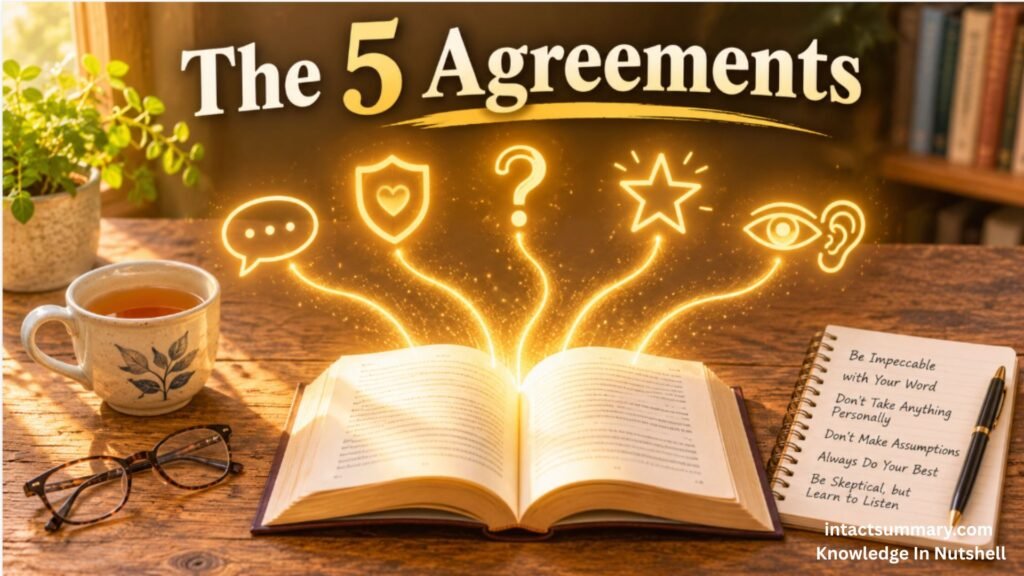
Here they are in a quick list: Be impeccable with your word. Don’t take anything personally. Don’t make assumptions. Always do your best. Be skeptical, but learn to listen in The Fifth Agreement.
The word “agreement” is important. In the book, an agreement is any belief you said yes to, even if you never said it out loud. When a child hears “you are lazy” again and again, the child may start to agree. That agreement then lives in the mind for years. The five agreements are new, healthy agreements you choose on purpose. They replace the old ones that cause pain.
The First Four Agreements Explained Simply
First Agreement: Be Impeccable with Your Word in The Fifth Agreement
The word impeccable means “without mistakes or harm.” So this agreement asks you to use your words in a clean and kind way. Words are more powerful than most people think. The book says words create reality in a person’s mind. If you call yourself “stupid” many times, you start to believe it. If you tell a friend something cruel, the sting can last a long time in The Fifth Agreement.
The book calls hurtful words emotional poison. It also says gossip and negativity spread this poison from person to person. The fix is to speak with integrity. Say what you mean. Be honest. Use your words to lift people up, including yourself. Try to stop negative self-talk and self-criticism, because the first person who hears your words is you.
Second Agreement: Don’t Take Anything Personally in The Fifth Agreement
This agreement is about emotional independence. The book says that what other people say or do is about their own beliefs and feelings, not about you. Each person lives inside their own mind, with their own personal opinions. When someone is rude, it usually shows how they feel inside in The Fifth Agreement.
Think about a classmate who says, “Your drawing is ugly.” If you take it personally, you feel hurt. But maybe that classmate had a bad day, or maybe they just like a different style. The words say more about them than about you. When you stop taking things personally, you protect your self-worth and avoid a lot of unnecessary suffering. The book also says this works for kind words. You do not need praise to feel good about yourself in The Fifth Agreement.
Third Agreement: Don’t Make Assumptions in The Fifth Agreement
An assumption is when you guess something and then treat the guess like a fact. We do this all the time. A friend does not text back, and we think, “She must be mad at me.” Then we feel sad or angry, and the story may not even be true.
The book says that making assumptions leads to misunderstandings and drama. The simple cure is to ask questions and communicate clearly. Instead of guessing, say, “Is something wrong?” This agreement is about seeking the truth instead of filling the empty spaces with scary stories.
Fourth Agreement: Always Do Your Best in The Fifth Agreement
This one sounds easy, but it has a clever twist. Your “best” is not the same every day. When you are healthy and rested, your best is high. When you are tired or sick, your best is lower. The book says you should just do the best you can in each moment, and then stop judging yourself.
This agreement is about progress over perfection. It also says to act because you want to, not only to win a prize. When you do your best, you avoid self-judgment and regret. You can look back and know you tried. That brings inner peace in The Fifth Agreement.
The Fifth Agreement Explained: Be Skeptical, But Learn to Listen
To be skeptical means to doubt and ask, “Is this really true?” To listen means to hear what someone is saying with an open mind. At first these two things look like opposites. One says “question it,” and the other says “hear it.” But the book says they work as a team in The Fifth Agreement.
Here is the main idea in simple words. Do not believe everything you hear. That includes what other people tell you, and it also includes what your own mind tells you. Your mind has a voice that talks all day long. That voice is often full of old beliefs. If you trust it without checking, it can lead you into fear and sadness in The Fifth Agreement.
Read More:/the-lost-library-summary/
But the book does not want you to become a person who rejects everyone. If you doubt everything and never listen, you will miss helpful messages. Imagine a friend who tells you something hard but true. If you shut your ears, you cannot learn. So the fifth agreement asks for balance. Listen to understand the message. Look at the intention behind the words. Then decide for yourself what is true in The Fifth Agreement.
The book says this skill is the tool that makes the other four agreements last. Why? Because you can break an old agreement only if you can notice it and question it. Without doubt, you keep believing the same old stories. With doubt and listening together, you gain discernment, which means the skill of telling what is real from what is only a story.
This is also called healthy skepticism. It is not about being negative or mean. It is about being curious and awake. It helps you with independent thinking while you still understand different viewpoints in The Fifth Agreement.
Here is an everyday example. Say a classmate tells you, “Nobody likes you.” A skeptical listener thinks, “Is that true? Does everyone really feel that way? Or is this person just upset?” The listener also hears that the classmate may be hurting. This way, you do not accept the lie, and you still treat the person with kindness.
The Power of Doubt: Why Questioning Beliefs Matters
The book gives doubt its own special place. Many people think doubt is bad. We often hear “have faith” or “just believe.” But the book says that doubt can be a powerful tool for freedom in The Fifth Agreement.
Here is how it works. Everyone holds many personal beliefs. Some of them are helpful, like “being honest is good.” Some of them are harmful, like “I am not worthy of love.” The trouble is that we rarely check which is which. A belief feels like a fact, so we do not question it.

The power of doubt is the power to stop and ask, “Is this really true?” When you ask that question about a harmful belief, it starts to lose its grip. You may find out that the belief was never yours. It came from someone else, long ago.
The book also talks about the power of belief. It says belief is very strong. When you believe something with your whole heart, it shapes how you see the world, and it can even shape what you do. That is why believing a false story is so dangerous. It can lead you down a sad road for years. On the other hand, belief can also be used to build faith in yourself. The key is to choose what you believe on purpose in The Fifth Agreement.
It also helps to know that doubt is not the end goal. Doubt is a door. After you question a belief, you can listen for what is true and decide what to keep. Some beliefs will pass the test and stay. Others will fade away. Either way, you are the one in charge.
The Power of Symbols: How Words and Language Shape Our Beliefs
Another big idea in the book is the power of symbols. What is a symbol? It is anything that stands for something else. The letters in a word are symbols. The word “tree” is not a tree. It is a sound or a set of letters that we all agreed stands for a tree.
The book says that this is how humans communicate. We share symbols and agree on what they mean. Words, numbers, signs, and even gestures are all symbols. This is wonderful, because without them we could not share ideas, stories, or science.
But there is a catch. Symbols can also shape what we think and feel. When a child hears the word “bad” connected to their name, that symbol can stick to their identity. Soon the child sees themselves through that word. Symbols and agreements are tied together. We agree on a meaning, and then we live by it.
The book also points out that the same symbol can mean different things to different people. A word like “home” may bring warm feelings for one person and sad feelings for another. This is part of what the book means by every mind is a world. Each person has their own set of meanings, memories, and beliefs. So two people can hear the same sentence and understand it in different ways. This is why listening with awareness matters so much, and why we should be careful about assumptions.
When you understand the power of symbols, you can use language with more care. You can notice when a word is hurting you. You can also pick new words that help you grow.
How Social Domestication Shapes Who We Become
Social domestication is one of the biggest ideas in the book. It is also called human domestication or social conditioning. It means the way families, schools, and society teach us how to think and act.
Think about how people train a puppy. If the puppy does something good, it gets a treat. If it does something bad, it gets scolded. After a while, the puppy learns the rules. The book says humans are taught in a very similar way, using a punishment and reward system. Children get praise, hugs, and gold stars when they follow the rules. They get frowns, yelling, or time-outs when they do not.
This is how childhood programming works. A child wants to be loved and accepted, so the child learns to behave in the ways that get approval. Slowly, the child takes in thousands of rules about being good, being smart, being pretty, being strong, and being successful. Many of these rules are useful. But many come from the fears and cultural beliefs of the people around us.
The book says that over time, we begin to use these rules on ourselves. Two inner characters show up. One is the Judge, a harsh voice that says you are not good enough. The other is the Victim, the part of you that feels hurt and says, “It is not fair.” These two keep each other busy. The Judge criticizes, and the Victim suffers. This is where self-judgment and self-rejection come from in The Fifth Agreement.
The book also says that we start to chase external validation. That means we need other people to tell us we are okay. We try to be what others want. We wear a mask, and we hide our authentic self. The sad part is that we often forget the mask is a mask.
Here is a simple example. A girl loves to draw, but her family says, “Artists never make money.” She decides to give up art and does something “safe.” Years later, she feels empty and does not know why. The belief was not truly hers. It was inherited. The book says that once we see this clearly, we can begin to heal. We do not need to blame our parents or teachers. They were also taught by others. We only need to see the pattern and choose differently in The Fifth Agreement.
This is also where the collective dream comes in. The book says that society as a whole shares one big dream, made up of all our agreements. Each country, culture, and family has its own version. When you are born, you are born into this dream, and you learn it. Understanding this helps you see that many “rules of life” are shared stories, not natural laws.
The Three Dreams of Awareness in Toltec Wisdom
What are the three dreams of awareness? This is a question many readers ask. The book describes three stages of attention, or three ways a person can live. You can think of them as three levels of waking up. The book calls them the dream of the first attention, the dream of the second attention, and the dream of the third attention.
The Dream of the First Attention in The Fifth Agreement
This is where most people begin. In this stage, a person lives by the beliefs they were given. They are deeply shaped by social domestication. They follow the rules without asking why, and they often feel like victims of life. Things just “happen” to them. They may blame others, or they may blame themselves.
In this stage, the person also feels strong fear. They worry about being rejected and about not being good enough. The book says there is nothing shameful about this. Nearly everyone starts here, because we all grew up in the same kind of system.
The Dream of the Second Attention in The Fifth Agreement
This stage begins when a person wakes up a little. Something makes them stop and think, “Maybe I do not have to live this way.” The person starts to question their beliefs and to notice their inner voice. The book calls a person in this stage a warrior, but not a warrior who fights people. This warrior fights old agreements inside the mind in The Fifth Agreement.
This is where the five agreements become very useful. The warrior practices being impeccable with their word, not taking things personally, not making assumptions, doing their best, and using healthy skepticism. It takes effort and practice, so the book says to be patient with yourself. You will slip. That is normal. What matters is that you keep trying.
The Dream of the Third Attention in The Fifth Agreement
The last stage is the one the book calls mastery. A person in this stage has become very aware. They are no longer ruled by old beliefs. They can see the dream for what it is, and they can choose how to live in it. They live with love, peace, and freedom.
The book is clear that this stage is a path and not a finish line. Even people who are far along keep learning. You do not have to be perfect to begin. You only have to take the first step in The Fifth Agreement.

If you want an easy way to remember it, think of three people walking through a forest. The first person does not know there is a path and just follows the crowd. The second person starts to look around and ask, “Where am I going?” The third person has learned the forest well and can walk it freely.
Absolute Truth vs. Relative Truth: What Is Real?
The book separates truth into two kinds. Absolute truth is what really exists, no matter what anyone thinks, says, or believes. It is simply what is. A rock is there. The sun rises. A person is alive. Absolute truth does not need words.
Relative truth is a different thing. It is the version of the truth that we create using words, symbols, and personal beliefs. When we describe the rock as “ugly” or “beautiful,” we are giving our own interpretation. Another person may see it differently. Both views are relative. They depend on the person in The Fifth Agreement.
The book says the trouble starts when we forget the difference. We take our opinions and treat them like absolute facts. We say, “I am a failure,” as if that were as solid as a stone. But it is only a story, a relative truth that came from beliefs and assumptions. Seeing this is a big relief. Once you understand that a belief is not the same as reality, you can look at it more calmly.
The book also says that words can never fully capture the truth. Words are symbols, and symbols are only pointers. They are like a finger pointing at the moon. The finger is not the moon. That is why the book warns us not to fight over words and opinions. Each person’s version is shaped by their own mind.
This idea ties right back to the fifth agreement. When you learn to be skeptical, you ask, “Is this absolute truth or just someone’s story?” When you learn to listen, you understand that other people are speaking from their own relative truth. This makes it easier to respect different opinions and avoid unnecessary fights.
Here is a short example about facts versus opinions. “It rained today” is a fact. “Rainy days are sad” is an opinion. Learning to separate facts from personal opinions helps you think more clearly, and it helps you stay calm when people disagree with you.
Virtual Reality and Becoming a Seer: Seeing the World With New Eyes in The Fifth Agreement
The book uses a modern phrase to describe how the mind works: virtual reality. It does not mean a video game headset. It means that each of us lives in a personal picture of the world that our mind creates. This picture is made from our perception, our memories, our beliefs, and our imagination.
Think about it this way. Two people can stand in the same room and have two very different experiences. One feels excited and happy. The other feels nervous and out of place. The room is the same, but each person’s virtual reality is different. The book says that every mind is a world, and each world has its own rules.
This is a gentle but powerful idea. It means that your reality is not the only one. It also means that when someone sees things differently, they are not necessarily wrong. They are living in a different picture. This helps with understanding others, healthy relationships, and compassion.
The book teaches that the mind’s picture can be changed. Because the picture is built from agreements, we can update the agreements. That is how people experience personal transformation.
The book uses the word seer for a person who learns to look at life from a new point of view. A seer does not just look at the picture. A seer can see that there is a picture. This person can notice, “That is my belief talking,” or “That is only a story I am telling myself.” Because of this, a seer is much calmer and much freer.
Becoming a seer does not need magic or special powers. It starts with awareness. You pay attention to your thoughts, feelings, and reactions. You ask questions. You listen. Over time, you see more clearly.
How to Apply the Five Agreements in Everyday Life
A good book is only helpful if you can use it. So here are simple, practical ways to bring the five agreements into daily life. You do not have to do them all at once. Pick one and try it for a week.
To be impeccable with your word: Notice the words you use when you talk to yourself. If you catch a harsh thought, such as “I am so dumb,” pause and change it to something kinder, like “I made a mistake, and I can learn.” Also try to skip gossip. If a friend starts talking badly about someone, you can gently change the subject.
To not take things personally: The next time someone is rude, take a breath and say in your mind, “This is about them, not me.” Ask yourself what might be going on in that person’s day. This can protect your emotional well-being and help you build emotional resilience.
To not make assumptions: When you feel upset because of a guess, stop and ask. Say, “Can you help me understand?” Many fights end quickly when people simply talk honestly.

To always do your best: Set small goals and be kind to yourself on low-energy days. Your best on a tired day is still your best. Celebrate small progress instead of waiting for perfection.
To be skeptical, but learn to listen: When you hear a strong claim, from a person, an ad, a news story, or your own mind, ask, “Is this really true?” Then listen to the whole message before you decide. You can also write down a limiting belief, like “I am bad at math,” and ask where it came from. Was it a fact, or was it a comment someone made years ago?
A few more simple habits can help you reach inner peace and self-acceptance. Take a few quiet minutes each day to notice your thoughts. Keep a small journal about your inner dialogue. Spend time with people who treat you kindly. Forgive yourself when you slip. These small steps add up to self-mastery over time.
The book reminds us that this is a lifelong journey toward freedom. The goal is not to become perfect. The goal is to live with awareness, so that more of your choices are really yours.
The Fifth Agreement FAQ
1. What is the main message of The Fifth Agreement?
The main message is that you can free your mind from old, limiting beliefs by questioning them with healthy skepticism, while still listening with an open heart. The goal is self-mastery, personal freedom, and happiness and love.
2. Who wrote The Fifth Agreement?
It was written by Don Miguel Ruiz and his son Don Jose Ruiz, with Janet Mills. It was published in 2010 by Amber-Allen Publishing.
3. Is The Fifth Agreement a sequel to The Four Agreements?
Yes. It continues the ideas from The Four Agreements (1997) and adds a new rule. You can read it without the first book, because it reviews the four agreements early on.
4. What are the five agreements in The Fifth Agreement?
They are: be impeccable with your word, don’t take anything personally, don’t make assumptions, always do your best, and be skeptical, but learn to listen.
5. What does “be skeptical, but learn to listen” mean in The Fifth Agreement?
It means you should question what you hear and believe, whether it comes from others or from your own mind, but also hear the message with care. Doubt helps you find the truth. Listening helps you understand people.
6. What is Toltec wisdom in The Fifth Agreement?
Toltec wisdom is the set of ancient Mexican teachings that the Ruiz family says they received through their lineage. It focuses on how beliefs shape the mind and how people can find freedom through awareness.
7. What does it mean to be impeccable with your word?
It means using words honestly and kindly, without harming yourself or others. That includes avoiding gossip, self-criticism, and negative self-talk.
8. What is social domestication in The Fifth Agreement?
Social domestication is the process of teaching children the rules and beliefs of their family and society, using rewards and punishments. The book says it shapes our identity and often causes self-judgment.
9. What is the difference between absolute truth and relative truth in The Fifth Agreement?
Absolute truth is what simply exists, with no opinion added. Relative truth is the version we create with words, symbols, and beliefs. The book says we often mix them up.
10. What are the three dreams of awareness in The Fifth Agreement?
They are the dream of the first attention (living by inherited beliefs), the dream of the second attention (waking up and questioning, like a warrior), and the dream of the third attention (mastery and freedom).
11. What is the power of symbols in The Fifth Agreement?
Symbols, like words, stand for things and let us share ideas. They are powerful because they can also shape beliefs. A word attached to a child’s name can affect how that child sees themselves.
12. Who should read The Fifth Agreement, and is it worth it?
Anyone interested in self-awareness, inner peace, or personal transformation can enjoy it. It is short, gentle, and thoughtful. It is less suited to readers who want scientific proof or detailed workbooks.
About The Fifth Agreement: Our Research and Writing Approach
Research approach. This article was prepared by studying the book’s main ideas and structure, and by comparing them with the topics that other well-known summary and review pages cover. We looked at where those pages were thin, such as the power of symbols, social domestication, relative truth, and everyday use, and we gave those areas extra care.
Writing process. Every part was written in our own words. We did not copy competitor pages, and we did not reproduce passages from the book. The explanations and examples, such as the puppy, the forest path, and the drawing girl, were created for this article to make the ideas easy for any reader.
Accuracy review. We checked the main facts against the book’s core ideas: the title, authors, 2010 publication, the five agreements, and the key concepts. Where the book shares its teaching tradition, such as the Toltec story, we said so clearly instead of presenting it as proven history. We make no claims about professional credentials. This article is a reader’s guide, not a replacement for the book, and it is not medical or mental health advice. If you are struggling with your mental health, please talk with a qualified professional.
Conclusion of The Fifth Agreement
The Fifth Agreement is a short book with a big message. It says that most of the beliefs in your mind were learned from other people, not chosen by you. Through social domestication, families, schools, and society taught you what to think about yourself and the world. Some of those lessons helped you. Others, like “I am not good enough,” became limiting beliefs that caused pain.
The good news is that you can change this. The first four agreements give you daily habits: be impeccable with your word, don’t take anything personally, don’t make assumptions, and always do your best. The fifth agreement, be skeptical, but learn to listen, gives you a thinking tool. It teaches you to question what you hear, from others and from your own mind, while still listening with an open heart. That balance builds discernment, self-awareness, and emotional freedom.
Along the way, the book also explains the power of words, the power of symbols, the difference between absolute truth and relative truth, and the three dreams of awareness. Together, these ideas show that every person lives in their own personal reality, and that reality can be updated.