Few essays make the case that losing your accent means losing a piece of yourself as powerfully as Gloria Anzaldúa’s “How to Tame a Wild Tongue.” If you were assigned this essay for a composition or ethnic studies class, or you’re trying to understand why a dentist’s offhand comment about a “wild tongue” became the title of one of the most cited pieces of Chicana feminist writing, you’re likely looking for a summary that actually explains what happens and why it matters — not a vague paraphrase that could describe any immigrant-identity essay.
This guide breaks down “How to Tame a Wild Tongue” section by section: what Anzaldúa argues, how she structures her case, which literary and rhetorical devices she uses, and why the essay still shows up on syllabi and reading lists nearly forty years after its publication. You’ll get a spoiler-free overview for readers who want the gist before diving in, a fuller section-by-section walkthrough for students who need to write about specific parts, a plain-language explanation of key terms like “linguistic terrorism” and “Chicano Spanish,” and a set of discussion and study questions you can use for class or book club.
Whether you’re here to decide if you should read the full essay, refresh your memory before an exam, or find language to support your own analysis, this article is built to answer those questions directly and in depth.
Quick Answer
“How to Tame a Wild Tongue” is a 1987 autobiographical essay by Gloria Anzaldúa, published as a chapter in her book Borderlands/La Frontera: The New Mestiza. It argues that language and identity are inseparable — that punishing someone for how they speak is a way of attacking who they are. Anzaldúa draws on childhood memories of being disciplined for speaking Spanish, describes the many hybrid languages Chicanos speak (including Chicano Spanish and Spanglish), and calls for pride in these “illegitimate” languages as a form of cultural and personal survival.
What Is “How to Tame a Wild Tongue” About?
At its core, “How to Tame a Wild Tongue” is an argument essay disguised as a personal memoir. Anzaldúa uses her own life — dental appointments, classroom punishments, family arguments about accents — as evidence for a larger claim: that the language a person speaks is not separate from their sense of self, and that trying to correct or eliminate someone’s native speech is a form of cultural violence.
The essay is not fiction, so there’s no traditional “plot” in the sense of a novel. Instead, it moves through a series of connected episodes and arguments, held together by a central image: the untamed, “wild” tongue that refuses to be disciplined into a single, standardized language. Anzaldúa uses this image both literally (her tongue during a dental procedure) and figuratively (her refusal to abandon Chicano Spanish for “proper” English).
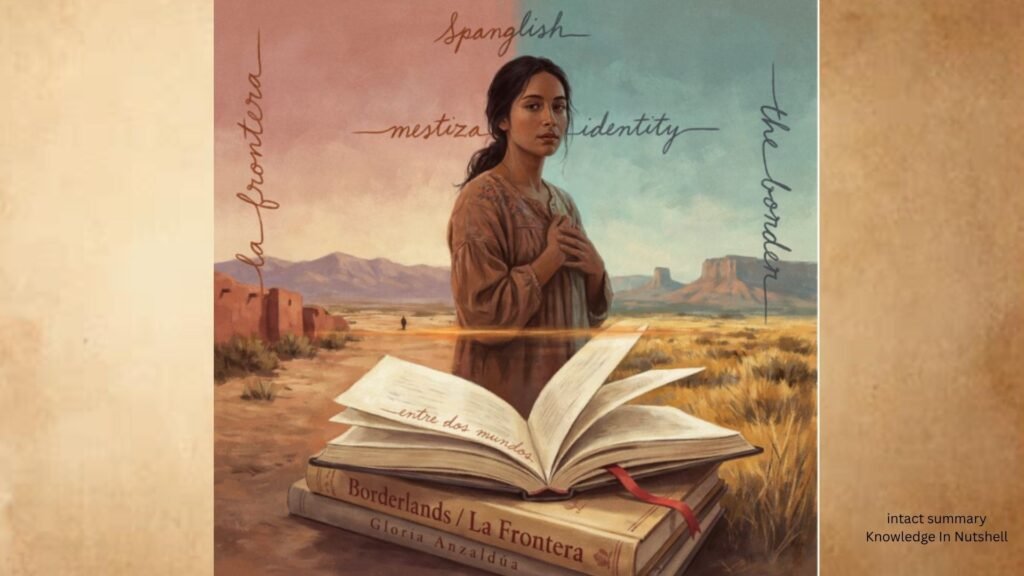
Genre-wise, the piece sits at the intersection of memoir, cultural criticism, and feminist theory. It was written for a mixed audience — Chicano and Chicana readers who share her experience of linguistic shame, and English-only readers who have likely never had to think about language as a battleground. Anzaldúa builds that tension deliberately: she moves between English and untranslated Spanish throughout the essay, so that non-Spanish-speaking readers briefly feel the same disorientation and exclusion that Chicano Spanish speakers feel in English-dominated spaces.
Since its publication, the essay has become one of the most frequently anthologized pieces in Chicana/o studies, women’s studies, and composition courses, largely because it gives language politics a concrete, personal face rather than treating it as an abstract policy debate.
Book Overview and Publication Background
“How to Tame a Wild Tongue” first appeared in 1987 as a chapter in Gloria Anzaldúa’s Borderlands/La Frontera: The New Mestiza, published by Aunt Lute Books. The book as a whole blends personal essay, history, and poetry to explore what Anzaldúa called the “borderlands” — not just the literal U.S.-Mexico border, but any space where cultures, languages, sexualities, and identities overlap and clash.
Borderlands/La Frontera quickly became a foundational text in Chicana feminist theory, queer theory, and border studies. “How to Tame a Wild Tongue” specifically is the essay most frequently excerpted in college readers and anthologies, largely because it distills the book’s central argument — that identity is shaped by language, and that hybrid identities deserve hybrid languages — into a single, teachable piece.

A useful piece of context for readers approaching the essay for the first time: Anzaldúa was writing from the Rio Grande Valley of South Texas, a region with a long history of Tejano (Texan of Mexican descent) settlement predating U.S. annexation. This matters because Anzaldúa is not describing the experience of a recent immigrant learning a new language. She is describing a community that has spoken a mixture of Spanish, English, and Indigenous-influenced dialects for generations, on land its ancestors occupied before the border existed — which is part of why she rejects the idea that her Chicano Spanish is a “broken” or lesser form of either English or Spanish.
About Gloria Anzaldúa
Gloria Evangelina Anzaldúa (1942–2004) was a Chicana lesbian feminist writer and theorist raised in the Rio Grande Valley of South Texas, in a family of farmworkers. She is best known for coediting, with Cherríe Moraga, the landmark anthology This Bridge Called My Back: Writings by Radical Women of Color (1981), and for Borderlands/La Frontera: The New Mestiza (1987), which introduced concepts like “mestiza consciousness” that remain widely taught in feminist and postcolonial theory.
Anzaldúa’s writing consistently blurs the line between personal narrative and theory — she treats her own body, language, and sexuality as legitimate sites of intellectual analysis, which was a deliberate challenge to academic norms that favored detached, “objective” argument. “How to Tame a Wild Tongue” is a clear example of this method: she builds a theoretical claim about language and power almost entirely out of autobiographical scenes.
Historical and Cultural Context: Why This Essay Matters
To understand why Anzaldúa’s essay carries the weight it does, it helps to know the backdrop she’s writing against.
- English-only school policies: In much of the 20th-century American Southwest, schools actively punished Spanish-speaking students for using their native language on campus, treating bilingualism as a deficiency to be corrected rather than an asset.
- The Chicano civil rights movement: The 1960s and ’70s saw a surge of Chicano cultural and political organizing, which included efforts to reclaim Chicano Spanish and Spanglish as legitimate forms of expression rather than “incorrect” language.
- Linguistic prescriptivism: Standardized-language ideology — the idea that there is one “correct” version of English or Spanish — treated regional and hybrid dialects like Tex-Mex as inferior, a framework Anzaldúa directly challenges.
- Gender norms within Chicano culture: Anzaldúa also writes against expectations that Chicanas, specifically, should be quiet and deferential, linking linguistic silencing to gendered silencing.
Anzaldúa wrote “How to Tame a Wild Tongue” into this environment as both a personal testimony and a political intervention — insisting that a language born from cultural collision (Chicano Spanish, Spanglish, Tex-Mex) is not a broken version of something else, but a legitimate language in its own right.
Spoiler-Free Summary
“How to Tame a Wild Tongue” opens with Anzaldúa recalling a dental appointment where her tongue keeps interfering with the procedure, prompting the dentist to comment that he needs to “tame” it. She turns that small, physical moment into the essay’s guiding metaphor: a tongue — and by extension, a way of speaking — that refuses to be disciplined into someone else’s idea of correctness.
From there, without giving away every beat, the essay moves through Anzaldúa’s own history of being punished and shamed for the way she spoke, then broadens into a defense of the many hybrid languages spoken along the Texas-Mexico border. She closes by connecting linguistic pride to a larger sense of cultural belonging, arguing that reclaiming one’s language is inseparable from reclaiming one’s identity. Readers who want the full emotional and argumentative arc intact should stop here and read the original essay before continuing to the detailed breakdown below.
Full Summary (With Spoilers): Section-by-Section Breakdown
Anzaldúa structures the essay as a series of titled sections that build on one another, moving from personal anecdote to cultural analysis to a closing call to action. Here’s how that progression unfolds.
The Dentist and the Wild Tongue. The essay opens with the dental-office scene: Anzaldúa’s tongue won’t stay still, and the dentist frames this as a problem to be fixed. Anzaldúa turns this into a rhetorical question she returns to throughout the piece — essentially, what does it even mean to “tame” something as personal as a tongue? She quickly connects this literal moment to a lifetime of being told, by teachers and even family, to change the way she spoke.
Overcoming the Tradition of Silence. This section shifts to gender. Anzaldúa recounts being raised with the expectation that Chicanas, specifically, should stay quiet, avoid “talking back,” and not gossip — pressures that were not placed on Chicano boys in the same way. She frames this as a second, gendered layer of linguistic control stacked on top of the cultural pressure to abandon Spanish, arguing that finding her voice as a writer was itself an act of defying this expectation of female silence.
Chicano Spanish. Here Anzaldúa gets specific and technical about language itself. She explains that she doesn’t speak one language but several — including formal English, formal Spanish, North Mexican Spanish dialect, Chicano Spanish, Tex-Mex, and Pachuco slang — and that switching between them depends on who she’s speaking with. She pushes back on the idea that Chicano Spanish is simply “incorrect” Spanish, explaining instead that living languages evolve and that a language spoken by millions of people across generations cannot reasonably be dismissed as broken.
Linguistic Terrorism. This is arguably the essay’s most quoted section. Anzaldúa describes the internalized shame many Chicano Spanish speakers feel about their own language — even among each other — and coins the phrase “linguistic terrorism” to describe the way this shame is enforced, both by outside institutions and within the community itself. She connects this shame directly to identity: attacking someone’s language, she argues, is functionally the same as attacking who they are.
“Vistas,” corridos, y comida: My Native Tongue. The tone shifts here to something warmer and more sensory. Anzaldúa describes the music (especially corridos, or narrative folk ballads), films, and food that shaped her sense of belonging to Chicano culture growing up — arguing that cultural identity isn’t purely linguistic, but is reinforced through everyday sensory experience.
Closing Sections: Toward Linguistic Pride. In the essay’s final movement, Anzaldúa ties everything together, arguing that until Chicanos can take pride in Chicano Spanish, Tex-Mex, and Spanglish as legitimate languages, they cannot fully take pride in themselves. She frames writing in her own hybrid voice — mixing English and Spanish without translation — as a direct act of resistance against a lifetime of being told to be quiet or to speak “properly.” The essay ends on a note of defiant self-acceptance rather than resolution: she isn’t asking permission to speak this way anymore.
Structure and Literary Style
Several stylistic choices make this essay distinct from a typical personal essay, and they’re worth understanding on their own:
- Untranslated code-switching. Anzaldúa moves between English and Spanish without providing translations for every phrase, deliberately putting monolingual English readers in an unfamiliar position — a formal choice that mirrors her argument rather than just illustrating it.
- Mixed genre. The essay incorporates memoir, historical explanation, linguistic analysis, and interspersed poetry (including work by other poets), rather than sticking to one consistent mode.
- Titled subsections. Rather than flowing as one continuous narrative, the essay is broken into clearly labeled sections, each tackling a distinct angle on the central argument — a structure that makes it easier to teach and cite in parts.
- First-person authority. Anzaldúa treats her own lived experience as valid evidence for a theoretical argument, a method distinct from more traditionally “objective” academic writing of the period.
Key Figures Referenced in the Essay
Because this is a nonfiction essay rather than a novel, there isn’t a traditional cast of characters — but several real people and figures recur and matter to the argument.
Figure: Gloria Anzaldúa (the narrator)
Role: As both author and subject, Anzaldúa is the essay’s central figure. Her personal transformation — from a child punished for speaking Spanish to an adult who insists on writing in her own mixed language without apology — is the emotional and argumentative throughline of the piece.
Figure: Anzaldúa’s Mother
Role & Significance: Anzaldúa’s mother appears as a figure of painful complexity — she was herself uncomfortable with her daughter’s accented English, illustrating how linguistic shame can be passed down and internalized even within families, not just imposed by outside institutions.
Figure: Teachers and Authority Figures
Role & Significance: Composite figures — Anglo teachers, school administrators, college speech instructors — represent the institutional side of language discrimination. Anzaldúa uses specific memories of being punished or corrected by these figures to ground her larger argument in concrete experience rather than abstraction.
Figure: Other Writers and Poets Anzaldúa Cites
Role & Significance: Anzaldúa weaves in references to other poets and writers throughout the essay, using their work to reinforce her own points and to situate her argument within a broader tradition of writers grappling with language, silence, and identity.
Key Themes Explained
Language and Identity
The essay’s central theme, stated most directly, is that language and identity cannot be separated. Anzaldúa argues that ethnic identity functions as “twin skin” to linguistic identity — meaning an attack on someone’s language is experienced as an attack on their selfhood, not just their communication style. This theme plays out across nearly every anecdote in the essay: the dentist trying to still her tongue, teachers punishing her for speaking Spanish, and her own mother’s discomfort with her accent are all framed as attempts to control who Anzaldúa is, disguised as attempts to control how she talks. For readers, this theme matters because it reframes accent discrimination and “correct” language policing as identity-level harm rather than a neutral communication issue.
Linguistic Terrorism and Internalized Shame
Anzaldúa’s term “linguistic terrorism” describes the way shame about one’s own language gets enforced — not just by outside institutions like schools, but by other Chicano and Chicana speakers policing each other’s Spanish for not being “authentic” enough. This theme is significant because it shows discrimination as a layered phenomenon: it isn’t only imposed from outside a community, but can be internalized and passed between members of the same community, making it harder to recognize and resist.
Language as Cultural Resistance
Throughout the essay, Anzaldúa frames the act of speaking and writing in Chicano Spanish, Tex-Mex, and Spanglish — without translating for outsiders — as a deliberate act of resistance. Rather than treating hybrid language as a compromise or a deficiency, she positions it as a legitimate language in its own right, and choosing to use it publicly as a refusal to assimilate. This theme connects directly to why the essay itself is written the way it is: the code-switching isn’t just described, it’s performed on the page.
Silence, Gender, and Patriarchal Control
In “Overcoming the Tradition of Silence,” Anzaldúa argues that Chicanas face a gendered layer of linguistic control that Chicano men do not: girls are raised to be quiet, deferential, and non-confrontational, while boys face no equivalent pressure. This theme matters because it complicates a purely ethnic or racial reading of the essay — Anzaldúa insists that patriarchal norms within Chicano culture itself contributed to her silencing, alongside pressure from the dominant white culture outside it.
Hybrid or “Mestiza” Identity
Anzaldúa rejects the idea that identity must be singular or “pure.” She describes speaking multiple dialects depending on context and treats this multiplicity as a strength rather than a confusion to be resolved. This theme foreshadows the “mestiza consciousness” she develops more fully elsewhere in Borderlands/La Frontera — the idea that living between cultures and languages can produce a richer, more flexible form of identity than belonging fully to just one.
Symbolism and Literary Devices
The Wild Tongue. The essay’s central symbol is the tongue itself — both the literal muscle the dentist tries to still and the figurative capacity for speech that authority figures throughout Anzaldúa’s life try to discipline. By the end of the essay, “wild” shifts from something the dentist frames as a problem into something Anzaldúa embraces as a form of integrity: a tongue that cannot be tamed without being destroyed.
The “Orphan Tongue.” Anzaldúa uses this phrase to describe Chicano Spanish — a language that belongs fully to neither official Spanish nor official English, and is treated by speakers of both as illegitimate. The symbolism works on two levels: it names the linguistic in-between status of Chicano Spanish, and it echoes the broader theme of Chicano identity existing in a borderland between two nations and cultures.
Corridos and Sensory Memory. In the “Vistas,” corridos, y comida section, Anzaldúa uses music, food, and film as symbols of cultural belonging that operate below the level of formal language. This device broadens her argument: identity isn’t sustained by grammar alone, but by an entire sensory and cultural environment.
Code-Switching as Form, Not Just Content. Perhaps the essay’s most distinctive device is that Anzaldúa doesn’t just write about code-switching — she does it, moving between English and untranslated Spanish throughout the piece. This formal choice functions as an argument in itself: readers who don’t speak Spanish briefly experience a small version of the exclusion Chicano Spanish speakers feel in English-only spaces.
Language and Identity Terms Explained
Because this essay is dense with specific terminology, a few key terms are worth defining plainly:
- Chicano Spanish: A distinct dialect that blends Spanish, English, and regional variations developed by Mexican Americans in the U.S. Southwest — not a “broken” version of standard Spanish, but its own linguistic system.
- Spanglish / Tex-Mex: Hybrid forms of speech that mix English and Spanish vocabulary and grammar, often used interchangeably depending on region; Anzaldúa treats these as legitimate, living languages rather than signs of incomplete bilingualism.
- Code-switching: The practice of shifting between languages or dialects depending on audience or context — something Anzaldúa describes doing fluidly among as many as eight variations of English and Spanish.
- Linguistic terrorism: Anzaldúa’s term for the psychological and social pressure that makes speakers ashamed of their own native or hybrid language, whether that pressure comes from outside institutions or from within one’s own community.
- Mestiza consciousness: A concept developed more fully elsewhere in Borderlands/La Frontera, referring to an identity that draws on multiple, sometimes contradictory cultural and linguistic influences rather than resolving into one fixed identity.
Common Misconceptions or Misreadings
Misconception: The essay is primarily about learning English as a second language. This is a common misreading, especially among readers unfamiliar with the Chicano/Tejano history of South Texas. Anzaldúa is not describing an immigrant’s journey to acquire English; she’s writing from a community with generations of history in the region, defending a language (Chicano Spanish/Tex-Mex) that already exists as its own dialect, not a stepping stone toward “real” English or “real” Spanish.
Misconception: Anzaldúa is arguing that everyone should reject English. The essay doesn’t call for abandoning English — Anzaldúa herself writes primarily in English, code-switching into Spanish. Her argument is about legitimacy and choice: she wants the freedom to move between languages without shame or forced translation, not the elimination of any one language.

intact summary
Knowledge In Nutshell
Misconception: “Linguistic terrorism” refers only to institutional discrimination. Readers sometimes assume this term applies only to schools or government policy. Anzaldúa is explicit that this shame is also enforced peer-to-peer, within Chicano communities themselves, which is part of what makes the concept distinct from a simpler discussion of discrimination by outside authorities.
Misconception: The essay is purely personal memoir with no argumentative structure. While it’s built from autobiographical scenes, the essay follows a clear rhetorical arc — from personal anecdote, to gendered critique, to linguistic analysis, to a call for pride and resistance. Treating it as loosely connected storytelling misses how deliberately it’s constructed to build a cumulative argument.
Why “How to Tame a Wild Tongue” Still Matters Today
Anzaldúa’s essay continues to be assigned because the underlying dynamics it describes — accent discrimination, English-only policy debates, and the tension between assimilation and cultural pride — remain active discussions in the U.S. today. Its influence extends well beyond Chicano studies: the essay is frequently cited in linguistics courses on language prejudice, in composition classes for its rhetorical structure, and in gender studies for its treatment of silence as a tool of patriarchal control. Its core claim — that language is identity, not just communication — has become a foundational reference point across multiple academic disciplines.
Frequently Asked Questions
What is “How to Tame a Wild Tongue” about?
It’s an autobiographical essay by Gloria Anzaldúa arguing that language and identity are inseparable, using her own experiences of being punished for speaking Spanish to make the case that linguistic discrimination is a form of identity-based harm.
Who wrote “How to Tame a Wild Tongue”?
Gloria Anzaldúa, a Chicana feminist writer and theorist, wrote the essay. It was published as a chapter in her 1987 book Borderlands/La Frontera: The New Mestiza.
What book is “How to Tame a Wild Tongue” from?
It’s a chapter within Borderlands/La Frontera: The New Mestiza, published by Aunt Lute Books in 1987.
What does “linguistic terrorism” mean in the essay?
It’s Anzaldúa’s term for the shame speakers of Chicano Spanish, Tex-Mex, and other hybrid dialects internalize about their own language — shame enforced both by outside institutions and by other members of their own community.
What is Chicano Spanish?
Chicano Spanish is a distinct dialect blending Spanish, English, and regional variations developed by Mexican Americans in the U.S. Southwest. Anzaldúa treats it as a legitimate language rather than an incorrect or incomplete version of standard Spanish.
Why does Anzaldúa write in both English and Spanish without translating?
The untranslated code-switching is a deliberate rhetorical choice: it puts monolingual English readers in an unfamiliar position, mirroring the exclusion Chicano Spanish speakers often feel in English-only environments, while also affirming that her hybrid language doesn’t need to be justified or translated to be legitimate.
What is the main theme of “How to Tame a Wild Tongue”?
The central theme is that language and identity are inseparable — attacking or shaming someone’s native or hybrid language is, in Anzaldúa’s argument, equivalent to attacking their sense of self.
Is “How to Tame a Wild Tongue” a memoir or an academic essay?
It’s a hybrid of both. Anzaldúa builds a theoretical argument about language and power almost entirely out of personal, autobiographical anecdotes, blending memoir with cultural and linguistic analysis.
What role does gender play in the essay?
In the section “Overcoming the Tradition of Silence,” Anzaldúa argues that Chicanas face a gendered expectation to stay quiet and deferential that Chicano men do not face in the same way, framing silence as a tool of patriarchal control layered on top of ethnic language discrimination.
What does the “wild tongue” symbolize?
It symbolizes Anzaldúa’s refusal to have her speech disciplined into a single, “correct” standard. It starts as a literal image (her tongue during a dental procedure) and becomes a metaphor for linguistic and personal integrity.
Is “How to Tame a Wild Tongue” worth reading?
For readers interested in language politics, bilingual identity, or Chicana feminist theory, it’s considered a foundational and highly influential essay — widely taught precisely because it grounds abstract arguments about language and power in vivid personal experience.
How long is “How to Tame a Wild Tongue”?
It’s a chapter-length essay, roughly a dozen pages in most print editions of Borderlands/La Frontera, making it a common standalone reading assignment even outside the full book.
Does the essay have a clear conclusion or resolution?
The essay ends on a note of defiant self-acceptance rather than a tidy resolution — Anzaldúa asserts her right to speak in her own hybrid voice without further justification, rather than resolving the tension between assimilation and resistance.
Conclusion
In conclusion, “How to Tame a Wild Tongue” is more than an essay about language; it is a deeply personal call to reclaim the parts of ourselves that others have taught us to hide. Gloria Anzaldúa reveals the pain of being silenced, corrected, and made to feel ashamed of the way one speaks. Yet, instead of allowing that shame to define her, she transforms her voice into a source of strength and resistance.
Her story reminds us that language carries memories, culture, family, and identity. To reject someone’s language is often to reject a part of who they are. Anzaldúa’s refusal to silence her “wild tongue” becomes a powerful symbol of courage and self-acceptance. Even today, her message speaks to anyone who has ever felt pressured to change in order to belong. Ultimately, the essay teaches us that our voices—no matter how different—deserve to be heard, respected, and celebrated.