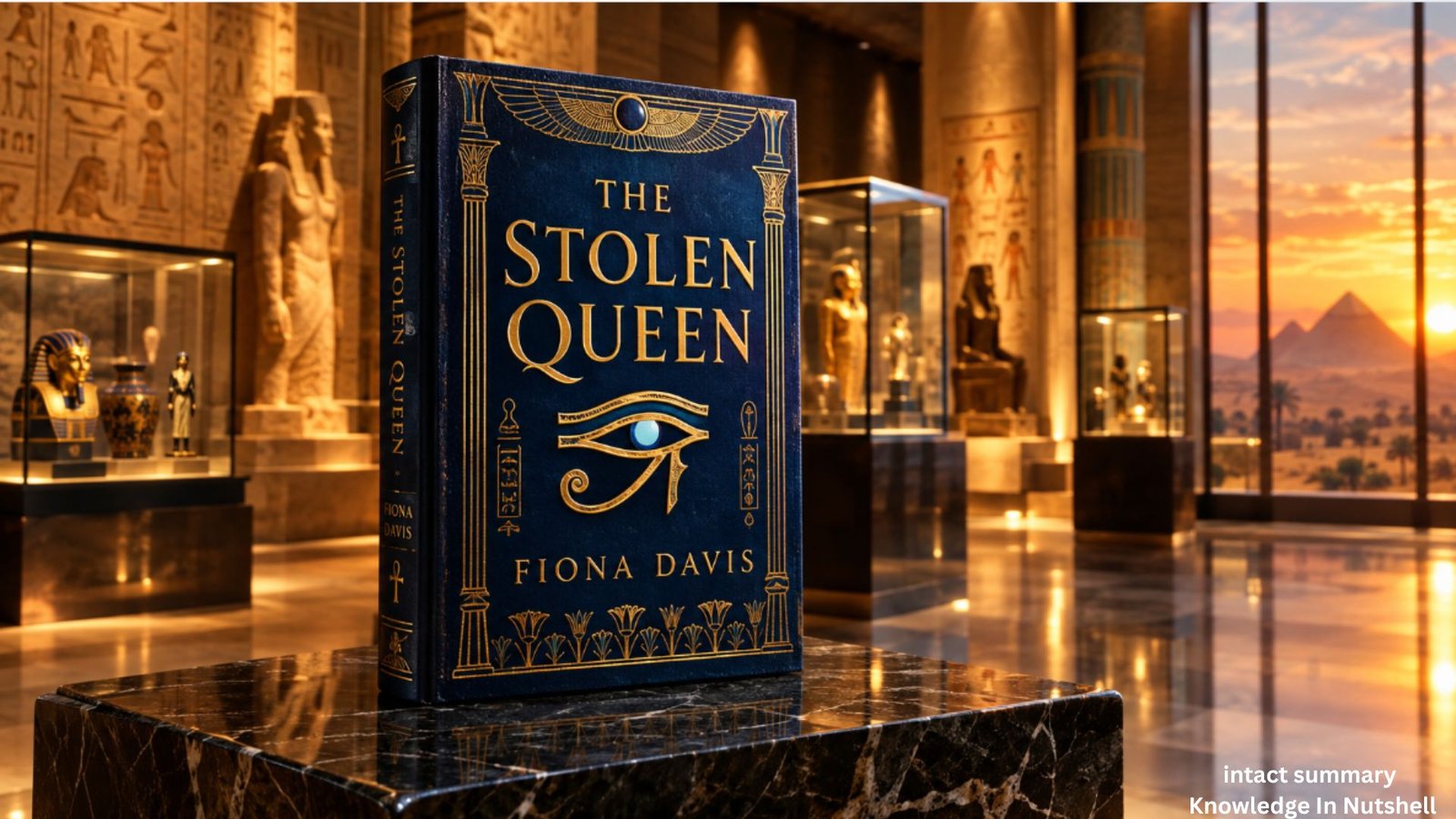
Maybe you spotted this book on a New York Times bestseller list. Maybe your book club picked it for next month. Or maybe you read it a while ago and now need a quick reminder of the plot and the ending. Whatever brought you here, the story has a lot going on. It jumps between two time periods, follows two women, and mixes a museum theft with an old curse and some deep family secrets. It is easy to feel a little lost, and it is fair to ask if the book is worth your time.
That is exactly why we wrote this guide. Here is the short answer. The Stolen Queen is a historical mystery from Dutton, published in January 2025. It follows Charlotte Cross, an expert in Egyptian art at the Metropolitan Museum of Art, and Annie Jenkins, a young woman working for fashion legend Diana Vreeland. When a priceless statue disappears on the night of the 1978 Met Gala, the two women team up to find it. Their search takes them all the way to Egypt, where Charlotte must face the painful secrets of her 1936 past. Most readers call the book exciting, easy to follow, and full of heart. A few readers feel some parts are a bit too convenient, and we will talk about that honestly too.
In this article, you will find a spoiler-free summary, a full plot summary with the ending explained (clearly marked with a spoiler warning), a close look at the characters, the book’s biggest themes, the debate over Egyptian artifact repatriation, and an honest review. You will also get book club discussion questions, book suggestions for what to read next, and a long FAQ.
Everything is written in plain, simple words, so anyone can follow along. We checked the facts against the publisher’s description, the author’s own website, and trusted reviews, so you get real details and not guesses. If you want zero spoilers, just stop before the section with the spoiler warning.
Quick Answer of The Stolen Queen
The Stolen Queen (2025) by Fiona Davis is a dual-timeline historical mystery about two women searching for a stolen Egyptian statue. In 1978 New York, museum curator Charlotte Cross and young assistant Annie Jenkins hunt for the missing Cerulean Queen after the Met Gala. Their search leads to Egypt, where Charlotte must face a tragedy from 1936. It is a great pick for fans of historical fiction, museum mysteries, and strong female leads.
What Is The Stolen Queen About?
The Stolen Queen is about a stolen statue, a hidden past, and two women who end up needing each other.
The story moves between two years. In 1936, a young anthropology student named Charlotte Cross wins a spot on an archaeological dig in Egypt’s Valley of the Kings. She is thrilled. But a terrible tragedy soon changes her life forever, and she swears she will never go back.
Now jump ahead to 1978 in New York City. Charlotte is the associate curator in the Met’s Department of Egyptian Art. She has a quiet life and one big passion: proving that Hathorkare, a rare female pharaoh, has been misjudged. Most Egyptologists think the queen does not matter much. Charlotte disagrees.
Also Read:/the-relationship-cure-summary/
At the same time, nineteen-year-old Annie Jenkins lands a job working for Diana Vreeland, who is planning the Met Gala, often called the party of the year. Annie is eager to prove herself, but the work is stressful and Vreeland expects a lot.
Then the big night arrives. One of the museum’s most valuable Egyptian treasures goes missing, and people whisper that Hathorkare’s old curse may be waking up. Annie and Charlotte join forces to find it. A hunch sends them to the one place Charlotte promised never to see again.
That is where the spoiler-free part ends. If you want to know who took the statue and why, the full summary later in this guide explains everything.
Is The Stolen Queen a Mystery or Historical Fiction?
It is both. The Stolen Queen is historical fiction because it uses real places, real people, and real history from the 1930s and 1970s. It is a mystery because the story is built around a theft, a trail of clues, and secrets that slowly come out.
Think of it as three stories in one:
- A historical novel. The Met, the Met Gala, Diana Vreeland, and the Valley of the Kings are real. Davis mixes them with invented characters.
- A museum mystery with a heist feel. A priceless missing artifact vanishes, and two very different partners play detective. One reviewer notes that the publisher pitches it like an old-style whodunit and a heist tale.
- A family drama. Under all the clues is a story about loss, grief, and family ties.
Is it a thriller? Not in the dark, scary sense. It is closer to a fast-paced historical mystery with adventure. The ancient Egyptian curse adds a spooky mood, but the plot depends on real-world clues and human choices.
Fiona Davis fans will notice her usual style: a famous New York landmark at the center. Her earlier novels used places like the New York Public Library and Grand Central Terminal. This time it is the Met, plus a big trip to Egypt.
How Readers and Critics Received The Stolen Queen
The book was a hit. According to the author’s website, it is an Instant New York Times bestseller and a USA Today bestseller. It was also a Goodreads Choice Awards 2025 finalist, a January LibraryReads Hall of Fame pick, a People magazine best book of January, and a Book of the Month add-on. It was a Book Club with Mary Calvi pick as well.
Critics liked it too. Publishers Weekly praised the careful research and said the book adds useful insight to the debate about whether artifacts should stay in their home countries. Booklist pointed to its themes of repatriation, personal loss, and women’s resilience. Bookreporter called it an excellent first read of 2025 and a sure-to-please book club choice.
Reader reviews are mostly warm. One book blogger gave it 4 out of 5 stars. She loved the Egypt scenes and the several mysteries, but she was less excited about the Met Gala parts and Charlotte’s belief in the curse. Another reviewer, from Book Club Chat, highly recommends it. She praised its heart, its history, and its thoughtful questions about art and ownership.
So the pattern is clear. Readers praise the vivid settings, the two strong women, and the smart look at museum ethics. The most common complaint is that a few story events feel a little too lucky. We cover both sides in our full review later.
Real History or Pure Fiction? What to Know Before You Read
The short answer: it is a mix of both.
What is real:
- The Metropolitan Museum of Art and the Met Gala
- Diana Vreeland, the famous fashion editor
- Egypt’s Valley of the Kings
- The 1978 setting, including the museum’s new Temple of Dendur and the excitement around a King Tutankhamun exhibit
What is invented:
- Charlotte Cross and Annie Jenkins
- The female pharaoh Hathorkare
- The Cerulean Queen statue
In her Author’s Note, Davis explains that Hathorkare was inspired by Hatshepsut, a real female pharaoh of ancient Egypt. She bent the story a little so it would fit Charlotte’s. So you will not find Hathorkare in a history book. Still, the facts around her, like the history of Egyptology, artifact theft, and the fight over who owns ancient objects, come from real research.
A few quick tips before you start:
- You do not need to know anything about Egypt. The book explains what you need.
- Expect three storylines. Charlotte in 1936, Charlotte in 1978, and Annie in 1978.
- Check the content notes. The book deals with grief, death, and unfair treatment of women at work. We explain more in the spoiler section.
- Take your time. The dual timeline is easier when you read a few chapters at once.
The Stolen Queen Plot Summary
Spoiler-Free Summary of The Stolen Queen
In 1936, a young student named Charlotte Cross joins an archaeological dig in Egypt’s Valley of the Kings. A terrible tragedy leaves her with a promise never to return. In 1978, Charlotte works as a curator of Egyptian art at the Metropolitan Museum of Art. Nineteen-year-old Annie Jenkins helps plan the Met Gala. On gala night, a priceless statue called the Cerulean Queen is stolen. The two women team up and follow the clues to Egypt, where Charlotte must face the past she tried to bury.
Full Summary (With Spoilers) of The Stolen Queen
Egypt, 1936–1937. Charlotte uncovers a new tomb that may belong to the female pharaoh Hathorkare. Inside is a mummy that could be the queen, plus a gold collar necklace. On the dig, she falls in love with Henry Smith, a young British archaeologist. When Charlotte becomes pregnant, the two marry and stay in Egypt, even though her parents disapprove. Their daughter, Layla, is born in 1937.
A few months later, Henry suddenly says they must leave. Charlotte thinks it is because of rising tension before World War II. Then, on a boat from Luxor to Cairo, she sees that Henry has secretly packed the gold collar. The Egyptian Museum had claimed that treasure as national property. A terrible storm flips the boat. Charlotte survives, but Henry and Layla are never found. Everyone thinks they are dead.

New York, 1978. Charlotte builds a career as a curator in the Met’s Egyptian department. She now lives with her partner, Mark. She is also working on a research paper that could change Egyptology. Her evidence says Hathorkare was a respected ruler. Later kings erased her name so that the next king’s son, not a woman, would inherit the throne.
Then the gold collar suddenly appears at the Met. An anonymous donor has loaned it to the museum. Charlotte becomes obsessed with finding the owner, since that person might know what happened to Henry and Layla. Meanwhile, she meets Annie, who has joined the Met Gala team.
On gala night, thieves steal the folder holding all of Charlotte’s Hathorkare research. She also spots a man stealing the Cerulean Queen. She and Annie chase him, but he escapes. Charlotte flies to Egypt to question Leon Pitcairn, an archaeologist from her old team who also survived the shipwreck. Annie insists on coming.
In Egypt, they find proof that Henry is alive. They also return to the tomb and confirm that the mummy is Hathorkare. Then they find the stolen statue in an antiquities shop owned by an Egyptian woman named Heba. A framed photo there shows Heba’s daughter, and Annie recognizes her as Mona, who works at the Met.
Back in New York, they confront Mona. She confesses. Mona is the daughter of Heba and Henry, who had been living under a different name. She found the gold collar as a child and grew up believing Egyptian treasures belong in Egypt. She stole the necklace from her father and later got a job at the Met to get close to the collection. She donated the collar, and then used a distraction and helpers to steal the Cerulean Queen and Charlotte’s research. Mona and Heba are arrested. Before that, Mona says she knows where Layla is.
Henry comes to New York and explains that he and Leon took the collar. After the shipwreck, he thought Charlotte and Layla had died, so he built a new life with Heba. Annie then realizes Layla now goes by Fatima and works at a hotel in Cairo, where they met her earlier. Layla agrees to meet. An Egyptian couple had adopted her after the wreck. She later pieced together who her birth parents were, but waited too long to reach out. The family is happy to reunite. Charlotte gets her research back, proves her theory, quits her job, and moves to Egypt to work full-time.
The Stolen Queen Dual Timeline Explained
The Stolen Queen uses a dual-timeline structure. That means the story jumps between two time periods. Here, it is really three storylines:
- Charlotte in 1936–1937 (Egypt)
- Charlotte in 1978 (New York, then Egypt)
- Annie in 1978 (New York, then Egypt)
How do they connect? Through objects and secrets. The gold collar from Hathorkare’s tomb links the two Charlotte timelines. The Cerulean Queen and Hathorkare link Charlotte’s research to Annie’s story. Annie links the two women in 1978. Each time the story jumps, a clue from the past helps explain the present.
Why does this work? The 1936 chapters show readers who Charlotte used to be. Without them, her calm, guarded 1978 self would not make sense. The 1978 chapters then show how that past still shapes her. As one reviewer noted, the old tragedy is never talked about, but it is never forgotten either.
Historical Setting: 1930s Egypt and 1978 New York
1936 Egypt. The dig in the Valley of the Kings shows what 1930s Egyptian archaeology looked like. Foreign teams ran many digs, and women in the field often struggled to get credit. In the book, Charlotte has to defend her work while men try to claim it. This is also why Women in archaeology is such a big theme. The Egyptian Museum’s claim on the gold collar also shows that people already argued about who owned Egyptian antiquities back then.
1978 New York. The Met is the star here. The setting includes the new Temple of Dendur, which the museum had just opened, and excitement about the King Tutankhamun exhibit. Then comes the Met Gala, where Diana Vreeland rules with high standards and big demands. Fashion and ancient Egypt may seem odd together, but the book uses glamour as a bright contrast to the dusty digs of the past.
The Stolen Queen Ending Explained
Mona planned the theft, with help from accomplices and her mother, Heba. Heba hid the statue in her antiquities shop in Egypt.
Henry survived the shipwreck and later built a new life under a different name. Layla also survived and was raised by an Egyptian family as Fatima. The book ends with them finding each other.

The book treats the curse as legend and mood. The theft and the lost-family mystery are both explained by real people and real choices. Charlotte’s fear of the curse says more about her grief than about magic.
Charlotte finally gets to prove her theory about Hathorkare. She leaves the Met to continue her research in Egypt, close to the daughter she thought she had lost. Annie, who began the story unsure of herself, ends it with more confidence and a part in solving the mystery.
The Stolen Queen Characters and Their Arcs
The book has a small group of key players. Here are the ones that matter most. Spoilers are marked.
Charlotte Cross
Role & Arc: Charlotte is the heart of the story. In 1936, she is a bright young anthropology student who gets a rare spot on a dig in the Valley of the Kings. She is brave and smart, and she has to defend her work when men try to take credit. By 1978, she is around sixty, a respected associate curator at the Met, and very guarded. She keeps her feelings locked away and puts her energy into her Hathorkare research.
Her arc is about facing the past. She spends decades avoiding Egypt and the memories there. The theft forces her to go back. By the end, she stops running. She gives up her museum job and moves to Egypt to study the queen she believed in. (Spoiler: she also reunites with her daughter, Layla.)
Annie Jenkins
Role & Arc: Annie is nineteen and full of hope. She works hard to support herself, and her mother is not much help. She dreams of a career in fashion, so working for Diana Vreeland feels like a golden ticket. But she is new, and every mistake feels huge.
Her arc is about finding confidence. At first, she is mostly trying to survive each day. Later, she stands up for herself, takes a big risk by traveling to Egypt, and becomes a real partner in the investigation. Annie also brings humor and fresh eyes. She notices things Charlotte, who is stuck in her old habits, might miss. (Spoiler: it is Annie who recognizes Mona from a photo and later figures out who Layla is now.)
Hathorkare
Role & Arc: Hathorkare is the female pharaoh at the center of Charlotte’s research. She is fictional, inspired by the real pharaoh Hatshepsut. She never appears as a living character, but she drives the whole plot. Most experts in the book think she was unimportant or even hated. Charlotte believes she was a strong, fair ruler whose memory was erased on purpose. (Spoiler: Charlotte proves she is right.)
Henry Smith
Role & Arc: Henry is the young British archaeologist Charlotte falls in love with in 1936. He seems kind and loving, but he hides a big secret about the gold collar. (Spoiler: after the shipwreck, he thinks his wife and daughter are dead and builds a new life under another name.) He is not a simple villain. He made a terrible choice, and the book lets readers wrestle with how to feel about him.
Mona
Role & Arc: Mona works at the Met and seems like a helpful coworker. (Spoiler: she is the thief.) She believes Egyptian treasures belong in Egypt, and she plans the theft to prove it. She is the book’s most complicated character. Her goal is understandable to many readers, but she hurts people to reach it, including Charlotte.
Diana Vreeland
Role & Arc: Diana Vreeland was a real fashion editor. In the book, she is demanding, dramatic, and hard to please. She is more of a supporting character than a main one. Her job in the story is to bring Annie to the Met and to make the Met Gala feel glamorous and high-pressure.

Other Helpful Characters in The Stolen Queen
- Mark Schrader: Charlotte’s steady partner in 1978. He shows that her life is comfortable, but she keeps a part of herself closed off.
- Layla / Fatima: Charlotte’s daughter. (Spoiler: she survived the shipwreck and grew up as Fatima.)
- Leon Pitcairn: A fellow archaeologist from Charlotte’s old team who survived the wreck and holds a piece of the truth.
- Heba: Mona’s mother, who helps hide the stolen statue.
The Stolen Queen Themes Explained
Women and Power in History in The Stolen Queen
This is the biggest theme. Charlotte fights to prove that Hathorkare was a strong, smart ruler, and that history ignored her because she was a woman. At the same time, Charlotte faces gender bias in archaeology herself. She is doubted, ignored, and sometimes robbed of credit. The book links the two women across thousands of years. Both are overlooked by history and both have to fight to be seen.
Read More:/the-queen-of-nothing-summary-plot-and-honest-review-2026/
Women’s Ambition and Pushback in The Stolen Queen
Annie and Charlotte both want more from life. The book shows how others react to that. People brush them off or try to control them. This theme matters because it feels true today, not just in the past.
Grief, Loss, and Resilience in The Stolen Queen
Charlotte’s life is shaped by a huge loss. The book shows how grief can make a person shut down, and how slowly a person can open up again. It also shows women’s resilience across generations. Charlotte keeps going, builds a career, and finally gets a second chance.
Mothers and Daughters in The Stolen Queen
Family ties run through the whole story. Charlotte has a bond with the daughter she lost. Annie has a hard relationship with her own mother. The book shows that love between mothers and daughters can be strong and messy at the same time.
Lost and Found Family in The Stolen Queen
The story keeps asking: who counts as family? It looks at hidden identities, secret second lives, and people who find each other again after many years. Annie and Charlotte also become a kind of found family themselves, as friends who learn from each other.
Identity and Belonging in The Stolen Queen
Many characters are not who they first seem. Henry lives under another name. Layla grows up as Fatima. Mona is torn between two worlds. The book asks what makes a person who they are: their birth, their home, or their choices.
Art Repatriation in The Stolen Queen
This is the part of the book that makes it stand out from other historical fiction.
What does repatriation mean?
Repatriation means sending a cultural object back to the place or people it came from. In the book, the debate is about Egyptian antiquities that sit in American museums.
How the book shows both sides
The book does not pick a side. It lets different characters make their cases:
- Why some say treasures should go home: Many objects left Egypt during old colonial-era excavations, when foreign teams often took what they found. People like Mona feel those objects are part of Egypt’s cultural heritage and national identity. The Egyptian Museum’s claim on the gold collar shows that this argument was already alive in the 1930s.
- Why some say museums should keep them: A big museum like the Met can protect objects, study them, and show them to millions of visitors. Not everyone can travel to Egypt, so a museum lets more people see these treasures. Reviewers also note that wealthy private owners may keep objects hidden away, which helps no one.
- The middle ground: One reviewer notes that the book shows the topic is truly complicated. A third idea is that who holds an object matters less than whether it is safe, studied, and shared.

Why this matters in real life
The debate about Western museums and Egyptian antiquities is real and ongoing. The book gives readers an easy way into it. You do not need any background. You just follow Charlotte and Mona and decide what you think. That is also why the book works so well for book club discussions.
Symbolism and Motifs in The Stolen Queen
These are our readings, not official ones. Good books let you see more than one meaning.
- The Cerulean Queen statue: It stands for forgotten women and for the fight over who owns the past. When it is stolen, the book asks who gets to hold a nation’s history.
- The gold collar necklace: It links Charlotte’s two timelines. It is a beautiful object, but it brings pain. It shows how a treasure can carry both history and heartbreak.
- The curse: The curse shows how fear and grief can shape belief. Charlotte reads her tragedies as part of it, but the book keeps clear that people, not magic, drive the plot.
- Hathorkare’s erased memory: It reflects how history can hide women’s stories on purpose, and how much digging it takes to bring them back.
- The Met Gala: The glittering party covers up secrets. It contrasts the polished surface of the museum with the messy truth beneath.
- Egypt vs. New York: Egypt stands for the past Charlotte cannot escape. New York stands for the life she built to hide from it.
The Stolen Queen FAQ
1. What is The Stolen Queen about?
It follows curator Charlotte Cross and young assistant Annie Jenkins as they search for a stolen Egyptian statue after the 1978 Met Gala. The hunt leads them to Egypt and to Charlotte’s painful past.
2. Who wrote The Stolen Queen?
Fiona Davis, a New York Times bestselling author known for historical novels set around New York landmarks.
3. When was it published, and how long is it?
Dutton published it on January 7, 2025. It runs about 352 pages.
4. Is The Stolen Queen based on a true story?
Not directly. The Metropolitan Museum, the Met Gala, and Diana Vreeland are real, but the main characters and the plot are invented.
5. Is Hathorkare a real pharaoh?
No. She is fictional and was inspired by the real pharaoh Hatshepsut.
6. What is the Cerulean Queen?
It is a valuable Egyptian statue at the Met that gets stolen on gala night. The necklace in the story is a different object.
7. Who stole the Cerulean Queen? (Spoiler)
Mona, a Met employee, planned the theft with help from others. She wanted to send the statue back to Egypt.
8. How does The Stolen Queen end? (Spoiler)
Charlotte proves her theory about Hathorkare, reunites with her daughter Layla (now called Fatima) and with Henry, and moves to Egypt to continue her research.
9. What is the main theme?
Women and power in history, tied closely to grief and resilience, family, and art repatriation.
10. Is The Stolen Queen a mystery or historical fiction?
Both. It is a historical mystery with adventure and family drama.
11. Is it a standalone book?
Yes. You can read it without any other Fiona Davis book.
12. Does it have a romance?
Yes, but it is a supporting part of the story. Charlotte falls in love with Henry in 1936, and the focus stays on the mystery and on family.
13. Is it good for book clubs?
Very. The repatriation debate, the strong characters, and the family twists give groups plenty to discuss.
14. Is the book appropriate for teens?
It is written for adults. It deals with grief, death, and sexism at work, so parents may want to read it first.
About The Stolen Queen: Our Research and Review Process
We wrote this guide to help readers get clear, honest, and useful information about The Stolen Queen.
- Research: We cross-checked the publisher’s description, the author’s official website, a study-guide summary, and several trusted reviews, including Publishers Weekly, Booklist, Bookreporter, and independent book bloggers.
- Writing: Everything is written in our own words. We did not copy competitor articles or reuse text from the book.
- Accuracy review: We compared plot details across more than one source and marked all major spoilers. If a source disagreed, we used the more careful wording.
- Limits: This is not an official study guide. Our star rating and symbolism notes are opinions, and we label them that way.
Final Thoughts: Is The Stolen Queen Worth Reading?
The Stolen Queen by Fiona Davis is a smart, warm, and exciting historical mystery. It takes you from the glitter of the 1978 Met Gala to the hot sands of Egypt’s Valley of the Kings, and it keeps you guessing the whole way.
The heart of the book is Charlotte Cross and Annie Jenkins. One has spent decades hiding from her past. The other is just starting to find her place in the world. Together, they chase a stolen statue, uncover family secrets, and learn that it is never too late for a second chance.
The book also gives you something big to think about. Should museums return ancient artifacts to the countries they came from? Davis does not hand you an easy answer. She shows several sides and lets you decide for yourself, which makes this a great pick for a book club.
It is not perfect. A few moments feel a little too lucky, and some readers may care less about the fashion scenes. Still, the strong characters, vivid settings, and big heart make up for it.
Our verdict: if you enjoy historical fiction, museum mysteries, and strong female leads, this book is well worth your time. If you are still deciding, start with the spoiler-free summary in this guide. Once you finish the novel, come back to the ending explained section to compare your thoughts. Then share it with a friend, or bring it to your next book club meeting.