If you just finished Go as a River by Shelley Read, or you’re trying to decide whether it’s worth your time, you probably have a few questions. Maybe you want a clear Go as a River summary without wading through spoilers. Maybe you’re in a book club and need discussion material. Or maybe you loved Where the Crawdads Sing and someone told you this book gives you the same feeling.
Whatever brought you here, this guide covers everything: the plot summary, the main characters, the biggest themes, the symbolism, and the true history hiding behind the story. This is a historical fiction and coming-of-age novel that takes place in rural Colorado in the 1940s, and it’s built around real events that most American readers have never heard of, the flooding of a small town called Iola, Colorado.
Read More:/captivated-by-you-summary/
Below, you’ll find a spoiler-free overview first, so you can decide if the book is for you, followed by a full spoiler section for readers who already finished it or don’t mind knowing the ending ahead of time. We’ll also walk through Victoria Nash and Wilson Moon, explain what the river symbolism really means, and answer the most common questions readers search for, including how the book ends.
Quick Answer
Go as a River is a literary historical fiction novel by Shelley Read, published in 2023. It follows Victoria “Torie” Nash, a seventeen-year-old girl running her family’s peach farm in the small town of Iola, Colorado, in the late 1940s. After a life-changing romance with Wilson Moon, a young man of Indigenous heritage, tragedy forces Victoria into the wilderness alone, where she must rebuild her life. The story is loosely inspired by the real flooding of Iola to create the Blue Mesa Reservoir.
Book Overview and Background of Go as a River
Go as a River is Shelley Read’s debut novel, and it blends several genres at once: historical fiction, literary fiction, a coming-of-age novel, and women’s fiction. It’s set mostly in the 1940s, in a fictionalized but historically grounded version of Iola, Colorado, a real ranch town on the Western Slope of Colorado.
The book matters because it’s rooted in true events. Shelley Read is a fifth generation Coloradoan who grew up hearing about the real town of Iola, which was permanently submerged in the early 1960s when the government built a dam and created the Blue Mesa Reservoir as part of the Colorado River Storage Project. That real disappearance of an entire town gives the novel its emotional backbone, even though Victoria Nash and her family are fictional.
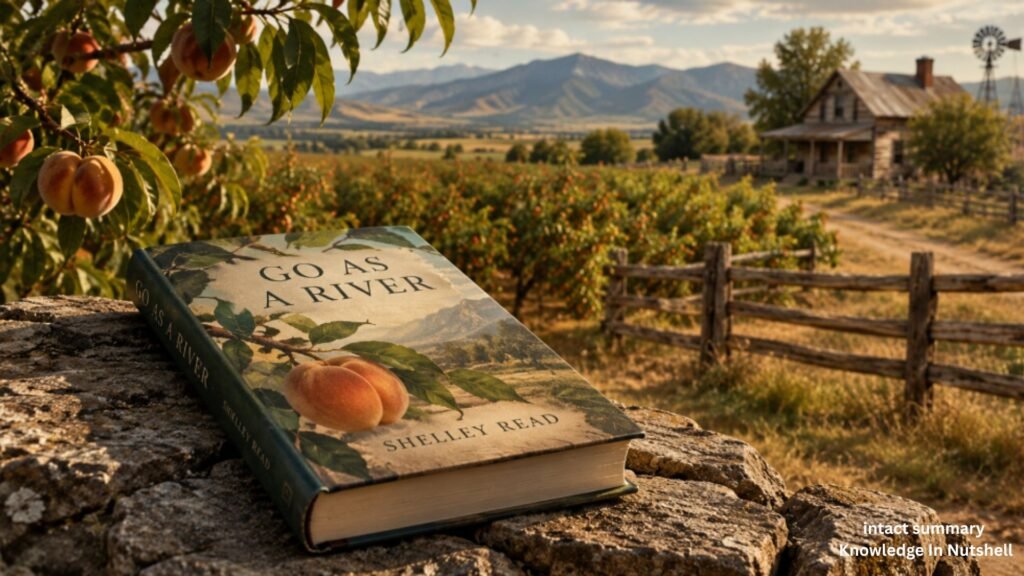
Before you start reading, it helps to know two things. First, this is a slow, character-driven story, not a fast-paced thriller, so patience with quiet, descriptive chapters pays off. Second, the novel deals honestly with heavy subjects, including racism, prejudice against Indigenous people, grief, and loss, so it’s written for adult readers rather than younger audiences. Since its release, the book has drawn frequent comparisons to Where the Crawdads Sing by Delia Owens, thanks to its female protagonist, its deep connection to the natural world, and its blend of romance and survival.
Plot Summary of Go as a River
Spoiler-Free Summary of Go as a River
Victoria Nash is seventeen years old and the only woman left in her household after a car accident killed her mother, aunt, and cousin. She spends her days cooking, cleaning, and working the family’s peach orchard in Iola, Colorado, caring for her grieving father, her bitter uncle, and her difficult younger brother.
Everything changes when she has a chance encounter with Wilson Moon, a quiet young drifter who has been displaced from his tribal land and is simply trying to find a place to belong. Their connection is immediate, but it’s also dangerous, because Wilson is Indigenous, and the town of Iola will not accept a relationship between them. As Victoria and Wil fall in love in secret, a single event changes the course of both their lives forever, sending Victoria away from everything she has ever known and into the wild Colorado mountains, where she has to learn how to survive largely on her own.
Over the following months and years, Victoria is forced to figure out who she is outside of the roles her family and town expected of her, all while the real Gunnison River keeps rising toward the peach farm and the town she grew up in.
Full Summary (With Spoilers) of Go as a River
The story opens in 1948. Victoria, still mourning her mother, meets Wilson Moon while running an errand in town. Wilson is Indigenous, self-reliant, and hiding from a community that views him with suspicion simply because of his heritage. Despite the risk, Victoria and Wil begin a secret relationship, and Victoria falls deeply in love for the first time, finding in Wilson a companionship and understanding she doesn’t get at home.
Their relationship deepens until tragedy strikes: a confrontation tied to the prejudice against Wilson turns violent, and in the chaos, Victoria’s younger brother, Seth, drowns. Because of the circumstances surrounding his death, and the racism already directed at Wilson, Victoria understands that Wil will be blamed and hunted if he’s found anywhere near Iola. To protect him, and because she discovers she is pregnant with his child, Victoria flees alone into the surrounding mountains rather than stay and face her family or the town.
Read More:/youd-be-home-now-summary/
Living alone in the wilderness, Victoria has to learn how to hunt, build shelter, and survive the changing seasons with almost no outside help. She eventually gives birth to her and Wilson’s son in isolation. Unable to raise the baby safely herself, given the prejudice he would face, Victoria makes the devastating decision to leave her newborn son with a kind couple she encounters, in the hope that he will have a safer, more accepted life than she can offer him alone.
Victoria eventually returns to her family and to what remains of her old life, carrying the secret of her son and her grief for Wilson, whose own fate remains uncertain for most of the book. The final section of the novel jumps forward to 1970. By this point, the real-life flooding of the Gunnison Valley has taken the family’s peach orchard and the town of Iola itself, submerging them beneath the new Blue Mesa Reservoir.
Through a series of letters, Victoria finally learns what became of the son she gave up, and readers learn Wilson Moon’s true fate. The novel closes with Victoria, now older, having found a version of home and peace she never expected, shaped by everything the river took and everything it eventually gave back.
Main Characters and Their Arcs of Go as a River
Character: Victoria “Torie” Nash
Role & Arc: Victoria is the female protagonist of Go as a River, a seventeen-year-old girl who becomes the sole surviving female in her household after a car accident kills her mother, aunt, and cousin. At the start of the novel, her entire identity is built around service: cooking, cleaning, and farm labor for the men in her life. Her arc is a coming-of-age transformation in the truest sense.
Through her relationship with Wilson Moon, then through the tragedy that follows, and finally through her months of survival in the wilderness, Victoria sheds the identity that was assigned to her and builds one of her own. By the novel’s end, she has become someone defined by resilience, hard-won personal growth, and an unshakable connection to the natural world, rather than by the household role she was born into.
Character: Wilson Moon (Wil)
Role & Arc: Wilson is a young drifter with a mysterious past, displaced from his tribal land and determined to live life on his own terms rather than let his circumstances define him. He functions as both a love interest and a mirror for the novel’s central themes of prejudice and displacement.
Because of his Indigenous heritage, he is treated with suspicion and hostility by most of Iola, forcing his relationship with Victoria into secrecy. Wilson’s arc is shorter on the page than Victoria’s, but it’s just as important: he represents what happens to people the world refuses to make room for, and his fate becomes one of the emotional centers of the book’s final chapters.
Supporting Family Members of Go as a River
Victoria’s Father: A hardworking but emotionally distant man, still grieving his wife’s death, who leans on Victoria to hold the household together without ever fully acknowledging what that costs her.
Victoria’s Uncle: A bitter, disabled man whose resentment adds to the weight Victoria carries at home, and whose presence reinforces the novel’s picture of a troubled family.
Seth (Victoria’s Younger Brother): A difficult, often cruel younger sibling whose recklessness and choices are directly tied to the novel’s central tragedy, making him a pivotal, if unlikable, part of the plot.
Ruby-Alice Akers: A reclusive older woman living in the mountains who quietly helps Wilson when the town of Iola turns against him. She represents the novel’s smaller, but important, thread of friendship and unexpected kindness in a hostile community.
Key Themes Explained of Go as a River
Love and Loss
The relationship between Victoria and Wilson Moon is the emotional engine of the book, but it’s never simple. Their young love blooms in secret, shadowed constantly by the threat of exposure, and the novel doesn’t shy away from showing how love and loss are tangled together.
Victoria loses her mother before the story begins, loses her brother during the story, loses Wilson in the events that follow, and eventually gives up her own son. Each loss reshapes how she understands love, until by the end she’s learned that love can survive even when the people or places holding it disappear.
Resilience and Survival of Go as a River
Once Victoria flees into the mountains, survival becomes both literal and symbolic. She has to physically learn to feed herself, find shelter, and endure the seasons alone, but she’s also surviving emotionally, rebuilding a sense of self after everything she knew was taken from her. This theme is where the book earns its title: like a river forced around an obstacle, Victoria doesn’t stop moving forward, she just finds a new channel.
Racism and Prejudice
Go as a River treats prejudice against Indigenous people as a central, unavoidable force in the plot, not a side issue. Wilson’s mistreatment by the town of Iola isn’t incidental, it’s the reason his relationship with Victoria has to stay hidden, and it directly shapes the tragedy at the heart of the book. The novel uses this racial prejudice to show how small-town intolerance in 1940s America could destroy lives, and how devastating the cost of that intolerance really was for people like Wilson.
Family and Duty
Before she meets Wilson, Victoria’s entire life is organized around family responsibilities: cooking, cleaning, and farm work for her father, uncle, and brother. The novel asks a quiet but persistent question throughout: what does a young woman owe to her family, and what does she owe to herself? Victoria’s journey is ultimately about discovering that duty and self-sacrifice aren’t the same thing as identity.
Nature and the Natural World
The peach orchard, the Gunnison River, and the surrounding mountain wilderness aren’t just scenery, they’re active forces in the story. Victoria’s relationship with nature deepens throughout the book, first through Wilson, who teaches her to see the land differently, and later through necessity, when the wilderness becomes her only shelter. By the end, nature has become the thing that saves her, even as it also takes her home away.
Identity and Home
Victoria spends much of the book known by different versions of her name and different roles: daughter, cook, farmhand, lover, mother, survivor. Her search for identity runs parallel to the literal disappearance of Iola itself. The novel’s final message about finding home suggests that home isn’t always a fixed place, sometimes it’s something you have to rebuild from scratch, in a shape you didn’t expect.
Symbolism and Literary Devices of Go as a River
The River
The river symbolism in the title isn’t subtle, and it isn’t meant to be. A river doesn’t stop when it hits an obstacle, it bends, floods, or carves a new path entirely. Victoria’s life follows the same pattern: dammed by tragedy and by the constraints placed on her as a young woman, she still finds a way to keep moving. The dammed river that eventually floods her hometown becomes a literal echo of everything blocking Victoria’s own life.
The Peach Orchard
The peach farm represents inheritance, both the family legacy Victoria is expected to protect and the version of her life that was decided for her before she had any say. When the orchard is eventually threatened by the rising reservoir, it mirrors Victoria’s own reckoning with what parts of her old life are worth holding onto.
Flooding and Submersion
The flooding of Iola beneath the Blue Mesa Reservoir works as a submerged past, a physical representation of grief that never fully disappears, it just moves underwater, out of sight but still there. This gives the book’s ending a bittersweet, almost archaeological quality, since droughts in real life have occasionally exposed the actual ruins of Iola decades later.
Seasons and Changing Landscape
Victoria’s time surviving alone in the wilderness is tracked through the changing seasons, a device that mirrors her internal emotional journey from raw grief toward a slower, hard-earned acceptance and strength.
Is Go as a River Based on a True Story?
This is one of the most-searched questions about the book, and the answer is: partly. Victoria Nash, Wilson Moon, and the specific events of the plot are entirely fictional, invented by Shelley Read. However, the setting and the historical events surrounding it are very real.
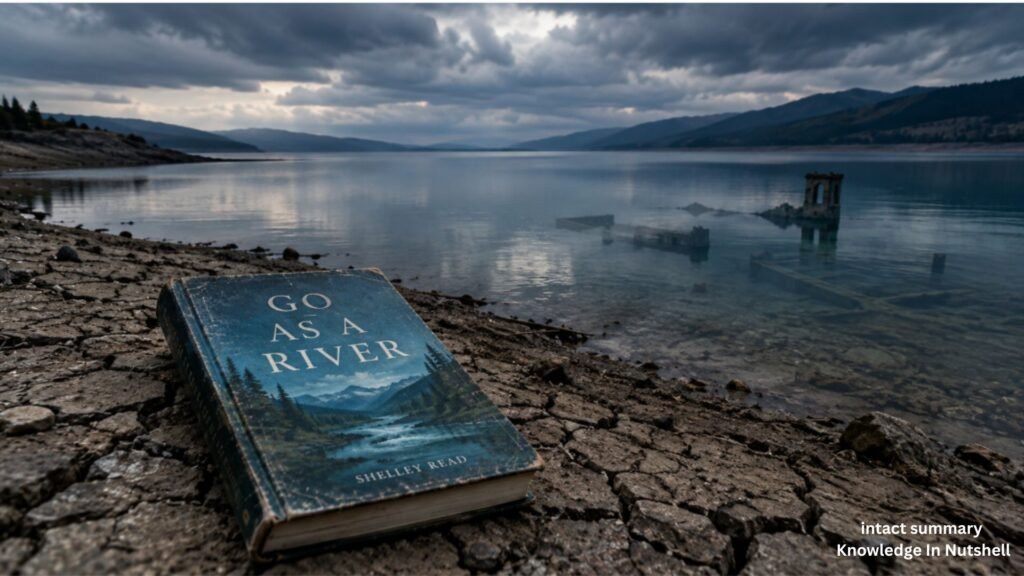
Iola, Colorado was an actual small ranch town in the Gunnison Valley. In the early 1960s, it was intentionally flooded as part of the Colorado River Storage Project, a government dam-building initiative that created the Blue Mesa Reservoir. The real Iola, along with its ranches, farms, and orchards, was permanently submerged, and its residents were displaced. Read, a fifth generation Coloradoan from the Western Slope and Elk Mountains region, grew up with family ties to this history, and drought years have occasionally lowered the reservoir enough to expose old building foundations and roads from the drowned town.
So while you shouldn’t search for “the real Victoria Nash,” the emotional core of the book, an entire community losing its home to a government decision, is grounded in historical events that really happened.
Writing Style and Literary Quality
Shelley Read’s prose in Go as a River is often described as lyrical and atmospheric, leaning heavily on detailed, sensory descriptions of the Colorado landscape. Readers and critics have generally agreed on a few things about the style:
- The pacing is slow and character-driven, prioritizing internal reflection and setting over fast plot movement.
- The nature writing is a genuine strength, with the mountains, river, and orchard described in vivid, immersive detail.
- Some critics, including a notably mixed Publishers Weekly review, have pointed out that a few of Victoria’s key relationships feel a little underdeveloped given how much emotional weight the plot places on them.
- The novel rewards patient readers more than those looking for a fast-paced thriller.
If you enjoy books where the setting feels like its own character, this literary fiction style will likely appeal to you. If you prefer dialogue-heavy, plot-first novels, the slower chapters may test your patience.
Frequently Asked Questions of Go as a River
1. What is Go as a River about?
Go as a River is a historical fiction novel about Victoria Nash, a teenage girl running her family’s peach farm in 1940s Colorado, whose secret relationship with a young Indigenous man named Wilson Moon leads to tragedy, forcing her to survive alone in the wilderness and rebuild her life.
2. Who wrote Go as a River?
The novel was written by Shelley Read, a fifth generation Coloradoan, and it was her debut novel, published in 2023.
3. Is Go as a River a true story?
No, the characters and plot are fictional, but the setting is based on true events. The real town of Iola, Colorado was flooded in the early 1960s to create the Blue Mesa Reservoir, and that historical event shapes the novel’s ending.
4. How does Go as a River end?
In the final section, set in 1970, Victoria learns the fate of the son she gave up as a baby through a series of letters, and Wilson Moon’s fate is finally revealed. The family’s peach orchard and the town of Iola have by then been submerged by the reservoir, and Victoria finds a hard-won sense of peace and home.
5. Who is Victoria Nash?
Victoria, also called Torie, is the female protagonist of the novel, a seventeen-year-old girl who becomes the sole surviving female in her household after her mother’s death, and who later must survive alone in the mountains after tragedy strikes.
6. Who is Wilson Moon in Go as a River?
Wilson Moon is a young drifter of Indigenous heritage who falls in love with Victoria. Their relationship must stay secret because of the racism and prejudice of the town of Iola.
7. What are the main themes of Go as a River?
The novel’s central themes include love and loss, resilience and survival, racism and prejudice, family duty, connection to the natural world, and the search for identity and home.
8. What does the title Go as a River mean?
The title refers to the idea of living life like a river, gathering strength, bending around obstacles, and always finding a way forward, even when dammed. It reflects Victoria’s own journey through hardship.
9. Is Go as a River similar to Where the Crawdads Sing?
Yes, both books feature a resilient female protagonist, a deep bond with nature and wilderness, and a forbidden romance, though Go as a River is anchored more directly to a real historical event.
10. Is Go as a River appropriate for teens?
The novel is generally categorized as adult fiction due to its serious treatment of racism, grief, and a teenage pregnancy storyline, so it’s best suited for older teen readers and adults rather than younger audiences.
11. What genre is Go as a River?
It’s classified as historical fiction, literary fiction, a coming-of-age novel, and women’s fiction.
12. Where is Go as a River set?
The novel is set primarily in and around Iola, Colorado, a small ranch town in rural Colorado, with major scenes taking place on a peach farm and in the surrounding mountain wilderness near the Gunnison River.
13. What happened to the real town of Iola, Colorado?
The real Iola was submerged in the early 1960s as part of the Colorado River Storage Project, when the Gunnison River was dammed to create the Blue Mesa Reservoir. Drought years have occasionally revealed remnants of the town.
14. Is Go as a River worth reading?
For readers who enjoy slow-paced, atmospheric, character-driven historical fiction with strong ties to real American history, most reviewers consider it a worthwhile, emotionally powerful read, though a few critics note some relationships feel a bit underdeveloped.
15. What should I read next if I liked Go as a River?
Readers often recommend Where the Crawdads Sing by Delia Owens, along with other rural historical fiction and coming-of-age novels centered on strong female protagonists and the American wilderness.
About This Article
This summary and analysis of Go as a River was researched and cross-referenced against the novel’s official publisher synopsis, professional literary reviews (including Publishers Weekly and Bookreporter), and verified historical background on the flooding of Iola, Colorado, and the Blue Mesa Reservoir.
All plot details were fact-checked against publicly available book descriptions and reviews to ensure accuracy, and quotations from the source novel have been kept minimal and used only where directly attributed. This guide was written to give readers, students, and book clubs a reliable, spoiler-labeled resource, without reproducing the author’s original text.
Conclusion
Go as a River is a big, emotional story about a girl named Victoria Nash who learns how to be strong, even when life is very hard. She lives on a peach farm in a small Colorado town, and her whole world changes when she meets Wilson Moon, a kind young man who is treated unfairly just because of who he is. When something terrible happens, Victoria has to leave everything she knows and learn to survive all by herself in the wild mountains.
This book teaches us that even when life feels dammed up, like a river that cannot flow, we can still find a new path forward. It shows us how love, loss, courage, and hope can all live together in one story. It also teaches us about prejudice, and why it is wrong to treat someone differently because of where they come from.
If you like stories about brave girls, beautiful nature, and finding home in surprising places, Go as a River is a powerful book to read. It is sad in parts, but it ends with hope, strength, and a reminder that we can always keep moving forward, just like a river.