
A sword can be a tool for fighting. But for thousands of years, people have also used it as a symbol. In many places, the sword symbol stands for power, authority, justice, and courage.
Now picture a whole city that became both a symbol and a sword at the same time. That is the story behind The Symbol and the Sword: Washington, D.C., 1860-1865.
Also Read:/the-briar-club-summary/
Maybe you searched “symbol of the sword” because you want to know what this book is about. Maybe you need a fast refresher for class. Or maybe you are just deciding if it is worth your time. This article helps with all of that.
Here is the short answer. The book is a short history book about Washington, D.C. during the American Civil War. In those years, the city was the symbol of the United States government. It was also a busy place full of soldiers, forts, and war. That is where the sword part comes in.
In this article, you will learn:
- What the book is and who made it
- Why it was published in 1962
- What the title’s symbol and sword most likely mean
- How Washington changed from 1860 to 1865
- The big themes, like power, strength, and protection
- How the sword shows up in real Washington art and in sword symbolism across cultures
- Who should read the book, plus study questions and answers to common questions
I wrote this in easy words on purpose. Whether you are ten or one hundred, you can follow it. I also kept it honest. Where I explain history that fits the topic, I say so. I don’t pretend to quote a book I can’t fully see.
Quick Answer of The Symbol and the Sword
The Symbol and the Sword: Washington, D.C., 1860-1865 is a short, illustrated Civil War history booklet, published in 1962, about the U.S. capital during the war years. It looks at Washington as a symbol of the Union and as a city defended by the sword, meaning its army and forts. It is best for readers who want a quick, focused look at Civil War Washington, not a long battle-by-battle story.
What Is The Symbol and the Sword About?
The book is nonfiction, so it has no made-up characters or plot twists. It is a historical nonfiction work about one place and one time: Washington, D.C., from 1860 to 1865.
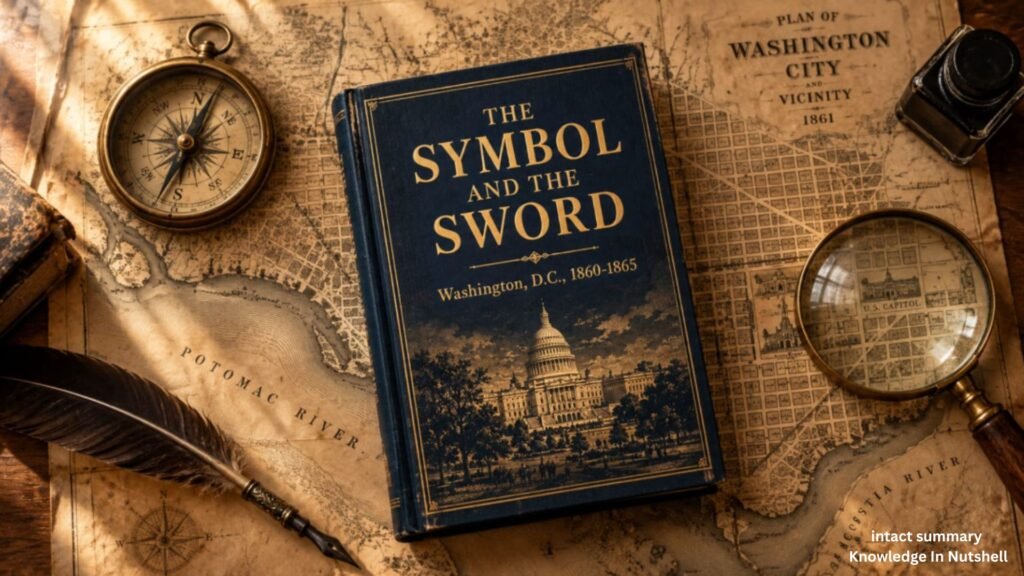
Here are the basic facts:
- Title: The Symbol and the Sword: Washington, D.C., 1860-1865
- Genre: American Civil War history / U.S. history
- Published: 1962
- Length: About 71 pages, with pictures
- Series: Volume 1 of a three-book set. Volume 2 is called The Shield, and Volume 3 is Upper Potomac During the Civil War
Notice the pattern in those titles: symbol, sword, shield. The set seems to tell one big story about a capital city that had to be a symbol, had to be defended, and had to stay protected.
Why Was the Book The Symbol and the Sword Published in 1962?
The date matters. The Civil War began in 1861, so 1961 to 1965 was the 100th anniversary, called the Civil War Centennial. All across the country, groups made books, tours, and events to remember the war.
The District of Columbia made a group for this job, the D.C. Civil War Centennial Commission. Library records list that commission as the author or publisher. Some bookstores list Paul J. Sedgwick as the author.
- It tells you the purpose. A commission book is made to teach the public. It is usually meant to be clear, short, and easy to use.
- It tells you the point of view. It was written in 1962. Historians have learned more since then, especially about enslaved people and free Black residents in Washington. Read it as one useful source, not the last word.
- It explains the small size. Centennial booklets were often made for visitors and students.
You can find the book today as a classic reprint, which means a company scanned an old copy and printed it again. Some reprints have small flaws from the old pages. That is normal.
What Does “Symbol of the Sword” Mean in The Symbol and the Sword? Two Ways to Read It
In this book’s title, the symbol is most likely Washington, D.C. itself, and the sword is the military force that defended it. That is my reading of the title. Check it against your copy.
But because you searched “symbol of the sword,” there is a second, bigger meaning too. Let’s look at both.
Meaning 1: The Book’s Meaning of The Symbol and the Sword
In 1860, Washington was the home of the President, Congress, and the Supreme Court. That made it the symbol of the nation. If the capital fell, the country would look weak. So the city needed protection. Soldiers, forts, and hospitals filled Washington during the war. That is the “sword.”
Meaning 2: The Sword as a Universal Symbol in The Symbol and the Sword
Across the world, the sword has stood for many things. Here are the most common sword symbolism meanings:
- Power and authority. Kings and rulers often held swords at big ceremonies.
- Justice. A sword can separate right from wrong. That is why statues of justice often hold one.
- Honor and courage. Knights and samurai treated the sword as a sign of honor.
- Protection. A sword can guard people, not only attack them.
- Life and death. A sword can end a life, so it reminds people that choices have weight.
In Parts B and C, I will show how these meanings connect to Washington. One real example: the famous statue on top of the U.S. Capitol holds a sword. I will explain it soon.
Where It All Began: How Washington Was Chosen in The Symbol and the Sword
To understand the war years, you need a tiny bit of history first. Publisher excerpts show that the book starts by explaining how the capital’s location was picked.
Here is the simple version:
- In 1790, Congress gave President George Washington the job of choosing a spot for the new capital.
- The land could be up to ten miles square along the Potomac River.
- The place was chosen partly because it sat between the North and the South.
- Maryland and Virginia each gave up some of their land to make it.
That last point matters a lot later. The capital was built right next to slave states. Virginia sat just across the river. When the war started, Washington was close to the enemy line. That made it easy to attack and hard to defend.
A simple way to picture it: imagine your house sits right on the border between two neighbors who start a big fight. You are in the middle, and everyone can see your front door. That was Washington in 1861.
Summary of The Symbol and the Sword: Washington, D.C., 1860-1865
A quick honesty note: This book is nonfiction, so there is no story with made-up characters. I built this summary from the book’s title, date range, and publisher details, plus well-documented facts about Washington during the war. Chapter names and small details may differ in your copy, so check it against the pages.
Spoiler-Free Summary of The Symbol and the Sword
The book follows Washington, D.C. from the year before the Civil War to the year it ended. At the start, the capital is a small, sleepy city. Then war breaks out, and Washington is suddenly in danger. It sits right next to the South. Soldiers pour in, forts rise on the hills, and hospitals fill with hurt men. Even so, the city keeps building. It keeps working as the home of the government. The book shows how one place can be both a symbol of a nation and a shield against attack.
Full Summary (With Spoilers) of The Symbol and the Sword
- 1860. Abraham Lincoln is elected President in November. Southern states begin to leave the Union.
- 1861. Lincoln takes office in March. In April, the war starts at Fort Sumter. Soon after, Washington is nearly cut off from the rest of the North for several days. Union troops arrive, and the army crosses the Potomac River into Virginia to protect the city.
- Summer 1861. A big Union army is beaten at Bull Run, not far from the capital. Tired soldiers stream back into Washington. Leaders begin building a ring of forts so the city is safer.
- 1862. The forts grow stronger. Hospitals multiply. In April, Congress ends slavery in the District of Columbia, freeing about 3,000 people. This happened months before the Emancipation Proclamation.
- 1863. The great dome of the U.S. Capitol keeps rising. A statue is placed on top in December.
- 1864. Confederate soldiers under General Jubal Early march close to the city. They are stopped at Fort Stevens, where the forts do their job.
- 1865. The war ends. President Lincoln is shot in Washington in April, and he dies the next day. In May, thousands of soldiers march through the city in a huge parade called the Grand Review.
Washington in 1860: A Small City With a Big Job in The Symbol and the Sword
Before the war, Washington did not look like the grand city you see today. In 1860, about 61,000 people lived there. Many streets were dirt. Farm animals wandered in some areas. The Washington Monument was unfinished, and the Capitol’s dome was still being built.
But it was the capital, and that made it special. Congress met there. The President lived there. Laws for the whole country were made there. That is why we call it a symbol of power and authority.
Read More:/the-life-impossible-summary/
Washington was also a Southern-leaning city in many ways. Slavery was legal in the District at that time. Many residents felt loyal to the South, and others felt loyal to the Union. When the war came, the city was full of people who felt torn.
Here is a simple way to remember it:
- Washington as a symbol: the home of the government, the flag, and the Constitution.
- Washington as a place: a small, muddy, crowded city with neighbors who disagreed.
April 1861: When the Capital Was Cut Off in The Symbol and the Sword
The war began on April 12, 1861, when Confederate guns fired on Fort Sumter in South Carolina. Lincoln asked states to send soldiers to defend the Union.
Then came a scary week for Washington. On April 19, an angry crowd attacked Massachusetts soldiers passing through Baltimore, Maryland. That city sat on the railroad line into Washington. Rails and telegraph wires were cut. For several days, the capital could hardly get mail, news, or soldiers.
Imagine your town’s only road is blocked, and the phone lines are down. That is how Washington felt. People worried the capital could be captured with almost no warning.
Help arrived when regiments such as the 7th New York reached the city on April 25. Soldiers camped in public buildings. Some even slept inside the Capitol.
Next, in May 1861, Union troops crossed the Potomac and took the high ground in Virginia. This mattered because cannons on those hills could have shot straight into the city. Taking that land was an early act of protection.
Key fact: In the first weeks of the war, Washington’s biggest problem was not a battle. It was being isolated and easy to reach.
The Ring of Forts: The “Sword” Around the City in The Symbol and the Sword
After the defeat at Bull Run in July 1861, leaders knew a plan was needed. Washington could not just hope for the best. So the army built a huge ring of forts around the city.
By the end of the war, that ring is often described as having about 68 forts and 93 gun positions called batteries, all linked by roads and lookout points. Together they stretched for miles across hills and along the rivers. Soldiers, engineers, and workers dug trenches, stacked dirt walls, and hauled heavy cannons.
This is where the book’s word sword fits best. In this sense, the sword means military strength used to defend, not just to attack. It is the same idea as a knight’s sword meant for protection.
The Test at Fort Stevens in The Symbol and the Sword
The ring was tested in July 1864. A Confederate force led by General Jubal Early came close to the northern edge of the city. The defenders at Fort Stevens held the line. Lincoln himself visited the fort during the fight, which is why people still tell the story. After a short time, Early pulled back.
Why this matters: Early’s raid was the closest the Confederacy came to actually attacking Washington’s defenses. The forts worked.
Today, some fort sites are parks. You can still see earth mounds and cannon spots in a few places.
Hospitals, Camps, and Daily Life in Wartime Washington in The Symbol and the Sword
War does not only mean battles. It also changes everyday life, and Washington changed fast.
Soldiers everywhere. Camps filled fields and parks. Streets were loud with marching feet, horses, and wagons.
Hospitals in unusual places. As wounded men arrived, the city ran out of hospital rooms. Churches, hotels, schools, and even government buildings were turned into hospitals. The Patent Office building is a famous example.
Helpers who became famous. Many people came to help the sick and hurt. Writer Walt Whitman visited wounded soldiers. Clara Barton, who later started the American Red Cross, helped too. Author Louisa May Alcott worked as a nurse in Georgetown.
A growing city. People from all over came for jobs, safety, or freedom. Many formerly enslaved people came from nearby states, hoping to find a safer life. In April 1862, Congress ended slavery in the District, which was a major step.
Everyday problems. Food, water, and clean streets were hard to manage. Mud, crowding, and illness were common.
Here is how to picture it. Washington was part capital, part army base, part hospital, and part new home for people looking for freedom. All of that is why the city is such a good example of a symbol carrying a heavy load.
Building the Capitol Dome While the War Raged in The Symbol and the Sword
The U.S. Capitol was getting a bigger, taller iron dome. Workers kept building it while soldiers marched below. A story often told is that Lincoln wanted the work to continue as a sign that the Union would survive. Whether or not it happened exactly as told, the meaning is clear. Finishing the dome sent a message: the nation is not falling apart.
That makes the dome a powerful symbol. It stood for strength, stability, and hope.
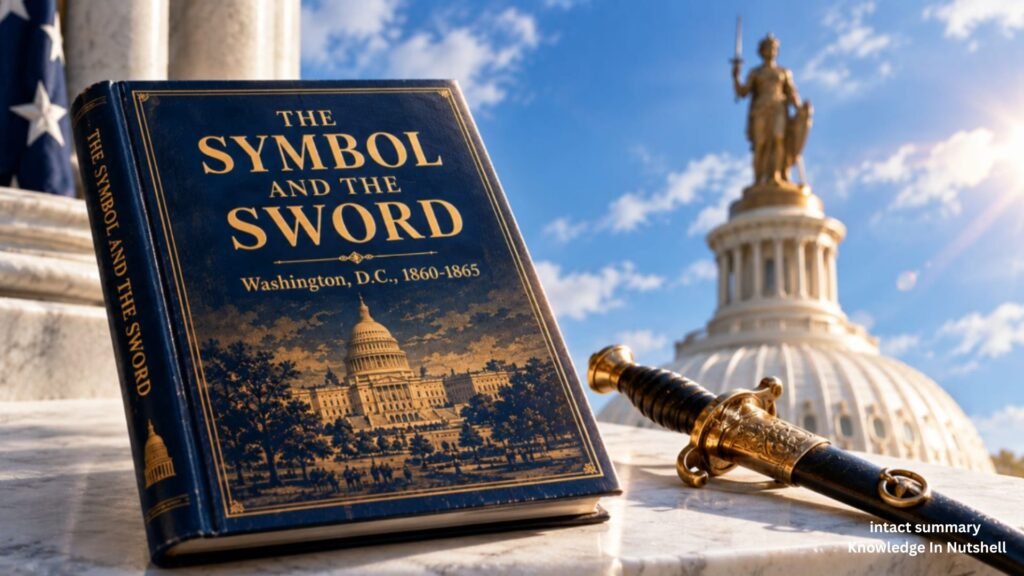
On December 2, 1863, the last piece went into place: a bronze statue called the Statue of Freedom. It stands at the very top of the dome. And here is the part that connects everything: the statue holds a sword.
Key Themes Explained in The Symbol and the Sword
A theme is a big idea that runs through a story or a history book. This book is short, so its themes come mostly from its title and its time and place. I explain each one with real history. Compare them with your copy to see which ones the author stresses most.
Symbol Versus Reality in The Symbol and the Sword
In speeches, the capital stood for freedom, law, and government. On the ground, it had dirt roads, sick soldiers, and neighbors who did not agree. The book’s title points at this. A symbol is only strong if people work to protect it.
Power and Authority in The Symbol and the Sword
Washington was where the President and Congress worked. That made it the center of political power and authority. Losing it would have made the Union look broken.
Protection and Defense in The Symbol and the Sword
The ring of forts shows this theme best. In this story, the sword is not mainly about attacking. It is about protection. That fits the second volume in the set, The Shield.
Strength and Courage in The Symbol and the Sword
Soldiers, builders, nurses, and leaders all showed courage. Building the Capitol dome during the war took a kind of moral courage too. It said, “We are still here.”
Freedom and Justice in The Symbol and the Sword
In April 1862, Congress ended slavery in the District of Columbia. That was a big step toward justice. It also links back to the sword. Swords have long been tied to justice, because they can “cut” between right and wrong.
The Cost of War in The Symbol and the Sword
A sword can protect, and it can also hurt. The hospitals in Washington remind us of the price. Life and death sat side by side in the city.
The Statue of Freedom: The Sword on Top of the Capitol
This is my favorite link between the keyword and the topic. On top of the U.S. Capitol dome stands a bronze woman called the Statue of Freedom. She was placed there on December 2, 1863, in the middle of the war.
Here are the facts:
- Sculptor Thomas Crawford designed her.
- She wears a helmet with an eagle’s head and feathers.
- Her right hand rests on a sheathed sword. The sword is inside its scabbard, so it is not drawn.
- Her left hand holds a laurel wreath, a sign of victory, and a shield with stripes.
- She was cast in bronze near Washington, and the pieces were lifted to the top of the dome.
- An earlier version of her headgear had a liberty cap. Officials changed it to the helmet after Secretary of War Jefferson Davis objected. Historians often retell this story, so it is worth checking in a museum source.
What Does the Sheathed Sword Mean according to The Symbol and the Sword?
Many people read it this way. The sword in its scabbard means strength that is ready but not used. It says, “We can defend ourselves, and we would rather not fight.” The shield next to it says protection. The wreath says victory and honor.
That gives you a neat match for the book’s title:
- Symbol: the statue, the dome, and the capital itself
- Sword: military strength held in reserve
- Shield: defense and safety (the name of Volume 2)
Sword Symbolism Across Cultures: What Does a Sword Represent in The Symbol and the Sword?
Since you searched “symbol of the sword,” here is the big picture. Sword symbolism is old and worldwide. Different cultures give the sword different meanings, but a few ideas keep coming back: power, authority, justice, honor, courage, and protection.
Sword Symbolism in Christianity in The Symbol and the Sword
- The Bible calls the word of God a double-edged sword.
- Ephesians mentions the Sword of the Spirit, a picture of spiritual warfare.
- In Matthew 10:34, Jesus says he brings a sword, which many readers understand as division caused by choosing faith.
- The Archangel Michael is often shown with a sword fighting evil.
- A flaming sword guards the Garden of Eden in Genesis.
Sword Symbolism in Islam in The Symbol and the Sword
A famous sword in Islamic tradition is Zulfiqar, linked to Ali ibn Abi Talib. It is often pictured with a forked tip. It stands for courage, justice, and spiritual authority. Islamic art often shows blades with fine calligraphy and inscriptions. The steel called Damascus steel is famous for strong, flexible blades.
Sword Symbolism in Hinduism in The Symbol and the Sword
The goddess Kali is often shown holding a sword. It stands for cutting away evil and ignorance. It is a symbol of liberation, not just violence.
Sword Symbolism in Zen and Japanese Culture in The Symbol and the Sword
In Japan, the katana is often called the soul of the samurai. Samurai followed Bushido, a code of honor, loyalty, and self-control. Zen Buddhism talks about a “sword of wisdom” that cuts through illusion. One of Japan’s famous legendary blades is Kusanagi-no-Tsurugi, a sacred sword in Japanese myth and one of the imperial treasures.
Sword Symbolism in Norse Mythology and the Viking Age in The Symbol and the Sword
In Norse stories, the hero Sigurd uses the sword Gram to defeat the dragon Fafnir. Swords in Viking times were also a status symbol. A rich warrior might own a blade with fancy decoration.
Sword Symbolism in Medieval Europe and Arthurian Legend
- In the Middle Ages, a knight’s sword stood for chivalry, honor, and protecting the weak.
- A knighting ceremony often involved a sword tap on the shoulder.
- Excalibur and the sword in the stone are tied to the idea of the rightful king. Only the true ruler could pull it out.
- Durendal, the sword of Roland, is another legendary blade from medieval French stories.
The Sword of Damocles in The Symbol and the Sword
This Greek story teaches an important lesson about power. A man named Damocles got to sit on a king’s throne. Then he noticed a sword hanging over his head by a single thin hair. The point is that people in power always live with danger.
The Sword and Justice in The Symbol and the Sword
Statues of justice often show a sword together with scales. The scales stand for fairness, and the sword stands for enforcing the law. This is the sword of justice idea. It connects nicely to Washington, where the courts and laws of the nation met.
Sword Symbolism in Tarot and Mysticism in The Symbol and the Sword
In Tarot, the suit of swords stands for the mind, truth, and hard choices. It is linked to the air element. Some writers connect the sword with alchemy and magical power too.
Sword Symbolism in Modern Pop Culture in The Symbol and the Sword
You already know many famous swords from stories and games. The lightsaber in Star Wars, the Master Sword in The Legend of Zelda, and the Valyrian steel swords in Game of Thrones all carry old meanings: destiny, heroism, and power.
Why Sword Craftsmanship Matters to Its Meaning
A real sword takes great skill to make. A swordsmith heats the metal, hammers it, and cools it in a process called quenching. Then the blade goes through tempering, which makes it strong but not brittle. Makers may use pattern welding or folded steel. Because it is so hard to make, a fine sword becomes a sign of prestige and skill.
Frequently Asked Questions About The Symbol and the Sword
1. What is The Symbol and the Sword about?
It is a short Civil War history booklet about Washington, D.C. from 1860 to 1865. It shows the capital as a symbol of the Union and as a city defended by military strength, the “sword.”
2. Who wrote The Symbol and the Sword?
Some bookstore listings credit Paul J. Sedgwick. Library catalog records name the District of Columbia Civil War Centennial Commission. Check the title page of your copy before you cite it.
3. When was it published?
It was published in 1962, during the Civil War Centennial, the 100th anniversary of the war.
4. Is it fiction or nonfiction?
It is nonfiction. It is a historical work, so it has no invented characters or plot.
5. What does the title mean?
The most likely meaning is that Washington is the symbol (the home of the government) and the sword is the military force that protected it. This is a reading of the title, so compare it with your copy.
6. What is the main theme?
The main idea is that a city can be both a symbol and a real place that needs protection. Other themes include power, authority, strength, courage, and freedom.
7. How long is the book?
Library records list about 71 pages with illustrations. Most readers can finish it in one or two sittings.
8. Is it worth reading?
Yes, if you want a quick, focused look at Civil War Washington. No, if you want a long modern study or a battle-by-battle account. Pair it with a newer book for the best result.
9. How does the story end?
The book covers 1860 to 1865. In that span, the city is never captured. The war ends in 1865, Lincoln is shot in April, and soldiers march in the Grand Review in May.
10. Was Washington, D.C. ever attacked in the Civil War?
Not in a full assault. In July 1864, Confederate troops under Jubal Early came near the city and fought at Fort Stevens. They pulled back, and the forts held.
11. What does a sword symbolize?
Around the world, a sword most often symbolizes power, authority, justice, honor, courage, and protection. It can also stand for life and death, because it can protect and it can harm.
12. What does a sword symbolize in Christianity?
It can stand for God’s word, spiritual warfare, and divine justice. Examples include the Sword of the Spirit, the flaming sword at Eden, and the sword of Archangel Michael.
13. What does the sword on the Statue of Freedom mean?
The Statue of Freedom on the Capitol dome rests a hand on a sheathed sword. Many people read it as strength held ready, meaning the nation can defend itself but is not attacking.
14. Is The Symbol and the Sword the same as The Book of the Sword?
No. The Book of the Sword is a separate work by Richard F. Burton about the history of swords. This booklet is about Washington during the Civil War.
15. Is this book part of a series?
Yes. Listings describe a three-volume set: The Symbol and the Sword, The Shield, and Upper Potomac During the Civil War.
About The Symbol and the Sword Article and How It Was Researched
The Symbol and the Sword is small, but its title carries a big idea. A capital city can stand for a nation’s hopes, and it can also need soldiers, forts, and hard work to keep those hopes alive. The sword in the title points to strength and protection. The symbol points to what a nation values. If you remember only one thing, remember that Washington never fell, and the Capitol dome was finished in the middle of the war.
Conclusion of The Symbol and the Sword
The Symbol and the Sword: Washington, D.C., 1860-1865 is a short history book about a real city during the Civil War. The city is Washington, D.C., the home of the President and Congress. Because of that, it was a symbol of the whole country.
But a symbol needs help to stay safe. So soldiers built forts on the hills all around the city. This is the sword part of the title. It means strength used for protection.
We also learned some cool facts:
- Washington was never captured, even when Confederate soldiers came close at Fort Stevens.
- Workers kept building the Capitol dome in the middle of the war.
- On top of the dome stands the Statue of Freedom. She rests her hand on a sword that is still inside its cover.
- In 1862, slavery ended in Washington, D.C.
Around the world, a sword can mean power, courage, honor, and justice. In Washington, it also meant keeping people safe.
The big lesson is simple. A symbol matters most when people work hard to protect it. Being strong and being kind can go together.
Now it’s your turn. Read the book, visit a fort if you can, or look for the sword on the Statue of Freedom. History is all around us, waiting to be found!
