
Maybe a parent wanted you to be the best at a sport, a school subject, or a musical instrument. Maybe you tried hard, and it still did not feel right. If so, you already understand the heart of Two Kinds by Amy Tan.
Two Kinds is a 1989 short story about a girl named Jing-mei and her mother. The mother believes her daughter can become a famous child prodigy. The daughter just wants to be herself. Their fight over piano lessons becomes one of the most famous mother-daughter conflicts in American short fiction.
Maybe you are here because you need a Two Kinds summary for class. Maybe you forgot what happened in the story. Or maybe you are only wondering if it is worth reading. This guide is made for all of you. It gives you the plot summary, the main characters, the setting, and the meaning of the title. It also explains the piano symbolism, the themes, and the ending.
You will see two types of summary. First comes a spoiler-free summary. Next comes a full summary with spoilers. Pick the one you need. After that, we go deeper. We look at Jing-mei’s character, her mother’s hopes, the American Dream, and the two piano songs at the end.
Everything here is written in simple words. It is based on the story itself and on trusted literary sources. It is not copied from any other website. By the end, you should be able to explain the story to a friend, write a strong essay, or join a class talk with confidence.
Quick Answer of Two Kinds by Amy Tan
Two Kinds by Amy Tan is a short story about a Chinese American girl named Jing-mei. Her immigrant mother wants her to become a child prodigy, and she pushes her to play the piano. Jing-mei fights back and ruins a piano recital on purpose, or at least by not trying. Years later, after her mother dies, she finds peace and understanding when she plays two old piano pieces and sees that they belong together. The story is about parental expectations, identity, and love between a mother and a daughter in Two Kinds by Amy Tan.
What Is Two Kinds by Amy Tan About?
The story is about a girl who wants to be herself and a mother who wants her to be amazing. The mother thinks that in America, a person can become anything. She wants her daughter to be famous at something. Jing-mei is told to try one thing after another. She hates feeling like she is never good enough in Two Kinds by Amy Tan.
Also Read:/the-most-wonderful-crime-of-the-year-review/
At the center is the piano. The mother makes Jing-mei take piano lessons. Jing-mei does not want to learn. She argues. She stops trying. A big moment happens in front of many people, and it changes how mother and daughter see each other in Two Kinds by Amy Tan.
The story is told by Jing-mei as a grown woman. She looks back on her childhood and tells us how it felt. That is why the story has a reflective, honest voice. She does not make herself look perfect. She tells us when she was angry, stubborn, and hurt. She also shows us, little by little, that her mother was not simply mean. Her mother hoped for something big because she had lost so much in Two Kinds by Amy Tan.
Background: Amy Tan and The Joy Luck Club
Amy Tan is a Chinese American author born in the United States to parents who came from China. Many of her stories look at immigrant families, the way parents and children see life differently, and what it means to belong to two cultures at once in Two Kinds by Amy Tan.
Two Kinds first came out in 1989. It was part of her very first novel, The Joy Luck Club, published by G. P. Putnam’s Sons. The book is made of linked stories. Each story is told by a different woman. Some are Chinese immigrant mothers. Some are their American-born daughters. Because of that, many readers call the book a short story collection and a novel at the same time in Two Kinds by Amy Tan.
Two Kinds is told by Jing-mei Woo, one of the daughters. It has since been printed on its own in school books, and it was also chosen for The Oxford Book of American Short Stories, a famous collection edited by Joyce Carol Oates. That shows how highly many readers and teachers value it. Today it is one of the most taught stories in American literature classes, especially in middle school, high school, and college in Two Kinds by Amy Tan.
Why does it matter? Because it shows a feeling that many families know. It speaks about generational differences, cultural identity, and the pain that can happen when a parent’s dream does not match a child’s own wishes. You do not have to be Chinese American to understand it. Many readers, from many backgrounds, see their own families in Two Kinds by Amy Tan.
One important idea before you read: the story is fiction. Still, it feels very real. Amy Tan has said in interviews that parts of her own life, and her own mother’s hopes for her, shaped the book. Readers should treat the story as a made-up tale, but one that is full of real feelings in Two Kinds by Amy Tan.
Where and When Does Two Kinds Take Place?
The story is set in San Francisco, California. The family lives in a small home in a neighborhood close to Chinatown. They are a Chinese immigrant family with modest family life. They are not rich. They live in a small apartment. That detail matters, because the mother has big dreams even though the family has little money in Two Kinds by Amy Tan.
The time is the mid-twentieth century. The mother came to America after leaving a very hard life in China behind. That is why she thinks the country is full of chances. In her mind, America is a place where hard work can change a life. This belief is called the American Dream, and it drives almost everything she does in the Two Kinds by Amy Tan.
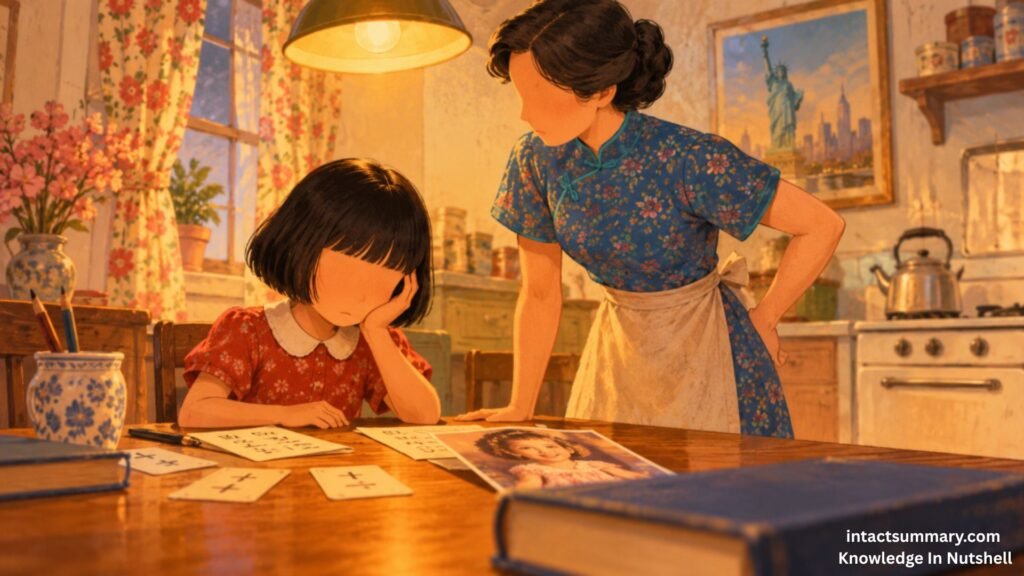
The setting also gives us a glimpse of daily life. Jing-mei studies at the kitchen table. She watches television. She goes to a church talent show. She practices on the family piano in the living room. These small places feel plain and normal. But each one becomes the stage for a big struggle between a child and her mother in Two Kinds by Amy Tan.
Two Kinds Spoiler-Free Summary
Jing-mei grows up in a home where her mother dreams big. The mother believes her girl could be a star, if only they can find the right talent. She watches famous children on television and says her daughter could be like them. So she starts testing Jing-mei with all kinds of small lessons and games at home in Two Kinds by Amy Tan.
Jing-mei tries at first because she also wants to be wonderful. But the tests keep going, and she feels more and more like a failure. At last her mother picks the piano as the best way to make her a prodigy. A teacher is found. Lessons begin. The family makes sacrifices to keep them going in Two Kinds by Amy Tan.
But Jing-mei does not feel the same dream. She starts fighting her mother in small ways and then in big ones. A public talent show brings everything to a head. After that, the two of them say hard things to each other. The story then jumps ahead many years. Jing-mei, now an adult, looks at that old piano again and sees it in a new way in Two Kinds by Amy Tan.
That is all you need to know if you want to stay spoiler-free. The story is short but strong, and the final scene is the part many readers remember most in Two Kinds by Amy Tan.
Two Kinds Full Summary (With Spoilers)
The story begins with Jing-mei remembering what her mother used to say. Her mother believed a person in America could be anything. So when Jing-mei was a young girl, her mother decided she could be a famous child. At first she hoped Jing-mei would be like Shirley Temple, the child movie star. She even took her to a beauty school, and Jing-mei came home with a short, curly haircut. Jing-mei looked more like a boy than a movie star in Two Kinds by Amy Tan.
The mother did not give up. She kept watching television shows and magazines for ideas. Each night, after dinner, she tested Jing-mei at the kitchen table. There were quizzes on the capital cities of countries, number problems, and memory games. Jing-mei did not do well at most of them. Every time she failed, she felt smaller. She also saw the hope in her mother’s face grow weaker in Two Kinds by Amy Tan.
One night the family watched The Ed Sullivan Show. A little girl played the piano, and her mother decided that was it. The piano would be the answer. Jing-mei at first hoped to be great at it, but when she heard how hard it was and saw how her mother pushed, she looked into the mirror and made a decision. She did not want to become a prodigy. She wanted to be herself. The mirror showed her a stubborn face, and she told herself she would not obey in Two Kinds by Amy Tan.
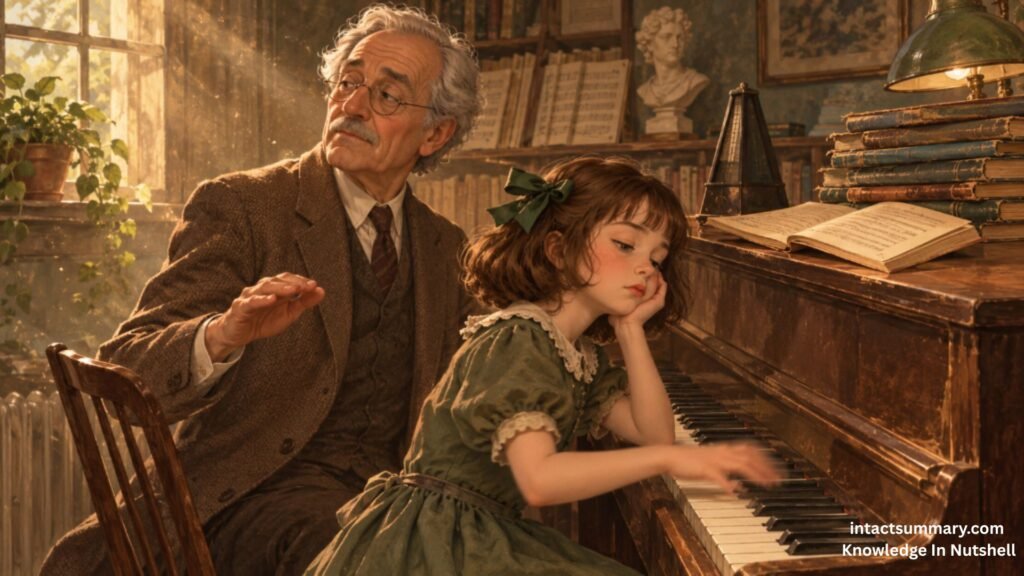
Her mother arranged lessons with Mr. Chong, an old, retired piano teacher who was almost deaf. In return, Jing-mei’s mother cleaned his apartment. Jing-mei soon learned that he could not hear her mistakes well. So she did not try hard. She played notes fast and wrong, and he still nodded as if she did a good job in Two Kinds by Amy Tan.
Meanwhile her mother kept bragging about her daughter to her friends. At the same time, a family friend named Auntie Lindo had a daughter named Waverly, who was a chess champion. Waverly’s success made Jing-mei’s mother feel she had to keep up. She was proud and a little jealous in Two Kinds by Amy Tan.
Then came the church talent show. Jing-mei had not practiced enough. When her turn came, she went to the piano with a big smile and a deep curtsy. But as soon as she started playing, she made mistake after mistake. The audience grew quiet. Her parents sat there, stunned. She finished the piece anyway, and the crowd clapped politely. Afterward, nobody said much in Two Kinds by Amy Tan.
At home, Jing-mei expected to be scolded. But her mother said nothing, and that scared her. Then the next day her mother told her to practice. Jing-mei refused. She shouted that she did not want to be the daughter her mother wanted. Her mother said there were only two kinds of daughters, the obedient kind and the kind who follows her own mind, and that in her house, only one kind was allowed in Two Kinds by Amy Tan.
Jing-mei yelled back, saying she wished she were not her mother’s daughter. She even said she wished she were dead like the babies her mother had lost in China. Her mother was shocked and hurt. She never mentioned the piano again in Two Kinds by Amy Tan.
The story then leaps forward. Many years later, on her thirtieth birthday, Jing-mei received the piano as a gift from her mother. She took it as a sign of peace and forgiveness. She did not play it for many years. Her mother then died. After that, Jing-mei had the piano tuned and moved to her own home in Two Kinds by Amy Tan.
One day, she sat down and tried the old music books. She found the pieces from her talent show, Pleading Child and Perfectly Contented. As she played them, she noticed something new. They were two songs, but they were also two halves of one piece. They matched, and they ended the same way. That small moment quietly says everything. She finally understood that her mother and she were not as different as they once seemed in v.
Main Characters in Two Kinds
Two Kinds has a small cast. Most of the story happens between two people, Jing-mei and her mother. A few other characters help show what the two of them are going through. Here are the key ones.
Character: Jing-mei Woo
Role and Arc: Jing-mei is the protagonist and the narrator. As a child, she is stubborn, smart, and tired of being tested. At first she wants to be special, because every child wants to make a parent proud. But after many failed tests, she begins to push back. She decides she will not become a prodigy just to please her mother. By the end, she is a grown woman who looks back with more understanding. Her character development goes from angry and hurt to calm and thoughtful. This is why many teachers use Jing-mei character analysis in class. She grows from a girl who says “no” to a woman who finally says “I see you.”
Character: Jing-mei’s Mother
Role and Arc: The mother is a Chinese immigrant mother who came to America with great hope. She believes this new country gives everyone a chance to be great. She is strong, loving, and also very strict. She does not give up easily. She wants the best for her child, but she does not see that her child feels crushed. In the story she does not change as loudly as Jing-mei does. Her change is quiet. After the big fight, she stops pushing the piano. Later, her gift of the piano shows she still loves her daughter and has forgiven her in Two Kinds by Amy Tan.
Character: Mr. Chong
Role and Arc: Mr. Chong is the piano teacher. He is old and almost deaf. He used to teach music, and he agrees to teach Jing-mei in exchange for house cleaning by her mother. He is kind, but he cannot hear her mistakes well. That is why Jing-mei learns she can play badly and still get away with it. He is a helper in the story, but he also makes the problem bigger, because he does not stop her lazy habits in Two Kinds by Amy Tan.
Character: Waverly Jong and Auntie Lindo
Role and Arc: Waverly is a girl who is famous for winning chess contests. Her mother, Auntie Lindo, brags about her all the time. They matter because they make Jing-mei’s mother feel pressure. If Waverly is a champion, then her own daughter must also be something. Waverly stands for the kind of child that Jing-mei’s mother wishes she had, and Auntie Lindo stands for the kind of competitive parenting that makes the pressure worse in Two Kinds by Amy Tan.
Character: Jing-mei’s Father
Role and Arc: Jing-mei’s father is a quiet figure. He sits through the talent show and shares the shock when it goes wrong. He does not speak much in the story. But his silence adds to the sad mood. It shows that the whole family felt the pain of that night in Two Kinds by Amy Tan.
Why Does Jing-mei’s Mother Want Her to Become a Prodigy?
Short answer: She believes in the American Dream, and she wants her daughter to have the life she could not have.
Now the longer answer. Jing-mei’s mother came from China after living through a very hard time. In the larger book, we learn she lost many things there, including family. So when she gets to America, she feels she has a fresh start. She hears that anyone can be rich or famous here. To her, her daughter is the best chance to prove it in Two Kinds by Amy Tan.
That is why she keeps looking for a talent. First it is Shirley Temple. Then it is the quiz games. Then it is the piano. Each time, she is not just trying to show off. She is trying to make her dream real. She also wants her child to have opportunities in America that she never had in Two Kinds by Amy Tan.
There is another reason. Her friend Auntie Lindo keeps talking about Waverly. This gives the mother a feeling of competition. She does not want to look like she failed as a parent. So her love turns into pressure. It is motherly love and sacrifice, but it also becomes controlling in Two Kinds by Amy Tan.
This is one of the most important things to understand about the story. The mother is not a bad person. She acts out of love and hope. But her way of showing that love hurts her child. Many readers feel both sad for Jing-mei and sorry for her mother.
Who Is Mr. Chong in Two Kinds?
Mr. Chong is the deaf piano teacher who gives Jing-mei her lessons. People often search for him because he looks like a small character, but he plays a clever part.
He is an old man who lives in the same neighborhood. He used to teach music and still has the piano and sheet music at home. Jing-mei’s mother cleans his place so that he will teach her daughter. That detail shows how much the mother is willing to work for her child. She trades hard labor for a chance at a dream.
Read More:/crown-of-midnight-summary/
In the story, the mother tells Jing-mei that Mr. Chong is a great man, and she compares him to Beethoven, who was also deaf. Jing-mei is not impressed. Instead, she sees a way out. If he cannot hear well, she does not need to work hard. She plays fast and sloppy. He waves his hands and keeps time, but he does not notice the wrong notes.
So Mr. Chong matters for two reasons. First, he helps start the music lessons that become the center of the story. Second, his deafness adds a touch of irony. A music teacher who cannot hear music well is teaching a child who does not want to play. It shows that something is missing in the whole project. The lessons look real, but the heart is not in them.
The Talent Show: What Happens and Why It Matters in Two Kinds by Amy Tan
The church talent show is the turning point of the story. It is the moment when everything that has been building up finally falls apart.
Here is what happens. Jing-mei walks on stage in front of her family, her mother’s friends, and many people from the church. She is smiling, and she makes a big curtsy. She feels sure of herself, because she believes she will do fine. But she has not practiced enough. When she starts to play Pleading Child, she stumbles. She hits the wrong notes. At first she thinks she can fix it, but the mistakes keep coming. The room gets quiet. She sees her parents’ faces, and she knows she has let them down.
When she finishes, people clap politely. Some adults even say kind words. But Jing-mei knows the truth. So do her parents. Afterward, a little girl says something unkind, and Waverly makes a sharp comment too. It adds to Jing-mei’s shame.
Why does it matter? First, it is the moment of public embarrassment. Jing-mei’s secret choice to be lazy is no longer secret. Second, it is a loss for her mother, who had told friends that her daughter was gifted. Third, it leads to the big argument that comes next. Without the talent show, there would be no fight and no final change.
It also shows the cost of parental pressure. Jing-mei did not fail because she could not play. She failed because she did not want the dream to belong to someone else. Her failure was a kind of rebellion, but it hurt her too.
The Mother-Daughter Relationship in Two Kinds
At its heart, Two Kinds is about the mother-daughter relationship. The piano is just the place where the fight happens.
At the start, Jing-mei and her mother are close in their own way. They talk. They sit at the kitchen table together. But the more her mother tests her, the more emotional distance grows between them. Jing-mei starts to feel that her mother does not love her for who she is. She only loves what she might become.
The big argument shows this clearly. Jing-mei says she wishes she were not her mother’s daughter. Her mother says that there are only two kinds of daughters, those who obey and those who follow their own mind. In her view, only the first kind can live in her house. These words are painful, and both of them feel it.
After that day, their relationship goes quiet. The mother stops pushing the piano. Jing-mei does not talk about it again. There is a lot of unspoken hurt between them. Many readers see this as a very real part of family life. Sometimes people do not apologize in words. They just stop mentioning the wound in Two Kinds by Amy Tan.
Yet the story shows that love does not end. On Jing-mei’s thirtieth birthday, her mother gives her the piano. Jing-mei sees it as a sign of forgiveness. Even though it comes without words, it speaks clearly. Later, after her mother dies, Jing-mei finds more meaning in the gift. The story ends with reconciliation, not through talk but through music and memory in Two Kinds by Amy Tan.
What Do the Two Piano Songs Mean? Pleading Child and Perfectly Contented in Two Kinds by Amy Tan
At the end of the story, Jing-mei plays two pieces from a book of music by the composer Robert Schumann. They come from a collection called Scenes from Childhood. The two pieces are Pleading Child and Perfectly Contented.
Short answer: The two songs stand for the two sides of Jing-mei and her mother. They also show that these two sides belong to the same whole.

Pleading Child is a short piece with a soft, begging feel. Many readers connect it to Jing-mei as a girl. She was the child who wanted to be loved and understood. She was also the girl who had to play before she was ready. The name itself sounds like someone asking for something. In a way, young Jing-mei was pleading with her mother to let her be herself.
Perfectly Contented feels calm and settled. Many readers link it to peace. It might stand for the way Jing-mei feels as an adult. It might also stand for the mother’s wish that her daughter be happy, even if not in the way she first planned.
The big moment comes when Jing-mei notices that the two songs are on facing pages. She plays one, then the other. She sees that they are not enemies. They fit together like two halves. The second one even ends in a way that feels like a return to the first.
This is the heart of the ending. The “two kinds” are not truly opposites. A daughter can be obedient and free. A mother can be demanding and loving. The two sides can meet. That is why the final scene is so quiet and strong.
What Is the Meaning of the Title “Two Kinds”?
Short answer: The title comes from the mother’s idea that there are two kinds of daughters: the obedient kind and the kind who follows her own mind. But the story slowly shows that this idea is too simple.
The title works on several levels. On the surface, it is about the fight between Jing-mei and her mother. Her mother says only one kind of daughter can live in her house. Jing-mei believes she is the other kind. They each think the two kinds cannot live together.
The title also points to the two piano songs at the end. Pleading Child and Perfectly Contented look like two different pieces. Yet Jing-mei finds that they fit together as one. So “two kinds” can also mean two parts of one whole.
A third meaning is inside Jing-mei herself. She is a girl who wants to please her mother, and she is a girl who wants to be free. She is a Chinese child and an American child at the same time. In the end, the title asks a quiet question. Do people really have to be one kind or the other? The story answers no. Most of us are both.
Major Themes in Two Kinds
A theme is the big idea a story wants you to think about. Two Kinds has several. Here are the main ones, explained in simple words.
Theme 1: Parental Expectations Versus Identity in Two Kinds by Amy Tan
This is the main theme of Two Kinds. Jing-mei’s mother expects her to be a star. Jing-mei wants to be an ordinary girl who is free to choose. The story shows how parental pressure can make a child feel unseen. It does not say that expectations are bad. Hopes can help a child grow. But when hopes are too heavy, a child may feel like a failure, or may rebel.
This theme also covers self-discovery. Jing-mei finds out who she is by saying what she is not. Looking in the mirror, she decides she will not be a prodigy. That small moment is the start of her personal identity. She says no, and she learns something about herself.
Theme 2: The American Dream and the Immigrant Experience in Two Kinds by Amy Tan
The mother believes in the American Dream, the idea that anyone can rise high in America if they work hard. This belief comes from her immigrant experience. She left a hard life in China. She wants her child to enjoy the chances she never had.
But the story also shows a cost. When a parent puts a whole dream on one child, the child can feel crushed. Jing-mei is an American-born child of immigrants, so she sees America differently. To her, being American means she can choose her own path. To her mother, it means she must use every chance. These two views clash. That clash is a generational difference and a cultural gap, and it makes the story feel real for many immigrant families.
Theme 3: Love, Sacrifice, and Misunderstanding in Two Kinds by Amy Tan
The mother cleans Mr. Chong’s home. She saves money for a piano. She gives up time and energy. These are real sacrifices. Yet Jing-mei does not see them as love at the time. She sees them as pressure. The theme shows that love and misunderstanding can live together in a family.
Theme 4: Forgiveness and Reconciliation in Two Kinds by Amy Tan
The story ends with peace. The mother gives the piano as a quiet sign of forgiveness. After she dies, Jing-mei finally understands. Without a single spoken apology, the two of them find reconciliation. The theme says that understanding sometimes comes late, but it can still come.
Theme 5: Regret and Reflection in Two Kinds by Amy Tan
Because Jing-mei tells the story as an adult, the story is full of reflection. She looks back and sees what she missed. There is a feeling of regret in the final scene. She would have liked to know her mother better while she was alive. This makes the ending gentle and a little sad.
Piano Symbolism in Two Kinds
What does the piano symbolize in Two Kinds? The piano stands for the mother’s hopes, the daughter’s struggle, and in the end, the love between them.
At first, the piano is a symbol of pressure. It is the tool that her mother hopes will turn Jing-mei into a prodigy. Every lesson feels like a test. When Jing-mei sits at the keys, she is not just playing music. She is carrying her mother’s dream.
Next, the piano becomes a symbol of rebellion. Jing-mei refuses to practice. She plays badly on purpose. Even the failed talent show is, in a way, a fight fought at the piano.
Later, the piano turns into a symbol of forgiveness. When her mother offers it on her thirtieth birthday, it is no longer a weapon. It is a gift. The same object that caused the fight now carries peace.
Finally, the piano becomes a symbol of memory and identity. After her mother dies, Jing-mei plays it again. She finds that the music she once hated now connects her to her mother. The piano is no longer about being a prodigy. It is about family.
There are other small symbols too. The mirror shows Jing-mei meeting her own stubborn self. The Peter Pan haircut shows how far her mother’s dream is from reality. The curtsy at the talent show shows her wish to look confident, even though she is unprepared. And the sheet music at the end shows the quiet link between past and present.
Literary Devices and Narrative Style in Two Kinds
Literary devices are the tools a writer uses to tell a story. Amy Tan uses several simple but strong ones.
First-person narration in Two Kinds by Amy Tan. The story is told by Jing-mei, using “I.” This lets us feel her anger and shame from the inside. We see everything through her eyes. Because it is retrospective narration, an adult looking back, she can also add wisdom she did not have as a child.
Irony of Two Kinds by Amy Tan. Irony is when the opposite of what we expect happens. A deaf piano teacher teaching a child who does not want to learn is one example. Another is that the mother says only one kind of daughter is allowed, yet at the end both “kinds” are shown to live in the same person. A third is that Jing-mei refuses to be a prodigy, but later finds meaning in the very music she rejected.
Imagery in Two Kinds by Amy Tan. Tan uses clear pictures to help us see. The mirror scene is a good example. Jing-mei sees a stubborn face looking back, and we see it too. The picture of her in a bad haircut also makes us laugh and feel for her at once.
Foreshadowing of Two Kinds by Amy Tan. Small hints early on prepare us for later events. Her mother’s strong belief in the American Dream hints at the big fight to come. Jing-mei’s secret choice to hold back hints that the talent show will go wrong.
Symbolism and motif of Two Kinds by Amy Tan. Music appears again and again. The piano, the lessons, and the two pieces all repeat the same idea. This repeating pattern is called a motif, and it ties the whole story together.

Contrast of Two Kinds by Amy Tan. The story compares obedient and free, mother and daughter, Pleading Child and Perfectly Contented, and Jing-mei and Waverly. These contrasts help us see what is at stake.
Narrative voice of Two Kinds by Amy Tan. Jing-mei’s voice is honest, a little funny, and not too fancy. She does not hide her faults. This makes her feel trustworthy, and it makes the story easy to read.
Two Kinds Ending Explained
Short answer: The ending shows that Jing-mei finally understands her mother. She sees that the two piano pieces belong together, just as she and her mother belong together.
After her mother dies, Jing-mei takes the piano into her life again. She has it tuned. One day she sits down and plays the old pieces. At first it feels like going back in time. She remembers the talent show. She remembers the fight. But then she plays Pleading Child, and next to it she finds Perfectly Contented. She plays that one too. As she does, she notices that they are two parts of one whole.
That small discovery is the ending of Two Kinds. It carries three messages.
The first is forgiveness. Jing-mei no longer holds on to the old pain. She sees the piano as her mother’s gift, and she accepts it.
The second is understanding. As a girl, she thought her mother only wanted to control her. As an adult, she sees the love behind that effort. Her mother’s hopes were big because her love was big.
The third is acceptance of individuality. Jing-mei does not become a famous pianist. She stays herself. But she also learns that being herself does not mean rejecting her mother. She can be her own person and still honor where she came from.
The ending is quiet. There is no big speech. A woman sits at a piano and plays two short songs. Yet the moment says more than words could. It tells us that the “two kinds” were never really enemies.
Frequently Asked Questions About Two Kinds by Amy Tan
What is Two Kinds by Amy Tan about?
It is about a Chinese American girl named Jing-mei and her immigrant mother. The mother wants her daughter to become a child prodigy, and the daughter resists. Their fight over piano lessons shows the gap between parent hopes and a child’s own identity.
Who is the protagonist of Two Kinds?
The protagonist is Jing-mei Woo. She is also the narrator. She tells the story as an adult, looking back on her childhood.
Is Two Kinds a true story?
No. It is fiction. Still, Amy Tan has said her own family life and her mother’s hopes for her helped shape her writing. So it feels very real, even though the characters and events are made up.
Where was Two Kinds published?
It was published in 1989 as part of The Joy Luck Club, Amy Tan’s first novel, by G. P. Putnam’s Sons. It has also been printed on its own in many school books.
What is the main theme of Two Kinds?
The main theme is the clash between parental expectations and personal identity. Other big themes include the American Dream, love and sacrifice, and forgiveness.
Why does Jing-mei refuse to play the piano in Two Kinds by Amy Tan?
She feels her mother is trying to turn her into someone she is not. After many failed tests, she decides she will not be a prodigy. Refusing to practice is her way of saying, “I want to be myself.”
Why does Jing-mei’s mother compare her to Shirley Temple in Two Kinds by Amy Tan?
Shirley Temple was a famous child star. Jing-mei’s mother believes that in America, any girl can become famous. She hopes Jing-mei can be like her. This shows how strongly she believes in the American Dream.
Who is Mr. Chong in Two Kinds?
Mr. Chong is Jing-mei’s deaf piano teacher. He is old and retired. Because he cannot hear her mistakes well, she gets away with playing badly. His role adds irony to the story.
What happens at the talent show in Two Kinds by Amy Tan?
Jing-mei walks on stage with a big curtsy but plays badly because she did not practice. The audience claps politely, but her parents are shocked and ashamed. It is the turning point of the story.
What does “two kinds of daughters” mean in Two Kinds by Amy Tan?
In the argument, Jing-mei’s mother says there are only two kinds of daughters: the obedient kind and the kind who follows her own mind. The story later shows that a person can hold both sides.
What do Pleading Child and Perfectly Contented represent in Two Kinds by Amy Tan?
Pleading Child can stand for young Jing-mei, who wanted to be understood. Perfectly Contented can stand for peace and acceptance. Together they show that her story and her mother’s belong together.
Why does the mother give Jing-mei the piano in Two Kinds by Amy Tan?
She gives it on Jing-mei’s thirtieth birthday as a quiet gesture of forgiveness and love. It is a way of saying she is still proud of her daughter, even without words.
Does Jing-mei forgive her mother in Two Kinds by Amy Tan?
Yes. After her mother dies, Jing-mei plays the old music and sees the love behind her mother’s hopes. This shows forgiveness and reconciliation.
What literary devices are used in Two Kinds?
Amy Tan uses first-person narration, irony, imagery, foreshadowing, symbolism, motif, and contrast. The piano is the strongest symbol in the story.
Is Two Kinds worth reading?
Yes. It is short, easy to read, and full of feeling. It is a great pick for students, and it also works well for readers who like family stories and coming-of-age themes.
Author and Editorial Note of Two Kinds by Amy Tan
This guide was written to help students, teachers, and readers understand Two Kinds by Amy Tan. The research approach was simple. The article was built from the story itself, with background from reliable literary sources about Amy Tan and The Joy Luck Club. The summary, analysis, and examples were written fresh in original words. No text was copied from other websites, and quotes from the story were avoided so that the writing stays original.
For quality, each plot point was checked against the story’s events so that nothing was invented. Themes and symbols are common readings, and some parts, like what the two piano songs mean, can be read in more than one way. We marked those as interpretations. If you are writing a paper, always read the story yourself and use your own ideas along with this guide.
Conclusion of Two Kinds by Amy Tan
Two Kinds by Amy Tan is a short story about a girl named Jing-mei and her mother. Her mother wants her to be a child prodigy, which means a kid who is amazing at something very early. So she gives Jing-mei piano lessons. But Jing-mei does not want to be someone else. She wants to be herself.
At the talent show, Jing-mei plays badly. Everyone feels shocked and sad. Later, she and her mother have a big fight. They say hurtful words to each other. After that, nobody talks about the piano again.
Many years later, her mother gives her the piano as a birthday gift. It is a quiet way of saying, “I still love you.” When her mother dies, Jing-mei plays two old songs, Pleading Child and Perfectly Contented. She sees that they fit together like two puzzle pieces. That is when she finally understands her mother.
The story teaches us some big ideas. Parents can love you very much, even when they push too hard. Kids can love their parents, even when they feel upset. It is good to be yourself. It is also good to listen and try to understand other people. Forgiveness can come slowly, and sometimes it comes without any words at all.
So the two kinds were never really enemies. A daughter can be free and still be loving. A mother can be strict and still be kind. Both can live in one family, and even in one heart.