Maybe you said something and got a quiet “uh-huh” back. Maybe you gave up on talking at all. Moments like this are small, but they add up. Over time, they can pull people apart.
That is the problem The Relationship Cure by John Gottman tries to solve. Many people think love fades because of big fights or big betrayals. Dr. Gottman, a famous relationship researcher, found something different. Love often fades through tiny missed moments, like a sigh, a joke, or a question that gets ignored.
If you are wondering whether this book is worth your time, here is the short answer. Yes, it is worth reading for most people. It is simple and practical, and it works for more than couples. The ideas help in marriage, family, friendships, and even at work. The book is also easy to use, because every step comes with questions and exercises.
If you only need a refresher, this article is made for you too. It explains the main idea of the book in plain words. It shows the five-step relationship guide one step at a time. It also tells you what the book does well and where it falls short.
Quick Answer of The Relationship Cure
The Relationship Cure is a self-help book by John M. Gottman and Joan DeClaire, first published in 2001. It teaches that strong relationships are built from small moments called bids for connection. A bid is any small attempt to get a partner’s, friend’s, or family member’s attention, support, or care. The book gives a five-step guide to help you notice these bids, respond to them, and improve your emotional communication at home, in friendships, and at work.
Who Are John Gottman and Joan DeClaire?
Dr. John M. Gottman is one of the best-known names in relationship psychology. He spent many years studying real couples. He taught at the University of Washington and later co-founded The Gottman Institute with his wife, Dr. Julie Schwartz Gottman. The Institute offers classes, therapy resources, and training based on his relationship research.
Also Read:/one-perfect-couple-ruth-ware-summary/
Part of his research was unusual. His team watched couples go about normal routines, such as chatting, making breakfast, and reading. They then followed up over time to see which relationships stayed strong. By watching real life instead of just asking questions, the team spotted patterns that people rarely noticed on their own.
Joan DeClaire is a writer who has worked with Gottman on parenting and relationship books. She helped turn complex research into plain, readable language. That teamwork is one reason the book feels friendly instead of scientific.
If you know Gottman from his earlier work on marriage, such as The Seven Principles for Making Marriage Work, this book feels like a close cousin. It focuses less on marriage rules and more on everyday emotional communication with everyone in your life.
Why The Relationship Cure Still Matters
The book came out in 2001, so you might ask if it is outdated. In most ways, it is not. Here is why.
1. The Relationship Cure explains a problem everyone knows. Phones, work stress, and busy schedules make it easy to ignore each other. The idea of “missed bids” fits modern life very well. Think of how often someone says something while you scroll.
2. The Relationship Cure is built on observation, not guesswork. The ideas come from years of watching how people actually act, which gives the advice more weight than a simple opinion.
3. The Relationship Cure works beyond marriage. The book’s own title promises help with marriage, family, and friendships. Many relationship books only focus on couples.
4. The Relationship Cure makes big change feel small. You do not need to fix your whole relationship in a weekend. You can begin by noticing one bid today and answering it kindly.
5. The Relationship Cure helps explain why couples feel lonely together. This is one of the most common reasons people search for the book. Feeling lonely in a relationship often does not come from one big event. It comes from many small moments where emotional needs went unseen.
The Five-Step Roadmap: How the Book The Relationship Cure Is Built
Before we dig in, here is the whole path from above. The Relationship Cure is built around a five-step relationship guide. In Step 1, you look at your bids for connection, which means how you reach out to people and how you answer them. In Step 2, you discover your brain’s emotional command systems, the built-in drives that shape what you want and need.
In Step 3, you examine your emotional heritage, which is how your family and your past taught you to handle feelings. In Step 4, you sharpen your emotional communication skills, so you can read and share feelings more clearly. In Step 5, you find shared meaning, the sense of what you care about together.
The Relationship Cure also opens with a chapter on how people connect emotionally. A short chapter on “bid busters” follows Step 1, and a closing chapter helps you apply everything. Think of the steps like building a house. Step 1 is the floor, and every other step sits on top of it. That is why we spend the most time on Step 1 here. Once you understand bids, the rest of the book makes much more sense.
What Are Bids for Connection in The Relationship Cure?
A bid for connection is any small attempt to get someone’s attention, care, or support. The Relationship Cure can be a word, a look, a touch, a question, or a gesture. Underneath, the message is almost always the same: “I want to feel close to you right now.” Gottman calls the bid the basic building block of emotional connection. In his view, big love is made of many tiny bids and many tiny answers.
Bids are very ordinary, and that is the whole point. A husband says, “Look at that bird outside.” A little girl holds up her drawing. A friend sends a funny photo. A coworker sighs and says, “What a day.” Each one is a quiet request to be noticed. Some bids are verbal, like a question or a joke.
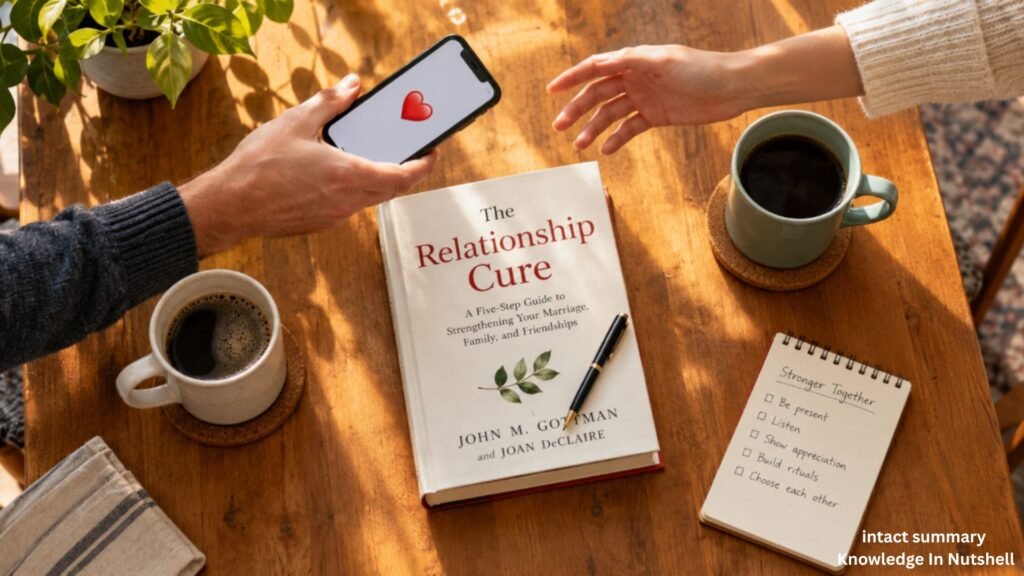
Others are nonverbal, like reaching for a hand, leaning in for a hug, giving a smile, or letting out a tired sigh. Many are so small that you can miss them if you are not paying attention, and that is exactly why so many relationships slowly lose their warmth.
Why does this matter so much? Each time you answer a bid kindly, you send a silent message: “You matter to me.” Each time you ignore one, the other person may hear: “You are not important right now.” One missed bid is no disaster. But when missed bids pile up, people often stop reaching out, and emotional distance grows.
A simple way to picture this is a shared jar of marbles. Every kind answer adds a marble, and every ignored bid takes one out. A full jar helps a couple get through bad days. An empty jar makes even small problems feel huge. (The jar is my own picture to help you remember, not an idea from the book.)
Bids also appear outside of romance. A child shouting, “Watch me jump!” is making one. So is a friend who texts, “Are you free this weekend?” The same rules work in every kind of relationship, which is why the book speaks to marriage, family, and friendships alike.
The Three Ways to Respond: Turning Toward, Turning Away, and Turning Against in The Relationship Cure
Turning toward means you notice the bid and answer in a positive way. The message is, “I heard you, and I care.” It does not need to be big. A nod, a smile, or a quick “Oh nice, tell me more” all count. If someone says, “Look, the first snow is falling!” and you reply, “Wow, it really is! Want some hot chocolate?” you have turned toward. This is the response that builds trust and affection, and it helps people feel valued and understood.
Read More:/the-queen-of-nothing-summary-plot-and-honest-review-2026/
Turning away means you miss the bid or ignore it. Most of the time this is not meant to be unkind. The person may be tired, busy, or looking at a phone. But picture the same snowfall comment met with silence while the other person keeps scrolling. It looks harmless, yet it hurts over time. The person who reached out can start to feel invisible. After enough of these moments, many people stop trying, which is how couples end up feeling lonely in a relationship even while sitting in the same room.
Turning against means you answer a bid with a harsh, sarcastic, or argumentative reply. If the snowfall comment gets back, “Great, now I have to shovel again. Why do you get excited about silly things?” that is turning against. It is the most damaging response, because the person is made to feel attacked for simply reaching out. One cold reply can sting, and when it becomes a habit, the other person learns that reaching out is not safe.
Do you have to say yes to every bid? No, and nobody could. Sometimes you are truly too busy or too upset. The goal is not to be perfect. The goal is to turn toward more often than you turn away, and to avoid turning against. When you cannot give a full answer, a kind sentence goes a long way, such as, “I really want to hear about this. Can we talk after dinner?” That still shows you care.
What Are Fuzzy Bids, and What Are Bid Busters?
So far we have talked about answering bids. But how you make a bid matters too, and this is where fuzzy bids come in. A fuzzy bid is an unclear or hidden request for connection. The other person cannot tell what you truly want, so they answer the wrong thing or miss it altogether. Imagine you feel lonely and want a hug. Instead of saying so, you snap, “You’re never home!” Your partner hears blame, not a need, so they defend themselves. Now you are in an argument instead of a hug.
People make fuzzy bids for a few common reasons. Some are afraid to ask clearly, because a “no” would hurt. Some are simply not skilled at finding the right words. Some state the need in a negative way, so it sounds like a complaint. And some do not even know what they need, because they only feel “off” and cannot say why.
The fix is to say the need out loud, in a simple and kind way. Instead of “You never listen to me,” you might say, “I had a rough day. Can I tell you about it?” Instead of sighing loudly and saying nothing, you might say, “I’m stressed. Could I get a hug?” Clear bids are far easier to answer. They also take a little courage, because you are showing a softer side. That is why this skill is closely tied to emotional vulnerability.
Fuzzy bids are easy to miss because they often wear a disguise. They can look like anger, a joke, or a random question. A grumpy “Did you lock the door?” might really be about feeling safe. A cranky “Where were you?” might really mean “I missed you.” Part of the book’s training is learning to ask, “What is this person really asking for?” This is a core piece of active listening and emotional awareness.

After Step 1, the book,The Relationship Cure includes a short chapter on six bid busters. These are habits that block bids from landing, either when you send them or when you receive them. I will not list all six, because that chapter is worth reading in full. The general idea is simple, though. Roadblocks like being too distracted, answering with sarcasm, or being so wrapped up in your own mood that you miss someone else’s all get in the way of emotional connection. The good news is that these habits can be unlearned, and the first step is simply noticing them in yourself.
You can try a small test this week. For three days, watch for bids from the people around you and quietly count how you answer. Did you turn toward, turn away, or turn against? Then pick one moment tomorrow to answer more warmly, and make one clear bid of your own in plain words. Many readers say the biggest surprise is how many bids happen each day. You may have been missing most of them.
Step 2: What Are Your Brain’s Emotional Command Systems in The Relationship Cure?
Emotional command systems are built-in drives in the brain that push us toward certain needs and feelings. Gottman borrows this idea from the neuroscientist Jaak Panksepp, who studied basic emotional systems in the brain. Gottman then gives them friendly job titles to make them easier to remember. The point of Step 2 is simple. People differ in what they crave and what they fear, and those differences shape how they make and answer bids.
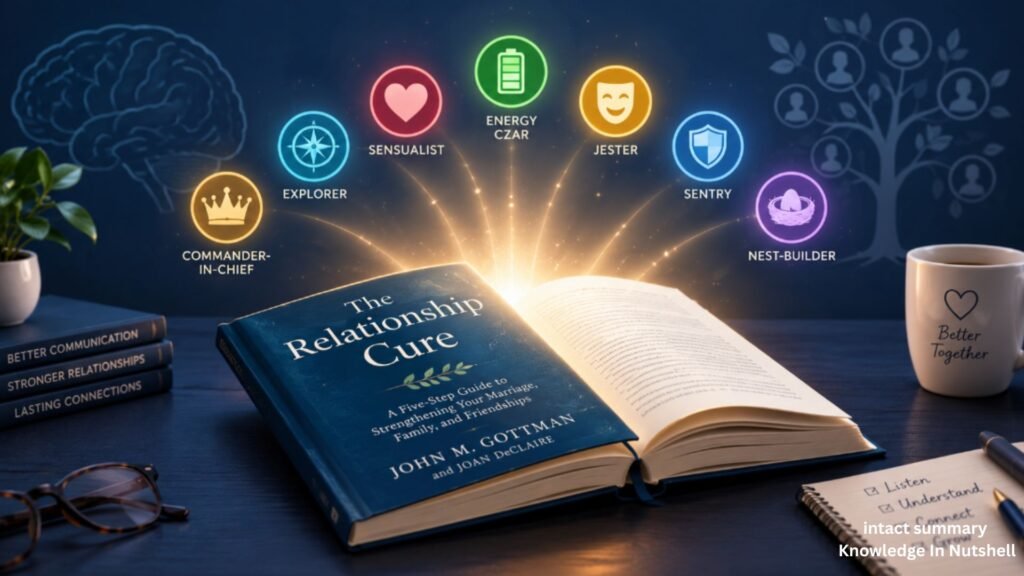
The book describes seven of these systems. The Commander-in-Chief is about power, control, and having a say in your life. The Explorer is about curiosity, adventure, and learning new things. The Sensualist is about romance, physical closeness, and pleasure. The Energy Czar watches your energy and wants rest and calm when you are running low. The Jester loves play, humor, and fun. The Sentry is on guard for danger and wants safety and security. And the Nest-Builder is about home, bonding, family, and caring for others.
Here is why this matters in real life. Imagine one partner is a strong Explorer who dreams of a surprise weekend trip. The other has a loud Sentry and a tired Energy Czar, so the idea sounds stressful. Without understanding these systems, the couple might think, “You are boring,” or “You are reckless.” With understanding, they can see that two normal brains want different things. Then they can find a middle path, like a short trip close to home.
The book includes questions that help you see which systems are strongest in you, and which are strongest in the people you love. This is a kind of emotional self-assessment. It does not label anyone as good or bad. It just makes individual differences visible, which lowers blame and makes compromise in relationships much easier.
Step 3: What Is Emotional Heritage, and How Does It Shape You?
Your emotional heritage is the story of how feelings were handled in your past, especially in your family. Step 3 asks you to look back. How did your parents show anger? Was sadness welcomed or hidden? Were you comforted when you cried, or told to stop? Gottman’s point is that those early lessons stay with us. They quietly shape how we make bids, how we answer them, and how safe it feels to be open as adults.
The book also explains that your heritage is more than childhood. It includes your life experiences and what some researchers call enduring vulnerabilities. These are painful events from the past that leave a lasting mark and can make certain moments feel extra sharp. A person who was once abandoned might react strongly when a partner seems distant. A person who grew up in a loud, angry home might freeze when voices rise. Without knowing the history, a partner may think the reaction is “too much.” With knowledge, it often makes sense.
Understanding childhood experiences and adult relationships is not about blaming your parents. It is about self-reflection and self-awareness. When you know why you react the way you do, you can choose a new response instead of repeating an old one. The book gives surveys and questions to help you and your loved ones explore your family emotional patterns, and sharing the answers can build real closeness. Many people find that simply telling a partner, “This is why that hit me so hard,” opens up a deeper kind of mutual understanding.
Step 4: How Can You Sharpen Your Emotional Communication Skills?
Step 4 is about becoming better at reading and sharing feelings. If Steps 2 and 3 help you understand yourself, Step 4 helps you put that understanding into action during real conversations.
A large part of this step is learning to notice nonverbal communication. Feelings often show up on the face, in the voice, and in the body before they show up in words. Gottman draws on research about facial expressions, including tiny flashes of emotion that cross a face very quickly. He also talks about posture, gestures, and tone of voice. Learning to notice these signals helps you catch hidden feelings and respond to bids that nobody said out loud. For example, a partner who says, “I’m fine,” with slumped shoulders and a flat voice may be sending a bid for comfort.
The second part is expressing your own feelings clearly without starting a fight. A key idea from Gottman’s wider work is the difference between a complaint and a criticism. A complaint focuses on one specific problem, like “You said you would take out the trash, and it’s still here.” A criticism attacks the person’s character, like “You’re so lazy.” The first invites a fix. The second invites defense and hurt feelings. Choosing complaint over criticism is one of the simplest ways to reduce criticism in relationships and to avoid blame during conversations.
The third part is listening well. Mindful listening means giving your full attention, letting the other person finish, and trying to understand their view before you answer. Listening without judgment does not mean you agree with everything. It means the other person feels heard. Add regular appreciation, such as saying thank you or naming something you admire, and the emotional climate of a home can change in a big way.
Step 5: How Do You Find Shared Meaning in a Relationship?
Shared meaning is the sense of purpose, values, and traditions that two people or a family build together. It is the last step, and it is the deepest. After you learn how to connect in small moments, Step 5 asks a bigger question: What are we about, as a team?
Gottman points to rituals of connection as one of the best ways to build this. A ritual is any small habit you repeat that carries a feeling of love. It might be a morning coffee together, a Friday movie night, a hello hug when someone comes home, or a family dinner with no phones. Rituals do not have to be fancy or perfect. They just need to happen often and to mean something. Over time they become daily relationship habits that quietly say, “We are in this together.”
Shared meaning also includes shared values and supporting each other’s dreams. Couples and families who talk about what matters to them, such as faith, home, adventure, or service, tend to feel closer and more united. It also helps to ask each other, “What do you hope for in life?” and then to cheer for those hopes.
Even when two people do not want identical things, understanding each other’s dreams builds respect and emotional intimacy that lasts. Family traditions work the same way. Holiday customs, birthday habits, and weekend routines tie people together across years.
Emotion Coaching: How Can Parents Use These Ideas With Children in The Relationship Cure?
The book also speaks to parents. Gottman has long studied how families deal with feelings, and he describes a few common styles. Some families practice emotion coaching, where feelings are welcomed and children are helped to name and manage them. Others dismiss feelings, treating them as a small problem to brush aside. Some disapprove of emotions and punish them, and some take a hands-off approach and hope feelings will simply go away. In his view, coaching is the healthiest path.
What does emotion coaching look like? Imagine a child comes home upset because a friend was unkind. A dismissing reply would be, “Oh, it’s nothing. Get over it.” A coaching reply would be, “That sounds really hurtful. Do you want to tell me what happened?” The parent still sets limits on behavior. All feelings are fine, but not every action is fine. This approach helps with emotional development in children, strengthens the parent-child bond, and teaches kids the same bid skills adults need. It also connects back to Step 3, because the style you grew up with often shapes the style you use as a parent.
How Can You Use The Relationship Cure in Real Life?
In marriage, the biggest change usually starts with small habits. Try to notice when your spouse makes a bid, like a comment about their day or a sigh at the sink. Answer it with a little warmth before you move on to your own task. Many couples find that a few kind seconds, repeated every day, do more for marital satisfaction than one big date night.
When a disagreement comes up, remember the difference between a complaint and a criticism. Saying “The dishes are still in the sink” invites a fix. Saying “You’re so lazy” invites a fight. Gottman’s wider research also shows that many couples have problems they never fully solve. Happy couples are not the ones with zero conflict. They are the ones who treat each other with mutual respect and accept differences in relationships without turning them into attacks.
In family life, the same skills apply to kids. When a child says, “Look at me!” or “Guess what happened today?” that is a bid. Stopping for even thirty seconds to look at them and respond sends a strong message that they matter. Parents who use emotion coaching help children grow up more able to name their feelings and handle them. Between siblings, it can help to teach kids to ask clearly, like “Can I play too?” rather than grabbing a toy, which is a fuzzy bid wearing a bad disguise.
In friendships, bids are easy to miss because they are often tiny, like a text, a meme, or a short “How are you?” Turning toward a friend’s message, even with a quick reply, keeps the bond alive across busy weeks. If a friend seems distant, try asking what they need instead of guessing. In workplace relationships, a coworker who says, “Got a minute?” is making a bid too. Responding kindly builds trust between coworkers and makes hard conversations easier later.
If you want a simple weekly routine, try this. On Monday, pick one person to focus on. During the week, notice their bids and answer as many as you can with warmth. On Friday, think about what changed. Then pick one ritual, like a shared coffee or a no-phone dinner, and repeat it. Small steps, done often, are the heart of the book.
What Are the Strengths and Limits of The Relationship Cure?
The biggest strength is clarity. The idea of a bid is easy to grasp, and once you learn it, you start seeing it everywhere. Another strength is range. Because the book covers marriage, family, friends, and work, it is useful to many readers, not just couples in trouble. A third strength is the practical tone. The questions and exercises give you something to do, not just something to think about. The book is also rooted in years of careful research, which gives its advice more weight than a casual opinion.
There are limits too. The book is from 2001, so it does not talk about modern habits like constant phone use, though its ideas fit that world very well. Some readers may find the exercises a bit like a workbook and want more story. Others may wish for more detail on the research itself, since the book is aimed at everyday readers.

Most importantly, the book is self-help, not therapy. It can help many relationships grow stronger, but it cannot fix every problem. If there is abuse, serious betrayal, or deep and lasting pain, a licensed counselor is a safer and better step than a book. And if you ever feel unsafe in a relationship, please reach out to a professional or a trusted person right away.
Frequently Asked Questions About The Relationship Cure
What is The Relationship Cure about?
It is a self-help book that teaches how small moments of reaching out, called bids for connection, build strong relationships. It gives a five-step plan to help you notice and answer those bids in marriage, family, friendships, and work.
Who wrote The Relationship Cure?
It was written by Dr. John M. Gottman, a well-known relationship researcher, and Joan DeClaire, a writer who helped make the ideas easy to read. It was first published in 2001.
What is a bid for connection in The Relationship Cure?
A bid is any small attempt to get someone’s attention, care, or support. It can be a word, a look, a touch, or a question. Examples include “Look at this!” or reaching for someone’s hand.
What are the five steps in The Relationship Cure?
The five steps are: look at your bids for connection, discover your brain’s emotional command systems, examine your emotional heritage, sharpen your emotional communication skills, and find shared meaning.
What does “turning toward” mean in The Relationship Cure?
Turning toward means you notice someone’s bid and respond in a positive way. It can be as small as a smile or a nod. It tells the other person, “I heard you, and I care.”
What is the difference between turning away and turning against in The Relationship Cure?
Turning away means you ignore or miss a bid, often by accident. Turning against means you answer with a harsh, sarcastic, or angry reply. Both hurt, but turning against is usually more damaging.
What are emotional command systems in The Relationship Cure?
They are built-in drives in the brain, based on the work of Jaak Panksepp, that shape what people want and fear. The book gives them names like Commander-in-Chief, Explorer, Sensualist, Energy Czar, Jester, Sentry, and Nest-Builder.
What is emotional heritage in The Relationship Cure?
It is the story of how feelings were handled in your family and past. It includes childhood lessons and painful life events, and it shapes how you make and answer bids as an adult.
What is a fuzzy bid in The Relationship Cure?
A fuzzy bid is an unclear or hidden request for connection, like snapping “You’re never home!” when you really want a hug. Clear bids are easier for others to understand and answer.
Is The Relationship Cure only for married couples?
No. Its full title mentions marriage, family, and friendships, and the ideas also help at work. Anyone who wants better emotional communication can use it.
Is The Relationship Cure worth reading?
For most readers, yes. It is clear, practical, and easy to apply. It is less suited for people who need professional help for serious relationship problems.
How is it different from The Seven Principles for Making Marriage Work?
The Seven Principles focuses mainly on marriage and its key habits. The Relationship Cure is broader, focusing on bids and emotional communication across many relationships.
Can The Relationship Cure help me feel less lonely in my relationship?
It can help. Loneliness in a relationship often comes from missed bids and unspoken needs. Learning to notice and answer bids, and to ask clearly for what you need, can rebuild closeness over time.
About The Relationship Cure: Our Research and Review Approach
This article was written to be helpful to real readers, and here is how it was made. The content was built from the book’s published table of contents, publisher and library descriptions, and several independent reviews, which were cross-checked against each other for accuracy.
All writing is in original words. No passages from the book or from competing websites were copied, and the article avoids long paraphrasing of the book’s text. Each section was checked to make sure it matches the book’s actual structure and does not invent details.
This article is for general education and is not medical, mental health, or professional counseling advice. If you are struggling in your relationship, a licensed therapist can give you personal support. No credentials are claimed beyond careful research and editing.
Conclusion: Is The Relationship Cure Worth Reading?
The Relationship Cure by John Gottman teaches one simple but powerful lesson: strong relationships are built in small moments. A glance, a joke, a question about your day, or a quiet sigh can each be a bid for connection. When you turn toward those bids, trust and emotional connection grow. When you turn away or turn against them, distance slowly creeps in.
The book’s five-step guide gives you a clear path. You learn to look at your bids, understand your brain’s emotional command systems, explore your emotional heritage, sharpen your emotional communication skills, and build shared meaning through rituals and common dreams. These steps work in marriage, family, friendships, and even at work. If you have ever felt unseen, this book can help you see others better, and feel seen too.
It is not a magic fix, and it cannot replace a counselor when a relationship faces serious pain. But as a friendly, practical starting point for strengthening relationships, it is hard to beat.
Here is a simple way to begin today. Notice one bid from someone you care about. Answer it with a smile, a kind word, or a few minutes of your full attention. Then do it again tomorrow. Small, steady habits like these are what the book is really about, and they can change how close you feel to the people you love.


