Picture a young girl in a dusty barn, gluing cereal boxes together for her dad. A few decades later, that same girl owns a giant ship, a palace in Florida, and a guest list full of presidents. That is the wild ride in The Magnificent Lives of Marjorie Post, a historical fiction novel by Allison Pataki.
Maybe you saw the book at the library and wondered, “Is it worth my time?” Maybe your book club picked it and you need a quick refresher. Or maybe you heard the name Marjorie Merriweather Post and want to know who she was. Whatever brought you here, you are in the right place.
Here is the short answer. The book is a fictionalized biography told in the first person, so Marjorie herself “talks” to you from the first page. You follow her from her childhood in Battle Creek, Michigan, through her four marriages, her giant food empire, her years in Moscow, and her final days in 1973. It is a warm, fast, easy-to-read story about a rich woman who wanted more than parties and pretty dresses. It has sad moments and plenty of love drama, but nothing too hard to follow. Many reviewers say they finished it knowing much more about American history than when they started.
Quick Answer of The Magnificent Lives of Marjorie Post
The Magnificent Lives of Marjorie Post is a 2022 historical novel by Allison Pataki about Marjorie Merriweather Post, the real-life Post Cereal heiress who became one of the richest women in America. Told in her own voice, it follows her from a Michigan childhood to her death in 1973.
Along the way it covers her four marriages, her growing role in General Foods, her time in Moscow, her famous homes, and her charity work. It is best for readers who enjoy women-centered historical fiction with plenty of romance and family drama.
What Is The Magnificent Lives of Marjorie Post About?
The book is about one woman’s whole life: a cereal heiress who learned to run a business, build great houses, give generously, and survive heartbreak. It is a novel, so the big events are real but the private thoughts and conversations are imagined by the author.
Think of the story as three threads woven together:
- Money and work. Marjorie grows up watching her father, C. W. Post, build a cereal company from scratch. Later she steps into leadership as the company grows into the General Foods empire.
- Love and heartbreak. She marries four times. Each husband brings a different kind of joy, and a different kind of trouble.
- Giving back. From soup kitchens during the Great Depression to hospital fundraising, Marjorie uses her wealth to help others.
The story starts in Battle Creek, Michigan, in the 1890s, when Marjorie is a small child and her father is very sick. It then moves through Connecticut, New York City, Palm Beach, Washington, D.C., the Adirondack Mountains, and Moscow. Big historical events sit in the background, including World War I, the 1929 stock market crash, the Great Depression, and World War II.
The book also ends with an author’s note, where Pataki explains how she approached the real history. She says she has rarely felt so much admiration for a subject.
Three ideas that help before you start reading:
- Marjorie is real. She lived from 1887 to 1973. You can still visit her Washington, D.C., home today.
- Old money vs. new money matters. In her day, families who had been rich for generations looked down on families who got rich from a business, and Marjorie feels that sting.
- Women could not vote until the Nineteenth Amendment passed in 1920, when Marjorie was already in her thirties. Keep that in mind when she makes bold choices.
Who Was Marjorie Merriweather Post in Real Life?
Marjorie Merriweather Post (1887–1973) was an American businesswoman, collector, and philanthropist. She was the only child of C. W. Post, who created Grape-Nuts cereal and the coffee substitute Postum. When her father died in 1914, she became his heir and one of the wealthiest women in America.
Also Read:/lady-tremaine-book-summary/
The family business grew into General Foods, the company behind many everyday grocery brands. Marjorie also helped push one of its biggest moves: buying the Birds Eye frozen food business. That decision helped change how American families shopped and cooked.
She was also famous for her homes:
- Mar-a-Lago, her showy Palm Beach estate
- Hillwood Estate, her Washington, D.C., home, now a public museum
- Camp Topridge, her Adirondack retreat
- The Sea Cloud, her giant sailing yacht
Besides her business, she is remembered for her Russian imperial art collection, her charity work, and her four marriages. Pataki’s novel takes these public facts and gives them an inner voice: what Marjorie might have felt, feared, and wanted.
Why Is the Book Called “Magnificent Lives” (Plural)?
Marjorie lived many different lives inside one long life. The book does not number them, but this is a handy way to picture her journey:
- The Battle Creek daughter. A bright girl who admires her father and helps in his early business.
- The young wife and mother. A woman in Connecticut and New York trying to fit into high society.
- The business partner. A leader pushing a growing food company into new ideas.
- The builder and hostess. A woman creating grand homes and hosting presidents and Hollywood stars.
- The ambassador’s wife. A diplomat’s partner in Washington, D.C., and Moscow.
- The giver and collector. A woman in her later years who shares her wealth and treasures.
The plural title also hints at her four husbands. Each marriage opened a new chapter, almost like a new life.
The Magnificent Lives of Marjorie Post Plot Summary
This book includes a parent’s death by suicide, divorce, and cheating in marriage. These parts are handled with care, but readers who want to know ahead of time should read the full summary below.
Spoiler-Free Summary of The Magnificent Lives of Marjorie Post
Marjorie is a small girl in the 1890s when her father gets very sick. The family travels to Battle Creek, Michigan, hoping he can heal. He does, and the experience gives him a big idea: to make foods that help people feel better. That idea becomes the Post Cereal company, and Marjorie grows up helping in the family barn.
As Marjorie gets older, money, fame, and high society come into her life. She falls in love, becomes a mother, and learns that being rich does not make life easy. She loses people she loves, fights to protect her family’s business, and slowly finds her own voice. Her story takes her from New York City to Palm Beach, Washington, D.C., and even Moscow.
The question that drives the book is simple. Can a woman with so much money and fame finally find real love and a life that is truly her own? The answer comes slowly, through four marriages, many parties, and a lot of giving.
Full Summary (With Spoilers) of The Magnificent Lives of Marjorie Post
Early years. The story opens in Battle Creek in 1891. Marjorie’s father, C. W. Post, is gravely ill. The family stays with a kind woman named Mrs. Elizabeth Gregory while he is treated at Dr. John Kellogg’s sanitarium. He recovers and invents Postum, a coffee substitute, and Grape-Nuts cereal. The company booms, but his marriage to Marjorie’s mother, Ella, grows cold. Marjorie feels stuck in the middle. Her father later marries a woman named Leila, which Marjorie hates.
First marriage. Marjorie studies in Washington, D.C., then meets Edward Close in Greenwich, Connecticut. They marry in 1905. Her father gives them a large estate called The Boulders. But Edward comes from old money and wants a quiet, traditional wife. Marjorie wants to help grow the business and do more with her life. They have two daughters, but the marriage slowly dries up.
Big losses. Marjorie’s mother dies in 1912. Her father dies in 1914 by suicide, which leaves her shocked and heartbroken. Leila then tries to take control of the company. Marjorie fights back and wins. During World War I, she throws herself into helping the war effort. After the war, she and Edward divorce in 1919.

Second marriage. She marries financier Edward “Ned” Hutton. He becomes chairman of her company, and together they buy many food brands. A key moment comes when Marjorie meets inventor Clarence Birdseye and urges Ned to buy his frozen food business. Ned does not like the idea, and they argue, but Marjorie pushes ahead. During the Great Depression, she helps open a large feeding center in New York City. She also builds Mar-a-Lago. But Ned cheats on her, and they divorce in 1935.
Third marriage and Moscow. In Palm Beach she meets Joseph E. Davies. He is still married at first, so she waits until he is free. They marry, and she wears pale pink instead of white. Washington society is cold to her at first, so she wins a seat on the General Foods board. President Franklin D. Roosevelt sends Joe to the Soviet Union as ambassador.
In Moscow, Marjorie buys beautiful Russian imperial treasures. War clouds gather, and they later serve near the front lines in Belgium before Joe returns to Washington. Over time, Joe grows jealous of her popularity and angry about his own fading power. After a messy, public divorce, Marjorie vows never to shrink herself for a man again.
Fourth marriage. She settles into Hillwood in Washington, D.C., and throws grand parties. Then she meets Herbert May. They marry in 1958, but she later learns a painful secret about him. She ends the marriage in 1964, and they part kindly.
Final years. Marjorie finds peace at Camp Topridge with her daughters and grandchildren. She offers Mar-a-Lago to the government as a possible Winter White House, and celebrates her 80th birthday surrounded by loved ones. The book ends with her death in 1973 and a short epilogue that shows how her giving lived on.
Marjorie Post’s Four Husbands Explained in The Magnificent Lives of Marjorie Post
Many readers pick this book mainly because of the marriages, so here is a clear side-by-side view.
| Husband | Marriage | What he was like | Why it ended |
|---|---|---|---|
| Edward Close | 1905 to 1919 | Banker from an old-money family | Wanted a traditional wife, while Marjorie wanted a bigger life |
| Edward “Ned” Hutton | Early 1920s to 1935 | Charming, hard-working financier | Fought over Birds Eye, then cheated |
| Joseph E. Davies | 1935 to the 1950s | Lawyer and U.S. ambassador to the Soviet Union | Became bitter and jealous as his power faded |
| Herbert A. May | 1958 to 1964 | Warm, charming businessman | A painful secret broke her trust |
Edward Close: The Young Love in The Magnificent Lives of Marjorie Post
Marjorie is young and in love with a man from a world she has never known. Edward Close brings her into high society, but he expects her to be a quiet hostess. Marjorie learns her first big lesson here: love alone does not fix two very different dreams. Together they have two daughters, and the marriage’s end leaves her feeling both sad and free.
Ned Hutton: The Business Partner
Ned Hutton feels like a perfect match, because he understands both fun and work. Together, they grow the company, and their daughter Nedenia is born. She later becomes the actress Dina Merrill. But his doubts about frozen food and his unfaithfulness crack the marriage. This is the husband Marjorie loved most deeply, which makes the loss hurt more.
Joseph Davies: The Diplomat in The Magnificent Lives of Marjorie Post
Joseph Davies opens up the world of politics and diplomacy for Marjorie. In Moscow, she hosts guests and collects treasures. This marriage shows Marjorie at her most powerful and public. But as she becomes more popular, Joe becomes more resentful.
Herbert May: The Last Chance in The Magnificent Lives of Marjorie Post
Herbert May is gentle and fun, and for a while Marjorie believes she has finally found a calm, happy partnership. When his secrets come out, she feels heartbroken. But she handles the ending with grace, and the book treats him with some kindness too.
Main Characters and Their Roles in The Magnificent Lives of Marjorie Post
Here are the key people in the story, with a short note on how each one matters.
Character: Marjorie Merriweather Post
Role & Arc: She is the narrator and heart of the book. She starts as a loving daughter who dreams of pleasing her father. Over time, she becomes a confident leader, a generous giver, and a woman who no longer lets anyone make her feel small.
Character: C. W. Post (“Papa”)
Role & Arc: Marjorie’s father is her hero and teacher. He is full of ideas and big stories, and he teaches her to keep going when things get hard. His death is the turning point that pushes her into adulthood and leadership.
Character: Ella Post
Role & Arc: Marjorie’s mother is often sick and distant. Their relationship is not warm, and Marjorie spends years trying to understand her. Her parents’ unhappy marriage shapes how Marjorie thinks about love.
Character: Leila Post
Role & Arc: Leila becomes Marjorie’s stepmother and then her rival over the family company. She represents the family fight Marjorie must win to protect her father’s legacy.
Character: Dina Merrill (Nedenia Hutton)
Role & Arc: Marjorie’s youngest daughter, who later became a real-life actress. She often sees her mother’s life more clearly than Marjorie does. Late in the book, she helps Marjorie face the truth about her fourth marriage.
Character: Alice Roosevelt
Role & Arc: A famous Washington figure and a sharp-tongued friend. She helps Marjorie get through the hard moments with Washington society and offers support during her divorce.
Character: Clarence Birdseye
Role & Arc: The inventor behind frozen food. He is a small but important character, because meeting him sparks Marjorie’s biggest business idea.
How Did Marjorie Post Help Build the General Foods Empire in The Magnificent Lives of Marjorie Post?
Short answer: Marjorie inherited her father’s Post Cereal business and helped it grow into General Foods. Her biggest move was pushing the company to buy Birds Eye Frozen Foods.
Read More:/the-relationship-cure-summary/
Here is how the story goes, in plain steps:
- The start. Her father, C. W. Post, created Postum and Grape-Nuts in the late 1800s. Grape-Nuts is often described as one of the first ready-to-eat breakfast ideas, so it was a new way to eat breakfast.
- The inheritance. After his death in 1914, Marjorie became heir to the Postum Cereal Company. In the book, she has to fight his widow, Leila, to protect it.
- The growth. In the 1920s, the company bought other food brands. In 1929, it took the name General Foods.
- The frozen food idea. In the novel, Marjorie meets Clarence Birdseye and sees that frozen food could help families eat well all year. Her husband Ned Hutton doubts it, but she keeps pushing. Birds Eye joined the company, and the frozen food revolution began.
Why does this matter? Before frozen food, many families could eat fresh fruit, vegetables, and fish only in season. Frozen food made meals easier, which is a big reason the book says she “reshaped” American kitchens.
One more thing to know: in real life, women in business were often kept out of top jobs. In the book, Marjorie pushes for her own seat on the General Foods board. That makes her a good example of women in business history.
Mar-a-Lago, Hillwood, and Camp Topridge: Marjorie’s Famous Homes in The Magnificent Lives of Marjorie Post
Marjorie did not just live in big houses. In the book, building and decorating them is how she shows who she is. Here are the main ones.
| Home | Where | What to know |
|---|---|---|
| The Boulders | Greenwich, Connecticut | A gift from her father. A fire at the estate later becomes a turning point. |
| Mar-a-Lago | Palm Beach, Florida | Her grand winter estate, built in the 1920s. She hoped it would one day serve the country. |
| Hillwood Estate | Washington, D.C. | Her home in her later years. Today it is a museum open to visitors. |
| Camp Topridge | Adirondack Mountains, New York | Her peaceful forest retreat. In the book, it is where she heals after a divorce. |
| Sea Cloud | On the ocean | Her huge sailing yacht, used for travel, parties, and a honeymoon voyage. |
Why Mar-a-Lago Matters in the Story of he Magnificent Lives of Marjorie Post
In real life, Marjorie wanted Mar-a-Lago to become a Winter White House for presidents. The government did accept it for a time, but it later proved too costly to keep, and the property returned to the Post Foundation, which sold it into private hands. The novel shows her offering it as a gift, which fits her giving nature.
Why Hillwood Is the Best Place to Match the Book
If you want to see the world of the novel, Hillwood is the place. Visitors can see her collections, her gardens, and rooms that match the style of her life. Reading the book first makes the visit feel like meeting an old friend.
Marjorie in Moscow: The Russian Art Collection in The Magnificent Lives of Marjorie Post
Short answer: Marjorie lived in Moscow when her third husband, Joseph Davies, was U.S. ambassador to the Soviet Union. There, she collected Russian imperial art that later filled Hillwood.
The Moscow chapters are some of the most exciting in the book. Here is why:
- A cold, tense place. The couple lives under watchful eyes in Stalin’s Soviet Union. Marjorie notices how hard daily life is for ordinary people.
- Grand dinners. Marjorie hosts big parties to show the Soviet guests a friendly side of America. In the story, she jokes about it as a kind of “grocery diplomacy,” since she brings food from home, including frozen foods.
- Treasure hunting. In shops where old Russian treasures were sold, Marjorie finds items once owned by the Russian royal family and rich nobles. She sees them not only as pretty things but as pieces of history worth saving.
For young readers: imagine finding a box of old family treasures, but instead of one box, it is a whole country’s worth, and you want to keep them safe. That is how Marjorie feels in these scenes.
This part also shows the book’s deeper idea. Wealth can be used for more than comfort. It can protect art, history, and memories.
Marjorie Post’s Philanthropy: Soup Kitchens, Hospitals, and Giving in The Magnificent Lives of Marjorie Post
Short answer: In the book, Marjorie is a serious giver. She helps feed people in the Great Depression, raises money for a hospital, and supports the war effort and the arts.

Here are her key acts of giving:
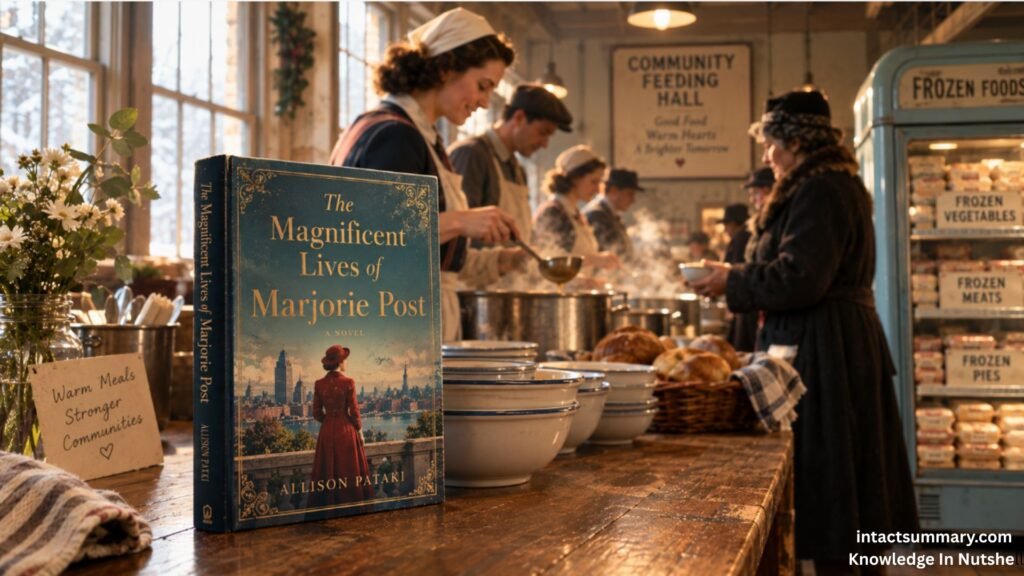
- Feeding centers and soup kitchens. When the 1929 stock market crash leaves many families hungry, she opens a large feeding center in New York City. She also uses the press to bring attention to hunger.
- Hospital fundraising. She hosts a glittering party to raise money for a new hospital for people in need, and she invites rich friends to help.
- War effort. During World War I and World War II, she uses her money, her homes, and even her yacht to help.
- Music and the arts. Later in life, she supports programs that bring music to young people.
One honest note: some readers say the book spends only a few pages on her soup kitchen work and more pages on her marriages. If you want more detail on her giving, a full biography such as American Empress by Nancy Rubin goes deeper.
The message of this thread is simple. Her father taught her that success is not just for you. In the book, Marjorie lives by that rule.
Key Themes Explained in The Magnificent Lives of Marjorie Post
Finding Your Own Voice in The Magnificent Lives of Marjorie Post
This is the biggest theme. Marjorie begins as a girl who wants to please her father and her first husband. By the end, she says what she wants and no longer shrinks to make a man feel big. Women’s economic independence and female agency are at the heart of the book.
Love, Betrayal, and Second Chances in The Magnificent Lives of Marjorie Post
Her marriages show different kinds of love, and different ways love can break. Her parents’ unhappy marriage haunts her, and she keeps trying to make a better one. Each ending hurts, but each also teaches her something. The book suggests that heartbreak does not have to end your story.
Wealth Comes with Responsibility in The Magnificent Lives of Marjorie Post
Marjorie is rich beyond belief, but the book keeps asking: what is money for? Her answer is to build, to share, and to save beautiful things. That is why her charitable contributions feel like a main part of her story, not a side note.
Family and Legacy in The Magnificent Lives of Marjorie Post
Her bond with her father, the fight for his company, and her love for her daughters tie the story together. She wants her family name to mean something good, and she wants her homes and art to last.
Resilience in The Magnificent Lives of Marjorie Post
Over and over, Marjorie loses something and gets back up. Her family motto in the story is about never staying down for long. This is also the lesson readers often say they take from the book.
Image vs. Reality in The Magnificent Lives of Marjorie Post
Newspapers and gossip follow Marjorie everywhere. People often judge her by her money or her divorces. The book shows the private person underneath, which is why it works so well in the first person.
Women’s History Context: What the Book Shows About Women Before and After Suffrage
Marjorie’s life stretches across a huge change for women. When she was a child, women could not vote. She was in her thirties when the Nineteenth Amendment passed. By the time she died in 1973, women were running for office and working in many more jobs.
The book helps us see a few important things:
- Not all women’s lives looked the same. Marjorie was rich, which gave her choices most women did not have. But she still faced rules about how a wife, mother, and hostess should act.
- Inherited wealth is not the same as respect. Even with money, she had to push to get a seat on the board and to be taken seriously in business.
- Marriage and independence often clashed. Several husbands expected her to take a smaller role.
One reviewer compared Marjorie with another real woman, Isabella L. Bird, a British traveler who rode through the Colorado Rockies in 1873. The two women lived very different lives. Isabella explored on horseback, while Marjorie built grand homes and a food empire. The point of the comparison is that women before suffrage lived many kinds of unusual lives. It also pushes back on the modern online argument that treats women’s history as just “Girl Boss” versus “Trad Wife.” Real women were more varied than either label.
If you want to read more history after this novel, American Empress by Nancy Rubin is the best-known full biography of Marjorie. The novel is for feeling the story. The biography is for checking the facts.
Allison Pataki’s Writing Style: An Honest Review of he Magnificent Lives of Marjorie Post
Short answer: The book is a smooth, easy, character-driven read with a warm voice. Its biggest strength is Marjorie herself, and its biggest weakness is that it leans so heavily on her love life.
What Works Well in he Magnificent Lives of Marjorie Post
- Easy to read. The story moves in a chronological line, so it is simple to follow. You never have to guess what year it is or who someone is.
- A voice you want to hear. The first-person narration puts you inside Marjorie’s head. Reviewers say this makes it easy to root for her, even when you know a marriage is headed for trouble.
- History made fun. You learn about General Foods, frozen food, Moscow, and the Great Depression without feeling like you are in class.
- A satisfying ending. The epilogue brings the story back to her generosity, which fits the book’s main message.
What Could Be Better in he Magnificent Lives of Marjorie Post
- Marriages over business. One reviewer said she wanted more about Marjorie’s brains and less about the men in her life. Another noted that her soup kitchen work gets only a few pages.
- The first-person choice. Marjorie describes her own kindness, which can feel a little self-praising. One reviewer wished the book used third person.
- A big life, covered fast. Eighty-plus years in about 400 pages means some years zip by, so the pacing can feel uneven.
- Mixed feelings about Marjorie. A few readers said they did not feel close to her. Most reviewers, though, call her fascinating.
Our Verdict: Is It Worth Reading?
Yes, if you like women’s historical fiction, family drama, and real-life stories with a strong female lead. Ratings across review sites we checked ranged from 3.5 to 4.5 stars, which tells you most readers like it, but not everyone loves it. Skip it if you want a deep business history or a footnoted biography. For that, try a non-fiction book instead.
Frequently Asked Questions about The Magnificent Lives of Marjorie Post
What is The Magnificent Lives of Marjorie Post about?
It is a historical novel about Marjorie Merriweather Post, the Post Cereal heiress. It follows her childhood, four marriages, business career, travels, and charity work until her death in 1973.
Who wrote The Magnificent Lives of Marjorie Post?
Allison Pataki wrote it. She is a New York Times bestselling author known for historical novels about real women, such as The Traitor’s Wife and Sisi.
Is The Magnificent Lives of Marjorie Post a true story?
It is based on a true life, but it is a novel. The main events are real, while many conversations and feelings are made up by the author.
What genre is the book?
It is historical fiction and biographical fiction. Some libraries and sites also list it as women’s fiction.
How many times did Marjorie Post marry in The Magnificent Lives of Marjorie Post?
She married four times: Edward Close, Edward “Ned” Hutton, Joseph E. Davies, and Herbert A. May.
Who was Dina Merrill in The Magnificent Lives of Marjorie Post?
Dina Merrill (born Nedenia Hutton) was Marjorie’s daughter with Ned Hutton. She grew up to be a well-known actress.
How did Marjorie Post inherit her fortune in The Magnificent Lives of Marjorie Post?
She was the only child of C. W. Post. After he died in 1914, she became heir to his company, which later became General Foods.
What role did Marjorie play in frozen food history in The Magnificent Lives of Marjorie Post?
In the novel, she meets Clarence Birdseye and pushes to buy his business even though her husband doubts it. That move brought Birds Eye into the company.
How does The Magnificent Lives of Marjorie Post end? (Spoiler)
The story follows Marjorie into her final years, with time at Camp Topridge, her offer of Mar-a-Lago to the government, and a big 80th birthday celebration. It ends with her death in 1973 and an epilogue about the generosity she left behind.
Is The Magnificent Lives of Marjorie Post worth reading?
Yes, for readers who like character-driven historical fiction with romance and family drama. It is less ideal for readers who want deep business detail or a strict biography.
Is there a sequel in The Magnificent Lives of Marjorie Post?
No. As far as we know, it is a standalone novel.
What is a good book to read after this one?
American Empress by Nancy Rubin is a great next step for the real-life details. For more historical fiction, try Pataki’s Sisi: Empress on Her Own or The Queen’s Fortune.
About The Magnificent Lives of Marjorie Post: Research and Review Approach
This guide was built to help readers decide, review, and discuss the book without needing to dig through many pages.
- Research approach. We compared several published reviews, the publisher’s synopsis, library catalog records, and a reading group guide. We also checked key real-life facts about Marjorie Post’s businesses, homes, and marriages against those sources.
- Original writing. Everything here is written in our own words. We did not copy competitor text or the book’s sentences, and we avoided quoting the novel.
- Quality and accuracy review. Plot points and character details were cross-checked across more than one source where possible. Spoilers are labeled, and we separate real history from fiction. If you spot an error, please let us know so we can fix it.
- Our promise. We do not claim special credentials. This is a reader’s guide, not a replacement for the book or for a full biography.
Conclusion: Is The Magnificent Lives of Marjorie Post Worth Your Time?
The Magnificent Lives of Marjorie Post is a warm, easy-to-read look at a real woman who turned a cereal fortune into a life of business, love, and giving. Allison Pataki tells the story in Marjorie’s own voice, so you feel her joy, her heartbreaks, and her courage. From a barn in Battle Creek to the halls of Mar-a-Lago, Hillwood Estate, and Moscow, the book shows that one person can live many different lives and still keep getting back up.
Here are the key points to remember:
- It is a novel, not a strict biography. The big events are real, and the private moments are imagined.
- It covers four marriages, the rise of General Foods, the Birds Eye frozen food story, Russian art, and philanthropy.
- Its best strength is Marjorie’s voice. Its main weakness is that it spends more time on romance than on her business and charity work.
- It is a great pick for book clubs and for fans of women’s historical fiction.
Our verdict: If you like stories about powerful women, family legacies, and American history, this book is well worth reading. If you want hard business facts, pair it with American Empress by Nancy Rubin.